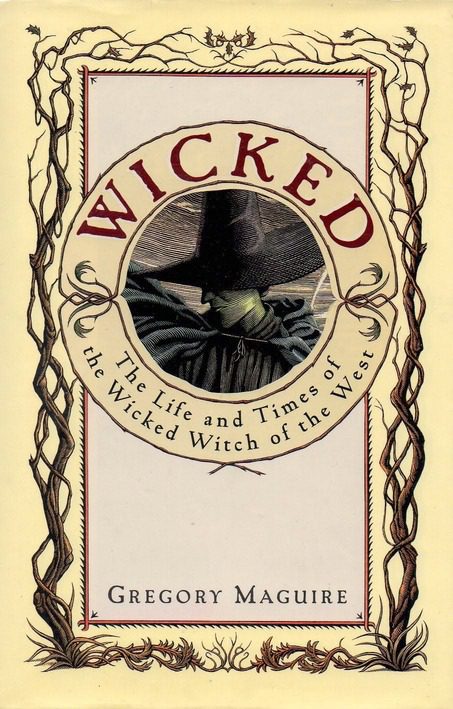
WICKED
The Life and Times of the Wicked Witch of the West
Prologue
On the Yellow Brick Road
A mile above Oz, the Witch balanced on the wind’s forward edge, as if she were a green fleck of the land itself, flung up and sent wheeling away by the turbulent air. ‘White and purple summer thunderheads mounded around her. Below, the Yellow Brick Road looped back on itself, like a relaxed noose. Though winter storms and the crowbars of agitators had torn up the road, still it led, relentlessly, to the Emerald City. The Witch could see the companions trudging along, maneuvering around the buckled sections, skirting trenches, skipping when the way was clear. They seemed oblivious of their fate. But it was not up to the Witch to enlighten them.
She used the broom as a sort of balustrade, stepping down from the sky like one of her flying monkeys. She finished up on the topmost bough of a black wiliow tree. Beneath, hidden by the fronds, her prey had paused to take their rest. The Witch tucked her broom under her arm. Crablike and quiet, she scuttled down a little at a time, until she was a mere twenty feet above them. Wind moved the dangling tendrils of the tree. The Witch stared and listened.
There were four of them. She could see a huge Cat of some sort-a Lion, was it?-and a shiny woodman. The Tin Woodman was picking flits out of the Lion’s mane, and the Lion was muttering and squirming from the aggravation. An animated Scarecrow lolled nearby, blowing dandelion heads into the wind. The girl was out of sight behind shifting curtains of the willow.
“Of course, to hear them tell it, it is the surviving sister who is the crazy one,” said the Lion. “What a Witch. Psychologically warped; possessed by demons. Insane. Not a pretty picture.”
“She was castrated at birth,” replied the Tin Woodman calmly. “She was born hermaphroditic, or maybe entirely male.”
“Oh you, you see castration everywhere you look,” said the Lion. “I’m only repeating what folks say,” said the Tin Woodman.
“Everyone is entitled to an opinion,” said the Lion airily. “She was deprived of a mother’s love, is how I’ve heard it. She was an abused child. She was addicted to medicine for her skin condition.”
“She has been unlucky in love,” said the Tin Woodman, “like the rest of us.” The Tin Woodman paused and placed his hand on the center of his chest, as if in grief.
“She’s a woman who prefers the company of other women,” said the Scarecrow, sitting up. “She’s the spurned lover of a married man.”
“She is a married man.”
The Witch was so stunned that she nearly lost her grip on the branch. The last thing she ever cared for was gossip. Yet she had been out of touch for so long that she was astonished at the vigorous opinions of these random nobodies.
“She’s a despot. A dangerous tyrant,” said the Lion with conviction.
The Tin Woodman pulled harder than was necessary on a lock of mane. “Everything’s dangerous to you, you craven thing. I hear she’s a champion of home rule for the so-called Winkles.” “Whoever she is, she must surely be grieving the death of her sister,” said the child, in a somber
voice too rich, too sincere for one so young. The Witch’s skin crawled.
“Don’t go feeling sympathetic now. I certainly can’t.” The Tin Woodman sniffed, a bit cynically.
“But Dorothy’s right,” said the Scarecrow. “No one is exempt from grief.”
The Witch was deeply irked by their patronizing speculations. She moved around the trunk of the tree, stretching to catch a glimpse of the child. The wind was picking up, and the Scarecrow shivered. While the Tin Woodman continued fussing over the Lion’s tresses, he leaned against the Lion, who held him tenderly. “Storm on the horizon,” said the Scarecrow.
Miles off, thunder echoed. “There-is-a-Witch on the horizon,” said the Tin Woodman, tickling the Lion. The Lion got spooked and rolled on top of the Scarecrow, whimpering, and the Tin Woodman collapsed on top of them both.
“Good friends, should we be wary of that storm?” said the girl.
The rising winds moved the curtain of greenery at last, and the Witch caught sight of the girl. She was sitting with her feet tucked underneath her and her arms wrapped around her knees. She was not a dainty thing but a good-size farm girl, dressed in blue-and-white checks and a pinafore. In her lap, a vile little dog cowered and whined.
“The storm makes you skittish. It’s natural after what you’ve been through,” said the Tin Woodman. “Relax.”
The Witch’s fingers dug into the bark of the tree. She still could not see the girl’s face, just her strong forearms and the crown of her head where her dark hair was pulled back into pigtails. Was she to be taken seriously, or was she merely a blow-away dandelion seed, caught on the wrong side of the wind? If she could see the girl’s face, the Witch felt she might know.
But as the Witch craned outward from the trunk, the girl at the same time twisted her face, turning away. “That storm is coming closer, and in a hurry.” The feeling in her voice rose as the wind rose. She had a throaty vehemence, like someone arguing through the threat of impending tears. “I know storms, I know how they come upon you!”
“We’re safer here,” said the Tin Woodman.
“Certainly we are not,” answered the girl, “because this tree is the highest point around, and if lightning is to strike, it will strike here.” She clutched her dog. “Didn’t we see a shed farther up the road? Come, come; Scarecrow, if there’s lightning, you’ll burn the fastest! Come on!”
She was up and running in an ungainly way, and her companions followed in a mounting panic. As the first hard drops of rain fell, the Witch caught sight, not of the girl’s face, but of the shoes. Her sister’s shoes. They sparkled even in the darkening afternoon. They sparkled like yellow diamonds, and embers of blood, and thorny stars.
If she had seen the shoes first, the Witch would never have been able to listen to the girl or her friends. But the girl’s legs had been tucked beneath her skirt. Now the Witch was reminded of her need. The shoes should be hers!-hadn’t she endured enough, hadn’t she earned them? The Witch would fall on the girl from the sky, and wrestle those shoes off her impertinent feet, if only she could. But the storm from which the companions raced, farther and faster along the Yellow Brick
Road, troubled the Witch more than it did the girl
who had gone through rain and the Scarecrow whom lightning could burn. The Witch could not venture out in such a vicious, insinuating wetness. Instead, she had to tuck herself between some exposed roots of the black willow tree, where no water could endanger her, and wait for the storm to pass.
She would emerge. She always had before. The punishing political climate of Oz had beat her down, dried her up, tossed her away-like a seedling she had drifted, apparently too desiccated ever to take root. But surely the curse was on the land of Oz, not on her. Though Oz had given her a twisted life, hadn’t it also made her capable?
No matter that the companions had hurried away. The Witch could wait. They would meet again.
Wicked – The Life and Times of the Wicked Witch of the West
Book 1 – Munchkinlanders
From the crumpled bed the wife said, “I think today’s the day. Look how I’ve gone.”
“Today? That would be like you, perverse and inconvenient,” said her husband, teasing her, standing at the doorway and looking outward, over the lake, the fields, the forested slopes beyond. He could just make out the chimneys of Rush Margins, breakfast fires smoking. “The worst possible moment for my ministry. Naturally.”
The wife yawned. “There’s not a lot of choice involved. From what I hear. Your body gets this big and it takes over-if you can’t accommodate it, sweetheart, you just get out of its way. It’s on a track of its own and nothing stops it now.” She pushed herself up, trying to see over the rise of her belly. “I feel like a hostage to myself. Or to the baby.”
“Exert some self-control.” He came to her side and helped her sit up. “Think of it as a spiritual exercise. Custody of the senses. Bodily as well as ethical continence.”
“Self-control?” She laughed, inching toward the edge of the bed. “I have no self left. I’m only a host for the parasite. Where’s my self anyway? Where’d I leave that tired old thing?”
“Think of me.” His tone had changed; he meant this.
“Frex”-she headed him off-“when the volcano’s ready there’s no priest in the world can pray it quiet.”
“What will my fellow ministers think?”
“They’ll get together and say, ‘Brother Frexspar, did you allow your wife to deliver your first child when you had a community problem to solve? How inconsiderate of you; it shows a lack of authority. You’re fired from the position.” She was ribbing him now, for there was no one to fire
him. The nearest bishop was too distant to pay attention to the particulars of a unionist cleric in the hinterland.
“It’s just such terrible timing.”
“I do think you bear half the blame for the timing,” she said. “I mean, after all, Frex.” “That’s how the thinking goes, but I wonder.”
“You wonder?” She laughed, her head going far back. The line from her ear to the hollow below her throat reminded Frex of an elegant silver ladle. Even in morning disarray, with a belly like a scow, she was majestically good-looking. Her hair had the bright lacquered look of wet fallen oak leaves in sunlight. He blamed her for being born to privilege and admired her efforts to overcome it-and all the while he loved her, too.
“You mean you wonder if you’re the father”-she grabbed the bedstead; Frex took hold of her other arm and hauled her half-upright-“or do you question the fatherliness of men in general?” She stood, mammoth, an ambulatory island. Moving out the door at a slug’s pace, she laughed at such an idea. He could hear her laughing from the outhouse even as he began to dress for the day’s battle.
Frex combed his beard and oiled his scalp. He fastened a clasp of bone and rawhide at the nape of his neck, to keep the hair out of his face, because his expressions today had to be readable from a distance: There could be no fuzziness to his meaning. He applied some coal dust to darken his eyebrows, a smear of red wax on his flat cheeks. He shaded his lips. A handsome priest attracted more penitents than a homely one.
In the kitchen yard Melena floated gently, not with the normal gravity of pregnancy but as if inflated, a huge balloon trailing its strings through the dirt. She carried a skillet in one hand and a few eggs and the whiskery tips of autumn chives in the other. She sang to herself, but only in short phrases. Frex wasn’t meant to hear her.
His sober gown buttoned tight to the collar, his sandals strapped on over leggings, Frex took
from its hiding place-beneath a chest of drawers-the report sent to him from his fellow minister over in the village of Three Dead Trees. He hid the brown pages within his sash. He had been keeping them from his wife, afraid that she would want to come along-to see the fun, if it was amusing, or to suffer the thrill of it if it was terrifying.
As Frex breathed deeply, readying his lungs for a day of oratory, Melena dangled a wooden spoon in the skillet and stirred the eggs. The tinkle of cowbells sounded across the lake. She did not listen; or she listened but to something else, to something inside her. It was sound without melody-like dream music, remembered for its effect but not for its harmonic distresses and recoveries. She imagined it was the child inside her, humming for happiness. She knew he would be a singing child.
Melena heard Frex inside, beginning to extemporize, warming up, calling forth the rolling phrases of his argument, convincing himself again of his righteousness.
How did that proverb go, the one that Nanny singsonged to her, years ago, in the nursery? Born in the morning,
Woe without warning; Afternoon child Woeful and wild; Born in the evening, Woe ends in grieving. Night baby borning Same as the morning.
But she remembered this as a joke, fondly. Woe is the natural end of life, yet we go on having babies.
No, said Nanny, an echo in Melena’s mind (and editorializing as usual): No, no, you pretty little pampered hussy. We don’t go on having babies, that’s quite apparent. We only have babies when we’re young enough not to know how grim life turns out. Once we really get the full measure of it-we’re slow learners, we women-we dry up in disgust and sensibly halt production.
But men don’t dry up, Melena objected; they can father to the death. Ah, we’re slow learners, Nanny countered. But they can’t learn at all.
“Breakfast,” said Melena, spooning eggs onto a wooden plate. Her son would not be as dull as most men. She would raise him up to defy the onward progress of woe.
“It is a time of crisis for our society,” recited Frex. For a man who condemned worldly pleasures he ate with elegance. She loved to watch the arabesque of fingers and two forks. She suspected that beneath his righteous asceticism he possessed a hidden longing for the easy life.
“Every day is a great crisis for our society.” She was being flip, answering him in the terms men use. Dear thick thing, he didn’t hear the irony in her voice.
“We stand at a crossroads. Idolatry looms. Traditional values in jeopardy. Truth under siege and virtue abandoned.”
He wasn’t talking to her so much as practicing his tirade against the coming spectacle of violence and magic. There was a side to Frex that verged on despair; unlike most men, he was able to channel it to benefit his life’s work. With some difficulty she set herself down on a bench. Whole choruses were singing wordlessly inside her head! Was this common for every labor and delivery? She would have liked to ask the nosy local women who would come around this afternoon, growling shyly at her condition. But she didn’t dare. She couldn’t jettison her pretty accent, which they found affected-but she could avoid sounding ignorant about these basic matters.
Frex noticed her silence. “You’re not angry I’m leaving you today?”
“Angry?” She raised her eyebrows, as if she had never encountered the concept before. “History crawls along on the peg legs of small individual lives,” said Frex, “and at the same
time larger eternal forces converge. You can’t attend to both arenas at once.” “Our child may not have a small life.”
“Now isn’t the time to argue. Do you want to distract me from holy work today? We’re facing the presence of real evil in Rush Margins. I couldn’t live with myself if I ignored it.” He meant this, and for such intensity she had fallen in love with him; but she hated him for it too, of course.
“Threats come-they’ll come again.” Her last word on the subject. “Your son will only be born once, and if this watery upheaval inside is any indication, I think it’s today.”
“There will be other children.”
She turned away so he could not see the rage in her face.
But she couldn’t sustain the fury at him. Perhaps this was her moral failing. (She wasn’t much given to worrying about moral failings as a rule; having a minister as a husband seemed to stir enough religious thought for one couple.) She lapsed sullenly into silence. Frex nibbled at his meal.
“It’s the devil,” said Frex, sighing. “The devil is coming.” “Don’t say a thing like that on a day our child is expected!”
“I mean the temptation in Rush Margins! And you know what I mean, Melena!”
“Words are words, and what’s said is said!” she answered. “I don’t require all your attention, Frex, but I do need some of it!” She dropped the skillet with a crash on the bench that stood against the cottage wall.
“Well, and likewise,” he said. “What do you think I’m up against today? How can I convince my flock to turn away from the razzle-dazzle spectacle of idolatry? I will probably come back tonight having lost to a smarter attraction. You might achieve a child today. I look forward to failure.” Still, as he said this he looked proud; to fail in the cause of a high moral concern was satisfying to him. How could it compare with the flesh, blood, mess, and noise of having a baby?
He stood at last to leave. A wind came up over the lake now, smudging the topmost reaches of the columns of kitchen smoke. They looked, thought Melena, like funnels of water swirling down drains in narrowing, focusing spirals.
“Be well, my love,” said Frex, although he had his stern public expression on, from forehead to
toes.
“Yes.” Melena sighed. The child punched her, deep down, and she had to hurry to the outhouse
again. “Be holy, and I’ll be thinking of you-my backbone, my breastplate. And also try not to be killed.”
“The will of the Unnamed God,” said Frex. “My will too,” she said, blasphemously.
“Apply your will to that which deserves it,” he answered. Now he was the minister and she the sinner, an arrangement she did not particularly enjoy.
“Good-bye,” she said, and chose the stink and relief of the outhouse over standing to wave him out of sight as he strode along the road to Rush Margins.
Frex was more concerned for Melena than she knew. He stopped at the first fisherman’s hut he saw and spoke with the man at the half-door. Could a woman or two spend the day and if needed the night with Melena? It would be a kindness. Frex nodded with a wince of gratitude, acknowledging without words that Melena was not a great favorite in these parts.
Then, before continuing around the end of Illswater and over to Rush Margins, he stopped at a fallen tree and drew two letters from his sash.
The writer was a distant cousin of Frex’s, also a minister. Weeks earlier the cousin had spent rime and valuable ink on a description of what was being called the Clock of the Time Dragon. Frex prepared himself for the day’s holy campaign by rereading about the idol clock.
I write in haste, Brother Frexspar, to catch my impressions before they fade.
The Clock of the Time Dragon is mounted on a wagon and stands as high as a giraffe. It is nothing more than a tottering, freestanding theatre, punched on all four sides with alcoves and
proscenium arches. On the flat roof is a clockwork dragon, an invention of green painted leather, silvery claws, ruby jeweled eyes. Its skin is made of hundreds of overlapping discs of copper, bronze, and iron. Beneath the flexible folds of its scales is an armature controlled by clockwork. The Time Dragon circles on its pedestal, flexes its narrow leathery wings (they make a sound like a bellows), and belches out sulfurous balls of flaming orange stink.
Below, featured in the dozens of doorways, windows, and porches, are puppets, marionettes, figurines. Creatures of folk tale. Caricatures of peasants and royalty alike. Animals and fairies and saints-our unionist saints, Brother Frexspar, stolen out from underneath us! I get enraged. The figures move on sprockets. They wheel in and out of doorways. They bend at the waist, they dance and dawdle and daily with each other.
Who had engendered this Time Dragon, this fake oracle, this propaganda tool for wickedness that challenged the power of unionism and of the Unnamed God? The clock’s handlers were a dwarf and some narrow-waisted minions who seemed to have only enough brain capacity among them to pass a hat. Who else was benefiting besides the dwarf and his beauty boys?
The cousin’s second letter had warned that the clock was making its way next to Rush Margins.
It had told a more specific story.
The entertainment began with a thrum of strings and a rattle of bones. The crowd pushed close, oohing. Within the lighted window of a stage, we saw a marriage bed, with a puppet wife and husband. The husband was asleep and the wife sighed. She made a motion with her carved hands to suggest that her husband was disappointingly small. The audience shrieked with laughter. The puppet wife went to sleep herself. ‘When she was snoring, the puppet husband sneaked Out of bed.
At this point, up above, the Dragon turned on its base, and pointed its talons into the crowd, indicating_without a doubt- a humble well digger named Grine, who has been a faithful if inattentive husband. Then the dragon reared back and stretched two fingers in a come-hither gesture, isolating a widow named Letta and her snaggle-toothed maiden daughter. The crowd hushed and fell away from Crine, Letta, and the blushing maid, as if they had suddenly been inflicted with running sores.
The Dragon rested again but draped a wing over another archway, which lit up to reveal the puppet husband, wandering out in the night. Along came a puppet widow, with sprigged hair
and high color, dragging along a protesting, flinty-toothed daughter. The kissed the puppet husband, and pulled off his leather trousers. He was equipped with two full sets of male goods, one in the front and another hanging off the base of his spine. The widow positioned her daughter on the abbreviated prong in the front, and herself took advantage of the morning arrangement in the rear. The three puppets bucked and rocked, emitting squeals of glee. When the puppet widow and her daughter were through, they dismounted and kissed the adulterous puppet husband. Then they kneed him, simultaneously, fore and aft. He swung on springs and hinges, trying to hold all his wounded parts.
The audience roared. Crine, the actual well digger, sweated drops as big as grapes. Letta pretended to guffaw, but her daughter had already disappeared from shame. Before the evening was out, Crine was set upon by his agitated neighbors and investigated for the grotesque anomaly. Letta was shunned. Her daughter seems to have vanished entirely. We suspect the worst.
At least Grine wasn t killed. Yet who can say how our souls have been stamped by witnessing such a cruel drama? All souls are hostages to their human envelopes, but souls must decay and suffer at much indignity, don’ t you agree?
Sometimes it seemed to Frex that every itinerant witch and toothless gibbering seer in Oz who could perform even the most transparent of spells had seized on the outback district of Wend
Hardings to scratch out a trade. He knew that folks from Rush Margins were humble. Their lives were hard and their hopes few. As the drought dragged on, their traditional unionist faith was eroding. Frex was aware that the Clock of the Time Dragon combined the appeals of ingenuity and magic-and he would have to call on his deepest reserves of religious conviction to overcome it. If his congregation should prove vulnerable to the so-called pleasure faith, succumbing to spectacle and violence-well, what next?
He would prevail. He was their minister. He had pulled their teeth and buried their babies and blessed their kitchen pots for years now. He had abased himself in their names. He had wandered with an unkempt
beard and a begging bowl from hamlet to hamlet, leaving poor Melena alone in the minister’s lodge for weeks at a time. He had sacrificed for them. They couldn’t be swayed by this Time Dragon creature. They owed him.
He moved on, shoulders squared, jaw set, stomach in a sour uproar. The sky was brown with flying sand and grit. The wind rushed high over the bills with the sound of a tremulous wail, as if pushing through some fissure of rock, on a ridge beyond any Frex could see.
It was nearly evening by the time Frex had worked up the courage to enter the ramshackle hamlet of Rush Margins. He was in a deep sweat. He hit his heels to the ground and pumped his clenched fists, and called out in a hoarse, carrying tone. “Hist, oh ye of small confidence! Gather while ye may, for temptation is abroad, to try ye sorely!” The words were archaic, even ridiculous, but they worked. Here came the sullen fishermen, dragging their empty nets up from the dock. Here came the subsistence farmers, whose hardscrabble plots had borne little during this dry year. Before he had even begun, they all looked guilty as sin.
They followed him to the rickety steps of the canoe repair house. Frex knew that everyone expected this evil clock to arrive at any instant; gossip was as contagious as the plague. He yelled at them for their thirsty anticipation. “Ye are dull as toddlers reaching their hands to touch the pretty embers! Ye are as if spawn of dragon womb, ready to suck on teats of fire!” These were time-worn scriptural imprecations and they fell a little flat tonight; he was tired and not at his best.
“Brother Frexspar,” said Bree, the mayor of Rush Margins, “could you perhaps tone down your harangue until we get a chance to see what fresh new form temptation might take?”
“You have no mettle to resist new forms,” said Frex, spitting.
“Haven’t you been our able teacher- these several years?” said Bree. “We’ve hardly had such a good chance to prove ourselves against sin! We’re looking forward to-to the spiritual test of it all.”
The fishermen laughed and jeered, and Frex intensified his glower, but at the sound of unfamiliar wheels in the stony ruts of the road, they all turned their heads and fell silent. He had lost their attention before he had gotten started.
The clock was being drawn by four horses and escorted by the dwarf and his cohort of young thugs. Its broad roof was crowned by the dragon. But what a beast! It looked poised as if ready to spring, as if indeed invested with life. The skin of the house was decorated in carnival colors, burnished with gold leaf. The fishermen gaped as it drew near.
Before the dwarf could announce the time of the performance, before the crowd of youths could draw out their clubs, Frex leaped on the lower step of the thing-a fold-down stage on hinges. “Why is this thing called a clock? The only clock face it has is flat, dull, and lost in all that distracting detail. Furthermore, the hands don’t move: Look, see for yourselves! They’re painted to remain at one minute before midnight! All you’ll see here is mechanics, my friends: I know this for a fact. You’ll see mechanical cornfields growing, moons waxing and waning, a volcano to spew a soft red cloth done up with black and red sequins. With all this tiktoky business, why not have a pair of circulating arms on the clock face? Why not? I ask you, I’m asking you, yes, you, Gawnette, and you,
Stoy, and you, Perippa. Why no real clock here?”
They were not listening, Gawnette and Stoy and Perippa, nor were the others. They were too busy staring in anticipation.
“The answer, of course, is that the clock isn’t meant to measure earthly time, but the time of the soul. Redemption and condemnation time. For the soul, each instant is always a minute short of judgment.
“One minute short of judgment, my friends! If you died in the next sixty seconds, would you want to spend eternity in the suffocating depths reserved for idolaters?”
“Awful lot of noise in the neighborhood tonight,” said someone in the shadows-and the spectators laughed. Above Frex-he whirled to see-from a little door had emerged a small, yapping puppet dog, its hair dark and as tightly curled as Frex’s own. The dog bounced on a spring, and the pitch of its chatter was annoyingly high. The laughter grew. Evening fell harder, and it was less easy for Frex to tell who was laughing, who now was shouting for him to move aside so they could see.
He wouldn’t move, so he was bundled unceremoniously from his perch. The dwarf gave a poetic welcome. “All our lives are activity without meaning; we burrow rat-like into life and we squirm rat-like through it and rat-like we are flung into our graves at the end. Now and then, why shouldn’t we
hear a voice of prophecy, or see a miracle play? Beneath the apparent sham and indignity of our rat-like lives, a humble pattern and meaning still applies! Come nearer, my good people, and watch what a little extra knowledge augurs for your lives! The Time Dragon sees before and beyond and within the truth of your sorry span of years here! Look at what it shows you!”
The crowd pushed forward. The moon had risen, its light like the eye of an angry, vengeful god. “Give over, let me go,” Frex called; it was worse than he had thought. He had never been manhandled by his own congregation.
The clock unfolded story about a publicly pious man, with lamb’s wool beard and dark curly locks, who preached simplicity, poverty, and generosity while keeping a hidden coffer of gold and emeralds-in the double-hinged bosom of a weak-chinned daughter of blue blood society. The scoundrel was run through with a long iron stake in a most indelicate way and served up to his hungry flock as Roast Flank of Minister.
“This panders to your basest instincts!” Frex yelled, his arms folded and his face magenta with
fury.
But now that darkness was almost total, someone came up from behind him to silence him. An
arm encircled his neck. He twisted to see which damned parishioner took such liberties, but all the faces were cloaked by hoods. He was kneed in the groin and doubled over, his face in the dirt. A foot kicked him square between the buttocks and his bowels released. The rest of the crowd, however, was not watching. They were howling with mirth at some other entertainment put on by the Clock Dragon. A sympathetic woman in a widow’s shawl grabbed his arm and led him away-he was too fouled, too much in pain to straighten up and see who it was. “I’ll put you down in the root cellar, I will, under a burlap,” crooned the goodwife, “for they’ll be after you tonight with pitchforks, the way that thing is behaving itself They’ll look for you in your lodge, but they won’t look in my keeping room.”
“Melena,” he croaked, “they’ll find her-“
“She’ll be seen to,” said his neighbor. “We women can manage that much, I guess!”
In the minister’s lodge, Melena struggled with consciousness as a pair of midwives went in and out of focus before her. One was a fishwife, the
other a palsied crone; they took turns feeling tier forehead, peeing between her legs, and stealing glances at the few beautiful trinkets and treasures Melena had managed to bring here from
Coiwen Grounds.
“You chew that paste of pinlobble leaves, duckie, you do that. You’ll be unconscious before you know it,” said the fishwife. “You’ll relax, out will pop the little sweetheart, and all will be well in the morning. Thought you would smell of rosewater and fairy dew, but you stink like the rest of us. Chew on, my duckie, chew on.”
At the sound of a knock, the crone looked up guiltily from the chest she was kneeling before and rummaging through. She let the lid close with a bang and affected a position of prayer, eyes closed. “Enter,” she called.
A maiden with tender skin and high color came in. “Oh, I hoped someone would be here,” she said. “How is she?”
“Nearly out and so is the babe,” answered the fishwife. “An hour more, I reckon.”
“Well, I’m told to warn you. The men are drunk and on the prowl. They’ve been riled up by that dragon of the magic clock, you know, and are looking for Frex to kill him. The clock said to. They’ll likely stagger out here. We’d better get the wife safely away-can she be moved?”
No, I cannot be moved, thought Melena, and if the peasants find Frex tell them to kill him good and hard for me, for I never knew a pain so extraordinary that it made me see the blood behind my own eyes. Kill him for doing this to me. At this thought, she smiled in a moment of relief and passed out.
“Let’s leave her here and run for it!” said the maiden. “The clock said to kill her too, and the little dragon she’s going to give birth to. I don’t want to get caught.”
“We’ve got our own reputations to uphold,” said the fishwife. “We can’t abandon the fancy ladything in mid-delivery. I don’t care what any clock says.”
The crone, her head back in the chest, said, “Anyone for some real lace from Gillikin?” “There’s a hay cart in the lower field, but let’s do it now,” said the fishwife. “Come, help me
fetch it. You, old mother hag, get your face out of the linens and come dampen this pretty pink brow. Right-o, now we go.”
A few minutes later the crone, the wife, and the maiden were trundling the hay cart along a rarely used track through the spindles and bracken of the autumn woods. The wind had picked up. It whistled over the treeless foreheads of the Cloth Hills. Melena, sprawled in blankets, heaved and moaned in unconscious pain.
They heard a drunken mob pass, with pitchforks and torches, and the women stood silent and terrified, listening to the slurred curses. Then they pressed on with greater urgency until they came upon a foggy copse-the edge of the graveyard for unconsecrated corpses. Within it they saw the blurred outlines of the clock. It had been left here for safekeeping by the dwarf-no fool he; he could guess this particular corner of the world was the last place jumpy villagers would seek tonight. “The dwarf and his boykins were drinking in the tavern too,” said the maiden breathlessly. “There’s no one here to stop us!”
The crone said, “So you’ve been peering in the tavern windows at the men, you slut?” She pushed open the door in the back of the clock.
She found a crawl space. Pendulums hung ominously in the gloom. Huge toothed wheels looked primed to slice any trespasser into sausage rounds. “Come on, drag her in,” said the crone.
The night of torches and fog gave way, at dawn, to broad bluffs of thundercloud, dancing skeletons of lightning. Glimpses of blue sky appeared briefly, though sometimes it rained so hard that it seemed more like mud drops falling than water. The midwives, crawling on hands and knees out of the back of the clock-wagon, had their little discharge at last. They protected the infant from the dripping gutter. “Look, a rainbow,” said the senior, bobbing her head. A sickly scarf of colored light hung in the sky.
What they saw, rubbing the caul and blood off the skin-was it just a trick of the light? After all, following the storm the grass did seem to throb with its own color, the roses zinged and hovered with crazy glory on their stems. But even with these effects of light and atmosphere, the midwives couldn’t deny what they saw. Beneath the spit of the mother’s fluids the infant glistened a scandalous shade of pale emerald.
There was no wail, no bark of newborn outrage. The child opened its mouth, breathed, and then kept its own counsel. “Whine, you fiend,” said the crone, “it’s your first job.” The baby shirked its obligations.
“Another willful boy,” said the fishwife, sighing. “Shall we kill it?” “Don’t be so nasty to it,” said the crone, “it’s a girl.”
“Hah,” said the bleary-eyed maiden, “look again, there’s the weather vane.”
For a minute they were in disagreement, even with the child naked before them. Only after a second and third rub was it clear that the child was indeed feminine. Perhaps in labor some bit of organic effluvia had become caught and quickly dried in the cloven place. Once toweled, she was observed to be prettily formed, with a long elegant head, forearms nicely turned out, clever pinching little buttocks, cunning fingers with scratchy little nails.
And an undeniable green cast to the skin. There was a salmon blush in the cheeks and belly, a beige effect around the clenched eyelids, a tawny stripe on the scalp showing the pattern of eventual hair. But the primary effect was vegetable.
“Look what we get for our troubles,” said the maiden. “A little green pat of butter. Why don’t we kill it? You know what people will say.”
“I think it’s rotten,” said the fishwife, and checked for the root of a tail, counted fingers and toes. “It smells like dung.”
“That is dung you’re smelling, you idiot. You’re squatting in a cow pattypie.”
“It’s sick, it’s feeble, that’s why the color. Lose it in the puddle, drown the thing. She’ll never know. She’ll be out for hours in her ladylike faints.”
They giggled. They cradled the infant in the crook of their arms, passing it around to test it for weight and balance. To kill it was the kindest course of action. The question was how.
Then the child yawned, and the fishwife absentmindedly gave it a finger to nurse on, and the child bit the finger off at the second knuckle. It almost choked on the gush of blood. The digit dropped out of its mouth into the mud like a bobbin. The women catapulted into action. The fishwife lunged to strangle the girl, and the crone and the maiden flared up in defense. The finger was dug out of the mire and shoved in an apron pocket, possibly to sew back onto the hand that had lost it. “It’s a cock, she just realized she didn’t have one,” screeched the maiden, and
fell on the ground laughing. “Oh, beware the stupid boy first tries to please himself with her!
She’ll snip his young sprout off for a souvenir!”
The midwives crawled back into the clock and dropped the thing at its mother’s breast, afraid to consider mercy murder for fear of what else the baby might bite. “Maybe she’ll chop the tit next, that’ll bring Her Drowsy Frailness around quick enough,” the crone chuckled. “Though what a child, that sips blood even before its first suck of mother’s milk!” They left a pipkin of water nearby, and under cover of the next squall they went squelching away, to find their sons and husbands and brothers, and berate and beat them if they were available, or bury them if not.
In the shadows, the infant stared overhead at the oiled and regular teeth of time’s clock.
For days Melena couldn’t bear to look at the thing. She held it, as a mother must. She waited for the groundwater of maternal affection to rise and overwhelm her. She did not weep. She chewed pinlobble leaves, to float away from the disaster.
It was a she. It was a her. Melena practiced conversions in her thinking when she was alone.
The twitching, unhappy bundle was not male; it was not neutered; it was a female. It slept, looking like a heap of cabbage leaves washed and left to drain on the table.
In a panic, Melena wrote to Coiwen Grounds to drag Nanny from her retirement. Frex went ahead in a carriage to collect Nanny from the way station at Stonespar End. On the trip back, Nanny asked Frex what was wrong.
“What is wrong.” He sighed, and was lost in thought. Nanny realized she had chosen her words poorly; now Frex was distracted. He began to mumble in a general way about the nature of evil. A vacuum set up by the inexplicable absence of the Unnamed God, and into which spiritual poison must rush. A vortex.
“I mean what is the state of the child!” retorted Nanny explosively. “It’s not the universe but a single child I need to hear about, if I’m going to be any help! Why does Melena call for me instead of for her mother? Why is there no letter for her grandfather? He’s the Eminent Thropp, for goodness sakes! Melena can’t have forgotten her duties so thoroughly, or is life out there in the country worse than we thought?”
“It’s worse than we thought,” said Frex grimly. “The baby-you had better be prepared, Nanny, so you don’t scream-the baby is damaged.”
“Damaged?” Nanny’s grip on her valise tightened and she looked out over the red-leafed pearlfruit trees by the side of the road. “Frex, tell me everything.”
“It’s a girl,” said Frex.
“Damage indeed,” said Nanny mockingly, but Frex as usual missed the dig. “Well, at least the family title’s preserved for another generation. Has she got all her limbs?” –
“Yes.”
“Any more than she needs?” “No.”
“Is she sucking?”
“We can’t let it. It has extraordinary teeth, Nanny. It has shark’s teeth, or something like.”
“Well she won’t be the first child to grow on a bottle or a rag instead of a tit, don’t worry about that.”
“It’s the wrong color,” said Frex. “What color is the wrong color?”
For a few moments Frex could only shake his head. Nanny did not like him and she would not like him, but she softened. “Frex, it can’t be that bad. There’s always a way out. Tell Nanny.”
“It’s green,” he finally said. “Nanny, it’s green as moss.” “She’s green, you mean. It’s a she, for heaven’s sake.”
“It’s not for heaven’s sake.” Frex began to weep. “Heaven is not improved by it, Nanny; and heaven does not approve. What are we to do!”
“Hush.” Nanny detested weeping men. “It can’t be as bad as all that. There isn’t a sniff of low blood in Melena’s veins. Whatever blight the child has will respond to Nanny’s treatment. Trust Nanny.”
“I trusted in the Unnamed God,” sobbed Frex.
“We don’t always work at cross purposes, God and Nanny,” said Nanny. She knew this was blasphemous, but she couldn’t resist a gibe as long as Frex’s resistance was down. “But don’t worry, I won’t breathe a word to Melena’s family. We’ll sort this all out in a flash, and no one need know. The baby has a name?”
“Elphaba,” he said.
“After Saint Aelphaba of the Waterfall?” “Yes.”
“A fine old name. You’ll use the common nickname Fabala, I suppose.”
“Who even knows if she’ll live long enough to grow into a nickname.” Frex sounded as if he hoped this would be the case.
“Interesting country, are we in Wend Hardings yet?” Nanny asked, to change the subject. But Frex had folded up inside, barely bothering to guide the horses onto the correct track. The country was filthy, depressed, peasant-ridden; Nanny began to wish she had not set out in her best traveling gown. Roadside robbers might expect to find gold on such a refined-looking older woman, and they would be right, for Nanny sported a golden garter stolen years ago from Her Ladyship’s boudoir. What a humiliation, if the garter should turn up these years later on Nanny’s well-turned if aging thigh! But Nanny’s fears were unfounded, for the carriage arrived, without incident, in the yard of the minister’s cottage.
“Let me see the baby first,” said Nanny. “It will be easier and fairer on Melena if I know what we’re dealing with.” And this wasn’t hard to arrange, as Melena was out cold thanks to pinlobble leaves, while the baby in a basket on the table wailed softly.
Nanny drew up a chair so she wouldn’t hurt herself if she fainted dead away. “Frex, put the basket on the floor where I can look into it.” Frex obliged, and then went to return the horses and carriage to Bree, who rarely needed them for mayoral duties but loaned them out to earn a little political capital.
The infant was wrapped in linens, Nanny saw, and the baby’s mouth and ears were strapped with a sling. The nose looked like a knob of bad mushroom, poking up for air, and the eyes were open.
Nanny leaned closer. The child couldn’t be, what, three weeks old? Yet as Nanny moved from side to side, looking at the profile of the forehead from this angle and that, so as to judge the shape of the mind, the girl’s eyes tracked her back and forth. They were brown and rich, the color of overturned earth, flecked with mica. There was a network of fragile red lines at each soft angle where the eyelids met, as if the girl had been bursting the blood threads from the exertion of watching and understanding.
And the skin, oh yes, the skin was green as sin. Not an ugly color, Nanny thought. Just not a human color.
She reached out and let her finger drift across the baby’s cheek. The infant flinched, and her backbone arched, and the wrapping, which was
tucked securely around the child from neck to toe, split open like a husk. Nanny gritted her teeth and was determined not to be cowed. The baby had exposed herself sternum to groin, and the skin on her chest was the same remarkable color. “Have you even touched this child yet, you two?” murmured Nanny. She put her hand palm down on the child’s heaving chest, her fingers covering the almost invisible baby nipples, then slid her hand down so she could check the apparatus below. The child was wet and soiled but felt made according to standard design. The skin was the same miracle of pliant smoothness that Melena had possessed as an Infant.
“Come to Nanny, you horrid little thing you.” Nanny leaned to pick the baby up, mess and all. The baby swiveled to avoid the touch. Her head beat itself against the rush bottom of the basket. “You’ve been dancing in the womb, I see,” said Nanny, “I wonder to whose music? Such well-
developed muscles! No, you’re not getting away from me. Come here, you little demon. Nanny doesn’t care. Nanny likes you.” She was lying through her teeth, but unlike Frex she believed some lies were sanctioned by heaven.
And she got her hands on Elphaba, and settled her on her lap. There Nanny waited, crooning and every now and then looking away, out the window, to recover herself and keep from vomiting. She rubbed the baby’s belly to calm the girl down, but there was no calming her down, not yet
anyway.
Melena propped herself up on her elbows in the late afternoon when Nanny brought a tray with tea and bread. “I have made myself at home,” said Nanny, “and I’ve made friends with your tiny darling. Now come to your senses, sweetheart, and let me give you a kiss.”
“Oh, Nanny!” Melena allowed herself to be coddled. “Thank you for coming. Have you seen the little monster?”
“She’s adorable,” said Nanny.
“Don’t lie and don’t be soft,” said Melena. “If you’re going to help you must be honest.”
“If I’m going to help, you must be honest,” said Nanny. “We need not go into it now, but I will have to know everything, my sweet. So we can decide what’s to be done.” They sipped their tea, and because
Elphaba had fallen asleep at last, it seemed for a few moments like the old days at Colwen Grounds, when Melena would come home from afternoon walks with lithesome young gentry on the make, and boast of their masculine beauty to a Nanny who pretended she had not noticed.
In fact, as the weeks went on, Nanny noticed quite a few disturbing things about the baby.
For one thing, Nanny tried to remove the baby’s bandages, but Elphaba seemed intent on biting her own hands off, and the teeth inside that pretty, thin-lipped mouth were indeed monstrous. She would bite a hole through the basket if she were left unfettered. She went after her own shoulder and scraped it raw. She looked as if she were strangling.
“Can’t a barber be had to pull the teeth out?” Nanny asked. “At least until the baby learns some self-control?”
“You’re out of your mind,” Melena said. “It will be all over the valley that the little marrow is green. We’ll keep the jaw strapped up until we solve the skin problem.”
“However in the world did her skin come green?” Nanny wondered, stupidly, for Melena blanched and Frex reddened, and the baby held her breath as if trying to turn blue to please them all. Nanny had to slap her to make her breathe again.
Nanny interviewed Frex out in the yard. After the double blow of the birth and his public embarrassment, he was not yet up to professional engagements and sat whittling praying beads out of oak, scoring and inscribing them with emblems of the Namelessness of God. Nanny set Elphaba down inside-she had an unreasonable fear of being overheard by this infant, and, worse, of being understood-and Nanny sat scooping out a pumpkin for supper.
“I don’t suppose, Frex, that you have green in your family background,” she began, knowing full well that Melena’s powerful grandfather would have confirmed such a predisposition before agreeing to let his granddaughter marry a unionist minister-of all the chances she had!
“Our family isn’t about money or about earthly power,” said Frex, taking no offense for once. “But I’m descended in a direct line from six ministers before me, father to son. We’re as well regarded in spiritual circles as Melena’s family is in parlors and at the court of Ozma. And no, there is no green, anywhere. I never heard of such a thing before in any family.”
Nanny nodded and said, “Well all right, I was only asking. I know you’re gooden than goblin martyrs.”
“But,” Frex said humbly, “Nanny, I think I caused this thing to happen. My tongue slipped on the day of the birthday-I announced that the devil was coming. I meant the Clock of the Time Dragon. But suppose those words unlocked room for the devil?
“The child is no devil!” snapped Nanny. She’s no angel either, she thought, but kept it to herself.
“On the other hand,” Frex continued, sounding more secure, “she may have been cursed by Melena, accidentally, who took my remark the wrong way and wept about it. Maybe Melena opened
up inside herself a window through which an unattached sprite entered and colored the child.”
“On the very day she is to be born?” said Nanny. “That’s a capable sprite. Is your goodness so exalted you attract the truly high-powered among the Spirits of Aberration?”
Frex shrugged. A few weeks earlier he would have nodded, but his confidence was shattered with his abject failure in Rush Margins. He did not dare suggest what he feared: The child’s abnormality was a punishment for his failure to protect his flock from the pleasure faith.
“Well Nanny asked practically, “if through a curse the goods were damaged, then through what might the ill be overturned?”
“An exorcism,” said Frex. “Are you empowered?”
“If I’m successful at changing her, we’ll know that I’m empowered,” said Frex. But now that he had a goal, his spirits brightened. He would spend some days in fasting, rehearsing prayers, and collecting supplies for the arcane ritual.
When he was off in the woods, and Elphaba napping, Nanny perched on the side of Melena’s hard marriage mattress.
“Frex wonders if his prediction that the devil was coming caused a window in you to open, letting an imp pass through to spoil the baby,” said Nanny. She was crocheting an edge of lace, clumsily; she had never excelled at piecework, but she liked handling the polished ivory crochet hook. “I wonder if you opened another window?”
Melena, groggy from pinlobble leaves as usual, arched an eyebrow in confusion. “Did you sleep with someone other than Frex?” Nanny asked.
“Don’t be mad!” said Melena.
“I know you, honey,” said Nanny. “I’m not saying you’re not a good wife. But when you had the boys buzzing around you in your parents’ orchard you changed your perfumed undergarments more than once a day. You were lusty and sneaky and good at it. I’m not looking down at you. But don’t pretend to me that your appetites weren’t healthy.”
Melena buried her face in the pillow. “Oh for those days!” she wailed. “It’s not that I don’t love Frex! But I hate being better than the local peasant idiots!”
“Well, now this green child brings you down to their level, you ought to be pleased,” said Nanny meanly.
“Nanny, I love Frex. But he leaves me alone so often! I would kill for some tinker to pass by and sell me more than a tin coffeepot! I would pay well for someone less godly and more imaginative!”
“That’s a question for the future,” said Nanny sensibly. “I’m asking you about the past. The recent past. Since your marriage.”
But Melena’s face was vague and blurry. She nodded, she shrugged, she rocked her head. “The obvious theory is an elf,” said Nanny.
“I wouldn’t have sex with an elf!” Melena shrieked.
“No more would I,” said Nanny, “but the green does give one pause. Are there elves in the neighborhood?”
“There’s a gaggle of them, tree elves, up over the hill someplace, but if possible they are more moronic than the fair citizens of Rush Margins. Really, Nanny, I’ve never even seen one, or only from a distance. The idea is repulsive. Elves giggle at everything, do you know that? One of them falls out of an oak and smashes his skull like a rotten turnip, and they gather and giggle and then forget about him. It’s insulting of you even to bring it up.”
“Get used to it, if we don’t find a way out of this quagmire.” “Well, the answer is no.”
“Then someone else. Someone handsome enough on the outside, but carrying a germ that maybe you caught.”
Melena looked shocked. She hadn’t thought of her own health since Elphaba was born. Could she be at risk?
“The truth,” said Nanny. “We must know.”
“The truth,” said Melena distantly. “Well, it is unknowable.” “What are you trying to say?”
“I don’t know the answer to your question.” And Melena explained. Yes, the cottage was off the beaten track, and of course she never passed more than the curtest greetings with local farmers and fishermen and thickheads. But more travelers took to the hills and woods than you would credit. Often she had sat, listless and lonely, while Frex was off preaching, and she had found comfort in giving passersby a simple meal and a buoyant conversation.
“And more?”
But on those boring days, Melena muttered, she had taken to chewing pinlobble leaves. When she would awake, because the sun was setting or Frex was there frowning or grinning at her, she remembered little.
“You mean you indulged in adultery and you don’t even have the benefit of a good saucy memory about it?” Nanny was scandalized.
“I don’t know that I did!” said Melena. “I wouldn’t choose to, I mean not if I was thinking clearly. But I remember once when a tinker with a funny accent gave me a draft of some heady brew from a green glass bottle. And I had rare expansive dreams, Nanny, of the Other World-cities of glass and smoke-noise and color-I tried to remember.”
“So you could well have been raped by elves. Won’t your grandfather be pleased to learn how Frex is taking care of you.”
“Stop!” cried Melena.
“Well, I don’t know what’s to be done!” Nanny lost her temper at last. “Everyone’s being irresponsible! If you can’t remember whether your marriage vows have been broken or not, there’s not much good in acting like an offended saint.”
“We can always drown the baby and start over.”
“Just try drowning that thing,” muttered Nanny. “I pity the poor lake asked to take her in.”
Later, Nanny went through Melena’s small collection of medicines-herbs, drops, roots, brandies, leaves. She was wondering, without much hope, if she could invent something that might cause the girl’s skin to blanch. In the back of the chest Nanny found the green glass bottle spoken of by Melena. The light was bad and her eyes weren’t strong, but she
could make out the words MIRACLE ELIXIR on a piece of paper pasted to the front.
Though she had a native skill in healing, Nanny was unable to come up with a skin-changing potion. Bathing the child in cow’s milk didn’t make the skin white, either. But the child would not allow herself to be lowered into a pail of lake water; she twisted like a cat in panic. Nanny kept on with the cow’s milk. It left a horrid sour stink if she did not rub it off thoroughly with a cloth.
Frex organized an exorcism. It involved candles and hymns. Nanny watched from a distance. The man was beady-eyed, perspiring with effort even though the mornings were colder and colder. Elphaba slept in her binding cloth in the middle of the carpet, oblivious to the sacrament.
Nothing happened. Frex fell, exhausted and spent, and cradled his green daughter within the crook of his arm, as if finally embracing the proof of some undisclosed sin. Melena’s face hardened.
There was only one thing left to try. Nanny gathered the courage to bring it up on the day she was to leave back for Colwen Grounds.
“We see that peasant treatments don’t work,” said Nanny, “and spiritual intercession has failed.
Do you have the courage to think about sorcery? Is there someone local who could magic the green venom out of the child?”
Frex was up and lashing out at Nanny, swinging his fists. Nanny fell backward off her stool, and Melena bobbed about her, shrieking. “How dare you!” cried Frex. “In this household! Isn’t this green girl insult enough? Sorcery is the refuge of the amoral; when it isn’t out-and-out charlatanism, it is dangerously evil! Contracts with the demons!”
Nanny said, “Oooh, preserve me! You fine, fine man, don’t you know enough to fight fire with fire?”
“Nanny, enough,” said Melena.
“Hitting a feeble old woman,” said Nanny, hurt. “Who only tries to help.”
The next morning Nanny packed her valise. There was nothing more that she could do, and she wasn’t willing to live the rest of her life with a fanatical hermit and a ruined baby, even for the sake of Melena.
Frex drove Nanny back to the inn at Stonespar End, for the coachand-four to take her home.
Nanny knew Melena might still think about
killing the child, but somehow she doubted it. Nanny held her valise to her ample bosom, fearing bandits again. Inside her valise was hidden her gold garter (she could always claim it had been planted there without her knowledge, whereas it would have been hard to claim it had been planted on her leg in the same circumstances). She also had squirreled away the ivory crochet hook, three of Frex’s prayer beads because she liked the carvings, and the pretty green glass bottle left behind by some itinerant salesman selling, apparently, dreams and passion and somnolence.
She didn’t know what she thought. Was Elphaba devil’s spawn? Was she half-elf? Was she punishment for her father’s failure as a preacher, or for her mother’s sloppy morals and bad memory? Or was she merely a physical ailment, a blight like a misshapen apple or a five-legged calf? Nanny knew her worldview was foggy and chaotic, pestered by demons, faith, and folk science. It didn’t escape her attention, however, that both Melena and Frex had believed uncompromisingly that they would have a boy. Frex was the seventh son of a seventh son, and to add to that powerful equation he was descended from six ministers in a row. VVhatever child of either (or any) sex could dare follow in so auspicious a line?
Perhaps, thought Nanny, little green Elphaba chose her own sex, and her own color, and to hell with her parents.
For one short, wet month, early in the next year, the drought lifted. Spring tipped in like green well water, frothing at the hedges, bubbling at the roadside, splashing from the cottage roof in garlands of ivy and stringflower. Melena went about the yard in a state of mild undress, so that she could feel the sun on her pale skin and the deep warmth she had missed all winter. Strapped in her chair in the doorway, Elphaba, now a year and a half old, hit her breakfast minnow with the bowl of her spoon. “Oh, eat the thing, don’t mash it,” said Melena, but mildly. Since the child’s chin-sling had been removed, mother and daughter had begun to pay some attention to each other. To her surprise, Melena sometimes found Elphaba endearing, the way a baby should be.
This view was the only thing she had seen since leaving the elegant mansion of her family, the only thing she would ever gaze upon again- the windswept surface of Illswater, the distant dark stone cottages and chimneys of Rush Margins on the other side, the hills lying in a torpor beyond. She would go mad; the world was nothing but water and want. If a frolic of elves scampered through the yard she would leap on them for company, for sex, for murder.
“You father is a fraud,” she said to Elphaba. “Off finding himself all winter, leaving me with only you for company. Eat that breakfast, for you’ll get no more if you throw it on the ground.”
Elphaba picked up the fish and threw it on the ground.
“Your father is a charlatan,” continued Melena. “He used to be very good in bed for a religious man, and this is how I know his secret. Holy men are supposed to be above earthly pleasures, but your father enjoyed his midnight wrestling. Once upon a time! We must never tell him we know he’s a humbug, it would break his heart. We don’t want
to break his heart, do we?” And then Melena burst into a high peal of laughter. Elphaba’s face was unsmiling, unchanging. She pointed to the fish.
“Breakfast. Breakfast in the dirt. Breakfast for the bugs,” Melena said. She dropped the collar of her spring robe a little lower and the pink yoke of her bare shoulders gyrated. “Shall we go walk by the edge of the lake today and maybe you’ll drown?”
But Elphaba would never drown, never, because she would not go near the lake. “Maybe we’ll go out in a boat and tip over!” Melena shrieked.
Elphaba cocked her head to one side as if listening for some part of her mother not intoxicated with leaves and wine.
The sun swept out from behind a cloud. Elphaba scowled. Melena’s robe dropped lower. Her breasts worked their way out from between the dirty ruffles of the collar.
Look at me, thought Melena, showing my breasts to the child I couldn’t give milk to for fear of amputation. I who was the rose of Nest Hardings, I who was the beauty of my generation! And now I am reduced to company I don’t even want, my own squirming thorny little girl. She is more grasshopper than girl, with those angular little thighs, those arching eyebrows, those poking fingers. She’s about the business of learning like any child, but she takes no delight in the world: She pushes and breaks and nibbles on things without any pleasure. As if she has a mission to taste and measure all the disappointments of life. In which Rush Margins is amply supplied. Mercy from the Unnamed God, she’s a creep, she is. She is.
“Or we might take a walk in the woods today and pick the last of the winter berries.” Melena was full of guilt at her lack of motherly feeling. “We can put them in a pie. Can we put them in a pie? Shall we, honey?”
Elphaba didn’t speak yet, but she nodded, and began to wiggle to get down. Melena started a clapping game Elphaba took no notice of. The child grunted and pointed to the ground, and arched her long elegant legs to illustrate her desire. Then she gestured to the gate leading from the kitchen garden and the hen yard.
There was a man at the uprights of the gate, leaning, shy and hungry-looking, with skin the color of roses at twilight: a dusky, shadowy red. He had a couple of leather satchels on his shoulders and back, and a
walking staff, and a dangerously handsome, hollow-looking face. Melena screeched and caught herself, directed her voice to a lower register. It had been so long since she had spoken to anyone but a whining toddler. “Good glory, you startled us!” she cried. “Are you searching for some breakfast?” She had lost the social touch. For instance, her breasts should not be staring at him so. Yet she did not clasp her gown.
“Please to forgive a sudden appearance by a strange foreigner at Lady’s gate,” said the man. “Forgiven, of course,” she said impatiently. “Come in where I can see you-come in, come in!”
Elphaba had seen so few other people in her life that she hid one eye behind her spoon, and peeked with the other eye.
The man approached. His movements showed the clumsiness of exhaustion. He was large of ankle and thick of foot, slender about the waist and shoulders, and thick again in the neck-as if he had been made on a lathe, and worked too briefly at the extremities. His hands, letting down the satchels, seemed like beasts with minds of their own. They were outsized and splendid.
“Traveler not to know where he is,” said the man. “Two nights to cross the hills from Downhill
Comings. To look for the inn at Three Dead Trees. To rest.”
“You’re lost, you’ve veered,” said Melena, deciding not to be perplexed at his scrambled words. “No matter. Let me fix you a meal and you can tell me your story.” Her hands were at her hair, which once used to be thought precious as spun brass. At least it was clean.
The man was sleek and fit. When he removed his cap his hair fell out in greasy hanks, sunset red. He washed at the pump, stripping off his shirt, and Melena noticed it was nice to see a waist on a man again (Frex, bless him, had run to plumpness in the year-and-some since Elphaba’s birth). Were all Quadlings this delicious dusty rose color? The man’s name, Melena learned, was Turtle Heart, and he was a glassblower from Owels, in little-known Quadling Country.
She bundled up her breasts at last, reluctantly. Elphaba squawked to be let loose, and without so much as flinching the visitor unbuckled her and swept her in the air and caught her again. The child crowed with surprise, even delight, and Turtle Heart repeated the trick. Melena took advantage of his concentration on the brat to scoop up the uneaten minnow from the dirt and rinse it off. She plopped it among the eggs and mashed tar root, hoping that Elphaba would not suddenly learn to speak and embarrass her. It would be just like the child to do that.
But Elphaba was too charmed by this man to fuss or complain. She didn’t even whine when Turtle Heart finally came to the bench and sat to eat. She crawled between his sleek, hairless calves (for he had shucked off his leggings) and she moaned some private tune with a satisfied smirk on her face. Melena found herself jealous of a female not yet two years old. She wouldn’t have minded sitting on the ground between Turtle Heart’s legs.
“I’ve never met a Quadling before,” she said, too loudly, too brightly. The months of solitude had made hem forget hem manners. “My family would never have Quadlings in to dine-not that there were many, or even any for all I know, in the farmlands around my family’s estate. The stories make out that Quadlings were sneaky and incapable of telling the truth.”
“How can a Quadling to answer such a charge if a Quadling is given always to lie?” He smiled at her.
She melted like butter on warm bread. “I’ll believe anything you say.” He told her of the life in the outreaches of Ovvels, the houses rotting gently into the swamp, the harvest of snails and murkweed, the customs of communal living and ancestor worship. “So you believe your ancestors are with you?” she prodded. “I don’t mean to be nosy but I’ve become interested in religion despite myself.”
“Does Lady to believe ancestors are with her?”
She could hardly focus on the question, so bright were his eyes, and so wonderful it was to be called Lady. Her shoulders straightened. “My immediate ancestors couldn’t be farther away,” she admitted. “I mean my parents- they’re still living, but so uninteresting to me they might as well be dead.”
“When dead they may to visit Lady often.”
“They are not welcome. Go away.” She laughed, shooing. “You mean ghosts? They’d better not.
That’s what I’d call the worst of both worlds-if there is an Other Land.” “There is an otherworld,” he said with certainty.
She felt chilled. She scooped Elphaba up and hugged her tightly. Elphaba sagged as if boneless in her arms, neither fussing nor returning the hug, just falling limp from the novelty of being touched. “Are you a seer?” said Melena.
“Turtle Heart to blow glass,” he said. He seemed to mean that as an answer.
Melena was suddenly reminded of the dreams she used to have, of exotic places she knew she was too dull to invent. “Married to a minister, and I don’t know that I believe in an otherworld,” she admitted. She hadn’t meant to say that she was married, although she supposed the child implicated
her.
But Turtle Heart had finished talking. He put down his plate (he had left the minnow) and he
took from his satchels a small pot, a pipe, and some sacks of sand and soda ash and lime and other minerals. “Might Turtle Heart to thank Lady for her welcome?” he asked; she nodded.
He built up the kitchen fire and sorted and mixed his ingredients, and arranged utensils, and cleaned the bowl of his pipe with a special rag folded in its own pouch. Elphaba sat clumplike, her green hands on her green toes, curiosity on her sharp pinched face.
Melena had never seen glass blown, just as she had never seen paper made, cloth woven, or logs hewn from tree trunks. It seemed as marvelous to her as the local stories of the traveling clock that had hexed her husband into the professional paralysis from which he still hadn’t quite escaped-though he tried.
Turtle Heart hummed a note through his nose or the pipe as he blew an irregular bulb of hot greenish ice. It steamed and hissed in the air. He knew what to do with it; he was a wizard of glass; Melena had to hold Elphaba back to keep her from burning her hands as she reached for it.
In what seemed like no time at all, in what felt like magic, the glass had gone from being semiliquid and abstract to a hardening, cooling reality.
It was a smooth, impure circle, like a slightly oblong plate. All the while Turtle Heart worked with it, Melena thought of her own character, going from youthful ether to hardening shell, transparently empty. Breakable, too. But before she could lose herself in remorse, Turtle Heart took her two hands and passed them near, but not touching, the flat surface of the glass.
“Lady to talk with ancestors,” he said. But she would not struggle to connect with old boring dead people in the Other Land, not when his huge hands covered hers. She breathed through her nose to suppress the smell of breakfast in an unwashed mouth (fruit and one glass of wine, or was it two?). She thought she might well faint.
“Look in glass,” he urged her. She could only look at his neck and his raspberry-honey-colored
chin.
He looked for her. Elphaba came and steadied herself with a small hand on his knee and peered
in, too.
“Husband Is near,” said Turtle Heart. Was this prophecy through a glass dish or was he asking her a question? But he went on: “Husband is traveling on a donkey and to bring elderly woman to visit you. Is ancestor to visit?”
“Is old nursemaid, probably,” Melena said. She was sloping downward into his crippled syntax, in unabashed sympathy. “Can you really to see that in there?”
He nodded. Elphaba nodded too, but at what?
“How much time do we have before he gets here?” she asked. “Till this evening.”
They did not speak another word until sunset. They banked the fire and hooked Elphaba to a harness, and sat her down in front of the cooling glass, which they hung on a string like a lens or a mirror. It seemed to mesmerize and calm her; she did not even gnaw absentmindedly at her wrists or toes. They left the door to the cottage open so that, from time to time, they could peer out from the bed to check on the child who, in the glare of a sunny day, would not be able to focus her eyes to see in the house shadows, and who anyway never turned to look. Turtle Heart was unbearably beautiful. Melena dragon-snaked with him, covered him with her mouth, poured him in her hands, heated and cooled and shaped his luminosity. He filled her emptiness.
They were washed, and dressed, with supper mostly made, when the donkey brayed a half mile down the lake. Melena blushed. Turtle Heart was back at the pipe, blowing again. Elphaba turned and looked in the direction of the donkey’s serrated statement. Her lips, which always looked almost
black against the new-apple color of her skin, twisted tight, chewed against each other. She bit her lower lip as if thinking, but she did not bleed; she had learned to manage the teeth somewhat, through trial and error. She put her hand on the shining disc. The glass circlet caught the last blue of the sky, until it looked like a magic mirror showing nothing but silver-cold water within.
All the way from Stonespar End, where Frex met her coach, Nanny complained. Lumbago, weak kidneys, fallen arches, aching gums, sore haunches. Frex wanted to say, And how about your swollen ego? Though he had been out of circulation for a while, he knew such a remark would be rude. Nanny flounced and petted herself, clinging determinedly to her seat until they arrived at the lodge near Rush Margins.
Melena greeted Frex with affecting shyness. “My breastplate, my backbone,” she murmured. She was slender after a hard winter, her cheekbones more prominent. Her skin looked scoured as if by an artist’s scratch brush-but she had always had the look of an etching-in-the-flesh. She was usually bold with her kisses and he found her reticence alarming until he realized there was a stranger in the shadows. Then, after introductions, Nanny and Melena fussed to get a meal on the table, and Frex put out some oats for the sorry nag who had to pull the carriage. When this was done he went to sit in the spring evening light and to meet his daughter again.
Elphaba was cautious around him. He found in his pouch a trinket he’d whittled for her, a little sparrow with a cunning beak and upraised wings. “Look, Fabala,” he whispered (Melena hated the derivative, so he used it: it was his and Elphaba’s private bond, the father-daughter pact against the world). “Look what I found in the forest. A little maplewood bird.”
The child took the thing in her hands. She touched it softly, and put its head in her mouth. Frex steeled himself to hear the inevitable splintering, and to hold back his sigh of disappointment. But Elphaba did not bite. She sucked the head and looked at it again. Wet, it had greater life.
“You like it,” Frex said.
She nodded, and began to feel its wings. Now that she was distracted, Frex could draw her between his knees. He nuzzled his crinkly-bearded chin into her hair she smelled like soap and wood smoke, and the char on toast, a good healthy smell-and he closed his eyes. It was good to be home.
He had spent the winter in an abandoned shepherd’s hut on the windward slope of Griffon’s Head. Praying and fasting, moving deeper inside and then further outside himself. And why not? At home, he had felt the scorn of the people of the whole claustrophobic valley of Illswater; they had connected the Time Dragon’s slanderous story of a corrupt minister with the arrival of a deformed child. They had drawn their own conclusions. They avoided his chapel services. So a sort of hermit’s life, at least in small intervals, had seemed both penance and preparation for something else, something next-but what?
He knew this life wasn’t what Melena had originally expected, mar-tying him. With his bloodlines, Frex had looked primed for an elevation to proctor or even, eventually, bishop. He had imagined the happiness Melena would have as a society dame, presiding over feast day dinners and charity balls and episcopal teas. Instead-he could see her in the firelight, grating a last, limp winter carrot onto a pan of fish-here she wasted away, a partner in a difficult marriage on a cold, shadowy lakeshore. Frex had a notion that she wasn’t sorry to see him go off from time to time, so that she could be glad to see him come back.
As he ruminated, his beard tickled Elphaba’s neck, and she snapped the wings off her wooden sparrow. She sucked on it like a whistle. Twisting away from him, she ran to a glass lens hanging from the projecting cave, and swatted at it.
“Don’t, you’ll break that!” said her father.
“She cannot to break that.” The traveler, the Quadling, came from the sink where he had been washing up.
“She just turned her toy into a cripple,” Frex said, pointing at the ruined bridling.
“She is herself pleased at the half things,” Turtle Heart said. “I think. The little girl to play with the broken pieces better.”
Frex didn’t quite get it, but nodded. He knew that months away from the human voice made him clumsy at first. The boy from the inn,
who had climbed Griffon’s Head to deliver Nanny’s request to be picked up at Stonespar End, had obviously thought Frex a wild man, grunting and unkempt. Frex had had to quote a little of the Ozlad to indicate some sort of humanity-“Land of green abandon, land of endless leaf”-it was all that would come to him.
“Why can’t she break it?” asked Frex.
“Because I do not to make it to be broken,” answered Turtle Heart. But he smiled at Frex, not aggressively. And Elphaba wandered around with the shiny glass as if it were a toy, catching shadows, reflections, lights on its imperfect surface, almost as if she were playing.
“Where are you going?” asked Frex, just as Turtle Heart was saying, “Where are you from?” “I’m a Munchkinlander,” said Frex.
“I to think all Munchkins to be shorter than I or you.”
“The peasants, the farmers, yes,” Frex said, “but anyone with bloodlines worth tracing married into height somewhere along the way. And you? You’re from Quadling Country.”
“Yes,” said the Quadling. His reddish hair had been washed and was drying into an airy nimbus. Frex was glad to see Melena so generous as to offer a passerby water to bathe in. Perhaps she was adjusting to country life after all. Because, mercy, a Quadling ranked about as low on the social ladder as it was possible to get and still be human.
“But I to understand,” said the Quadling. “Ovvels is a small world. Until I to leave, I am not to know of hills, one beyond the other and from the spiny backbones a world so wide around. The blurry far away to hurt my eyes, for I cannot to make it seen. Please sir to describe the world you know.”
Frex picked up a stick In the soil he drew an egg on its side. “What they taught me in lessons,” he said. “Inside the circle is Oz. Make an
he did so, through the oval-“and roughly speaking, you have a pie in four sections. The top Is Gillikin Full of cities and universities and theatres, civilized life, they say. And industry.” He moved clockwise. “East, is Munchkinland, where we are now. Farmland, the bread basket of Oz, except down in the mountainous south-these strokes, in the district of Wend Hardings, are the hills you’re climbing.” He bumped and squiggled. “Directly south of the center of Oz is Quadling Country.
Badlands, I’m
told–marshy, useless, infested with bugs and feverish airs.” Turtle Heart looked puzzled at this, but nodded. “Then west, what they call Winkie Country. Don’t know much about that except it’s dry and unpopulated.”
“And around?” said Turtle Heart.
“Sandstone deserts north and west, fleckstone desert east and south. They used to say the desert sands were deadly poison; that’s just standard propaganda. Keeps invaders from Ev and Quox from trying to get in. Munchkinland is rich and desirable farming territory, and Gillikin’s not bad either. In the Glikkus, up here”-he scratched lines in the northeast, on the border between Gillikin and Munchkinland-“are the emerald mines and the famous Glikkus canals. I gather there’s a dispute whether the Glikkus is Munchkinlander or Gillikinese, but I have no opinion on that.”
Turtle Heart moved his hands over the drawing in the dirt, flexing his palms, as if he were reading the map from above. “But here?” he said. “What is here?”
Frex wondered if he meant the air above Oz. “The realm of the Unnamed God?” he said. “The
Other Land? Are you a unionist?”
“Turtle Heart is glassblower,” said Turtle Heart. “I mean religiously.”
Turtle Heart bowed his head and didn’t meet Frex’s eye. “Turtle Heart is not to know what name to call this.”
“I don’t know about Quadlings,” said Frex, warming to a possible convert. “But Gillikinese and Munchkinlanders are largely unionist. Since Lurlinist paganism went out. For centuries, there have been unionist shrines and chapels all over Oz. Are there none in Quadling Country?”
“Turtle Heart does not to recognize what is this,” he said.
“And now respectable unionists are going in droves over to the pleasure faith,” said Frex, snorting, “or even tiktokism, which hardly even qualifies as a religion. To the ignorant everything is spectacle these days. The ancient unionist monks and aunts knew their place in the universe-acknowledging the life source too sublime to be named-and now we sniff up the skirts of every musty magician who comes along. Hedonists, anarchists, solipsists! Individual freedom and amusement is all! As if sorcery had any moral component! Charms, alley magic, industrial-strength sound and light displays, fake shape-changers! Charlatans, nabobs of necromancy, chemical and herbal wisdoms, humbug hedonists!
Selling their bog recipes and crone aphorisms and schoolboy spells! It makes me sick.”
Turtle Heart said, “Shall Turtle Heart to bring you water, shall Turtle Heart to lie you down?” He put fingers soft as calfskin on the side of Frex’s neck. Frex shivered and realized he had been shouting. Nanny and Melena were standing in the doorway with the pan of fish, silent.
“It’s a figure of speech, I’m not sick,” he said, but he was touched at the concern the foreigner had shown. “I think we’ll eat.”
And they did. Elphaba ignored her food except to prod the eyes out of the baked fish and to try to fit them onto her wingless bird. Nanny grumbled good-naturedly about the wind off the lake, her chills, her backbone, her digestion. Her gas was apparent from more than a few feet away and Frex moved, as discreetly as possible, to be upwind. He found himself sitting next to the Quadling on the bench.
“So is all that clear to you?” Frex pointed a fork at the map of Oz.
“Is Emerald City to be where?” said the Quadling, fish bones poking out from between his lips. “Dead center,” Frex said.
“And there is Ozma,” said Turtle Heart.
“Ozma, the ordained Queen of Oz, or so they say,” Frex said, “though the Unnamed God must be ruler of all, in our hearts.”
“How can unnamed creature to rule-” began Turtle Heart.
“No theology at dinner,” sang out Melena, “that’s a house rule dating from the start of our marriage, Turtle Heart, and we obey it.”
“Besides, I still harbor a devotion to Lurline.” Nanny made a face in Frex’s direction. “Old folks like me are allowed to. Do you know about Lurline, stranger?”
Turtle Heart shook his head.
“If we have no theology then we surely have no arrant pagan nonsense-” began Frex, but Nanny, being a guest and invoking a touch of deafness when it suited her, plowed on.
“Lurline is the Fairy Queen who flew over the sandy wastes, and spotted the green and lovely land of Oz below. She left her daughter Ozma to rule the country in her absence and she promised to return to Oz in its darkest hour.”
“Hah!” said Frex.
“No hahs at me.” Nanny sniffed. “I’m as entitled to my beliefs as you are, Frexspar the Godly.
At least they don’t get me into trouble as yours do.”
“Nanny, govern your temper,” said Melena, enjoying this.
“It’s rubbish,” said Frex. “Ozma rules in the Emerald City, and anyone who’s seen her, or paintings of her, knows that she’s from Gillikinese stock. She’s got the same broad band of forehead, the slightly gapped front teeth, the frenzy of curling blond hair, the quick shifts of mood- usually into anger. All characteristic of Gillikinese peoples. You’ve seen her, Melena, tell him.”
“Oh, she is elegant in her way,” Melena admitted. “The daughter of a Fairy Queen?” said Turtle Heart. “More nonsense,” said Frex.
“Not nonsense!” snapped Nanny.
“They think she bears herself again and again like a phoenix,” said Frex. “Hah and double hah. There’ve been three hundred years of very different Ozmas. Ozma the Mendacious was a dedicated aunt, who lowered rulings in a bucket down from the topmost chamber in a cloister tower. She was as mad as a bung beetle. Ozma the Warrior conquered the Glikkus, at least for a time, and commandeered the emeralds with which to decorate the Emerald City. Ozma the librarian did nothing but read genealogies for her whole life long. Then there was Ozma the Scarcely Beloved, who kept pet ermines. She overtaxed the farmers to begin the road system of yellow brick that they’re still struggling to complete, and much luck to them, I say.”
“Who is Ozma now?” asked Turtle Heart.
“Actually,” said Melena, “I had the pleasure to meet the last Ozma at a social season in the Emerald City-my grandfather the Eminent Thropp had a town house. The winter I was fifteen I was brought out into society there. She was Ozma the Bilious, because of a bad stomach. She was the size of a lake narwhal, but she dressed beautifully. I saw her with her husband, Pastorius, at the Oz Festival of Song and Sentiment.”
“She is no longer the Queen?” asked Turtle Heart, confused.
“She died in an unfortunate accident involving some rat poison,” said Frex. “Died,” said Nanny, “or her spirit moved next into her child, Ozma Tippetarius.”
“The current Ozma is just about the age of Elphaba,” said Melena, “so her father, Pastorius, is the Ozma Regent. The good man will rule until Ozma Tippetarius is old enough to take the throne.”
Turtle Heart shook his head. Frex was annoyed because they had spent so much time talking about the worldly ruler and ignored the eternal realm, and Nanny lapsed into a bout of indigestion for which they all were very sorry, olfactorily speaking.
Anyway, even being irritated, Frex was glad to be home. Because of the beauty of Melena-she was almost glowing tonight as the sun left the sky-and because of the surprise of Turtle Heart, smiling and un-self-conscious next to him. Maybe because of Turtle Heart’s religious emptiness, which Frex found challenging and appealing, almost tempting.
“Then there’s the dragon beneath Oz, in a hidden cavern,” Nanny was saying to Turtle Heart. “The dragon who has dreamt the world, and who will burn it in flames when he awakes-“
“Shut up that superstitious codswallop!” shouted Frex.
Elphaba, on all fours, advanced on the uneven planks of the flooring. She bared her teeth-as if she knew what a dragon was, as if she were pretending-and roared. Her green skin made her more persuasive, as if she were a dragon child. She roared again-“Oh sweetheart, don’t,” said Frex-and she peed on the floor, and sniffed her urine with satisfaction and disgust.
One afternoon toward the end of summer, Nanny said, “There’s a beast abroad. I’ve seen it at dusk several times, lurking about in the ferns. What sorts of creatures are native to these hills anyway?”
“You don’t find anything larger than a gopher,” said Melena. They were at the side of the brook,
working at laundry. The small spring wetness had long since ceased, and the drought had clamped its hand down again. The stream was only a thin trickle. Elphaba, who would not come near the water, was stripping a wild pear tree of its stunted crop. She clung to the trunk with her hands and out-turned feet, and threw her head around, catching the sour fruit with her teeth and then spitting seeds and stem on the ground.
“This is larger than a gopher,” said Nanny. “Trust me. Have you bears? It could have been a bear cub, though it moved mighty fast.”
“No bears. There’s the rumor of rock tigers on the felltop, but they tell me not a single one has been sighted in ages. And rock tigers are notoriously skittish and shy. They don’t come near human dwellings.”
“A wolf then? Are there wolves?” Nanny let the sheet droop in the water. “It could have been a wolf.”
“Nanny, you think you’re in the desert. Wend Hardings is desolate, I agree, but it’s a tame barrenness for all that. You’re alarming me with your wolf and your tiger talk.”
Elphaba, who would not speak yet, made a low growl in the pocket of her throat.
“I don’t like it,” said Nanny. “Let’s finish up and dry these things back at the house. Enough is enough. Besides, I have other things I want to say to you. Let’s give the child to Turtle Heart and let’s go off somewhere.” She shuddered. “Somewhere safe.”
“What you have to say you can say within earshot of Elphaba,” said Melena. “You know she doesn’t understand a word.”
“You confuse not speaking with not listening,” said Nanny. “I think she understands plenty.” “Look, she’s smearing fruit on her neck, like a cologne-“
“Like a war paint, you mean.”
“Oh, dour Nanny, stop being such a goose and scrub those sheets harder. They’re filthy.” “I need hardly ask whose sweat and leakage this is .
“Oh you, no you needn’t ask, but don’t start moralizing at me-“
“But you know Frex is bound to notice sooner or later. These energetic afternoon naps you take-well, you always had an eye for the fellow with a decent helping of sausage and hard-boiled eggs-“
“Nanny, come, this is none of your affair.”
“More’s the pity,” said Nanny, sighing. “Isn’t aging a cruel hoax? I’d trade my hard-won pearls of wisdom for a good romp with Uncle Flagpole any day.”
Melena flipped a handful of water in Nanny’s face to shut her up. The older woman blinked and she said, “Well, it’s your garden, plant there what you choose and reap what you may. What I want to talk about is the child, anyway.”
The girl was now squatting behind the pear tree, eyes narrowed at something in the distance. She looked, thought Melena, like a sphinx, like a stone beast. A fly even landed on her face and walked across the bridge of her nose, and the child didn’t flinch or squirm. Then, suddenly, she leaped and pounced, a naked green kitten after an invisible butterfly.
“What about her?”
“Melena, she needs to get used to other children. She’ll start talking a little bit if she sees that other chicks are talking.”
“Talking among children is an overrated concept.”
“Don’t be glib. You know she needs to get used to people other than us. She’s not going to have an easy time of it anyhow, unless she sheds her greeny skin as she grows up. She needs the habits of conversation. Look, I give her chores to do, I warble nursery rhymes at her. Melena, why doesn’t she respond like other children?”
“She’s boring. Some children just are.”
“She ought to have other pups to play with. They would infect her with a sense of fun.” “Frankly, Frex doesn’t expect a child of his to be interested in fun,” said Melena. “Fun is
counted for overmuch in this world, Nanny. I agree with him on that.”
“So your dragon-snaking with Turtle Heart is what-devotional exercises?”
“I said don’t be catty, please!” Melena focused on the toweling, beating it with annoyance. Nanny would go on about this; she was up to something. And Nanny had hit the nail on the head. There crept Turtle Heart into the cool shadows of the cottage, when Melena was tired from a morning’s work in the vegetable garden. He covered her with a sense of holiness, and it was more than her undergarments that would drop away from her when they tumbled panting onto the bedclothes. She would lose her sense of shame.
She knew this did not follow conventional reason. Nevertheless, should a tribunal of unionist ministers call her to court for adultery, she would tell the truth. Somehow Turtle Heart had saved her and restored her sense of grace, of hope in the world. Her belief in the goodness of things had been dashed into bits when little green Elphaba crawled into being. The child was extravagant punishment for a sin so minor she didn’t even know if she had committed it.
It was not the sex that saved her, though the sex was mighty vigorous, even frightening. It was that Turtle Heart didn’t blush when Frex showed up, that he didn’t shrink from beastly little Elphaba. He set up shop in the side yard, blowing glass and grinding it, as if life had brought him here just to redeem Melena. Wherever else he might have been heading had been forgotten.
“Very well, you old interfering cow,” said Melena. “For the sake of argument, what do you propose?”
“We must take Elphie to Rush Margins and find some small children for her to play with.”
Melena sat back on her haunches. “But you have to be jesting!” she cried. “Slow and deliberate as Elphaba is, at least she’s unharmed here! I may not be able to summon much maternal warmth, but I feed her, Nanny, and I keep her from hurting herself! How cruel, to inflict the out-
side world on her! A green child will be an open invitation for scorn and abuse. And children are wickeder than adults, they have no sense of restraint. We might as well go throw her in the lake she’s so terrified of.”
“No no no,” said Nanny, putting her fat hands on her own knees; her voice was thick with determination. “Now I am going to argue with you about this, Melena, until you give in. Time in its wisdom will bring you around to my way of thinking. Listen to me. Listen to me. You are only a pampered little rich girl who flitted about from music lessons to dance lessons with neighborhood children equally rich and stupid as you. Of course there’s cruelty. But Elphaba must learn who she is and she must face down cruelty early. And there will be less of it than you expect.”
“Don’t play Nanny Goddess with me. I won’t have it.”
“Nanny is not giving up,” said Nanny, just as fiercely. “I have a long-range view of your happiness as well as hers, and believe me, if you don’t give her the weapons and armor with which she can defend herself against scorn, she’ll make your life miserable as hers will be miserable.”
“And the weapons and armor she’ll learn from the dirty urchins of Rush Margins?” “Laughter. Fun. Teasing. Smiling.”
“Oh, please.”
“I’m not above blackmailing you about this, Melena said Nanny. “I can wander into Rush Margins this afternoon and find where Frex is trying to hold his revival meeting and whisper a few words to him. While Frex is busy cranking up the religious ardor of Rush Margins sluggards, would he be interested in knowing what his wife is up to with Turtle Heart?”
“You are a miserable old fiend! You are a foul, unethical bully!” cried Melena.
Nanny grinned with pride. “No later than tomorrow,” she said, “we’ll go in tomorrow and get
her life started.”
In the morning a stiff, unforgiving wind galloped from the heights. It picked up old leaves and the remains of failed crops and kitchen gardens. Nanny pulled a shawl across her rounded shoulders and tugged a bonnet over her brow. Her eyes were full of marginal beasts; she kept turning to see a slinking cat-thing or a vixen dissolve into clots of skeleton leaves and debris.
Nanny found a blackthorn staff as if to aid her over stones and ruts, but she hoped to be ready to wield it against some hungry beast. “The land is dry and cold,” she observed, almost to herself. “And so little rain! Of course the big beasts would be driven from the hills. Let’s walk together, no running ahead, little green.”
They made their way in silence: Nanny fearful, Melena angry at having to miss her afternoon dalliance, and Elphaba like a windup toy, one foot solidly in front of the other. The margins of the lake had receded, and some of the crude docks were now walkways over pebble and drying greenrot, with the water pulled back beyond their reach.
Gawnette’s was a dark stone cottage with a roof of moldering thatch. Because of a bad hip, Gawnette was no good at hauling the fishing nets or at kneeling over the wasting vegetable gardens. She had a mess of small children in various stages of undress, squawling and sulking and trotting around the dirty yard in a little pack. She looked up as the minister’s family approached.
“Good day, and you must be Gawnette,” said Nanny brightly. She was pleased to open the gate and be safely inside the garden, even of this hovel. “Brother Frexspar told us we would find you here.”
“Sweet Lurline, what they say is true!” said Gawnette, making a holy sign against Elphaba. “I thought it vicious lies, and here she is!”
The children had slowed to a walk. They were boys and girls, brown-faced and white, all of them filthy, all of them keen on something new. Though they kept walking, playing some game of endurance or make-believe, their eyes never left Elphaba.
“You know this is Melena-of course you do-and I am their Nanny,” said Nanny. “We’re pleased to meet you, Gawnette.” She slid a glance at Melena and bit her upper lip and nodded.
“Very pleased, I’m sure,” said Melena stonily.
“And we need some advice, for you come well recommended,” said Nanny. “The little girl has problems, and the best of our thinking just doesn’t seem to bring forth any good ideas.”
Gawnette leaned forward, suspicious.
“The child is green,” whispered Nanny confidentially. “You may not have noticed, being attracted by her charm and warmth. Of course, we know the good people of Rush Margins wouldn’t let a thing like that
bother them. But because she is green, she is shy. Look at her. Little frightened spring turtle. We need to draw her out, make her happier, and we don’t know how.”
“She’s green all right,” said Gawnette. “No wonder useless Brother Frexspar retired from his preaching for so long!” She threw back her head and laughed raucously, unkindly. “And he’s only now had the nerve to take it up again! Well, that’s balls if ever I heard it!”
“Brother Frexspar,” interrupted Melena coldly, “reminds us of the scriptures-’No one knows the color of a soul.’ Gawnette, he suggested I remind you of that very text.”
“Did he now,” mumbled Gawnette, chastised. “Well then, what do you want with me?”
“Let her play, let her learn, let her come here and be minded by you. You know more than we do,” said Nanny.
The cunning old cow, thought Melena. She is trying that rarest of strategies, telling the truth, and making it sound plausible. They sat down.
“I don’t know if they’d take to her,” said Gawnette, holding out a while. “And you know my hip
doesn’t let me hop up and stop them when they get going.”
“Let’s see. And of course there’d be some payment, some cash, Melena fully agrees,” said Nanny. The barren vegetable plot had caught her attention. This was poverty. Nanny gave Elphaba a push. “Well, go on in, child, and see what’s what.”
The girl didn’t budge, didn’t blink. The children came near to her. There were five boys and two girls. “What an ugly pug,” said one of the older boys. He touched Elphaba on the shoulder.
“Play nicely now,” said Melena, about to leap up, but Nanny kept her hand out to say, Stay down.
“Tag, let’s tag,” said the boy, “who’s the greenily?”
“Not it, not it!” The other children shrieked, and rushed in to
brush Elphaba with their hands, and then raced away. She stood for a minute, unsure, her own hands down and clenched, and then she ran a few steps, and stopped.
“That’s the way, healthful exercise,” said Nanny, nodding. “Gawnette, you’re a genius.” “I know my chicks,” said Gawnette. “Don’t say I don’t.”
Herdlike, the children rushed in again, tapping and darting away, but the girl would not chase them. So they neared her once more.
“Is it true you got a Quadling muckfrog staying with you too?” said Gawnette. “Is it true he only eats grass and dung?”
“I beg your pardon!” cried Melena.
“That’s what they say, is it true?” said Gawnette. “He’s a fine man.”
“But he’s a Quadling?” “Nell-yes.”
“Don’t bring him around here then, they spread the plague,” said Gawnette. “They spread no such thing,” snapped Melena.
“No throwing, Elphie dear,” called Nanny.
“I’m only saying what I hear. They say at night that Quadlings fall asleep and their souls climb out through their mouths and go abroad.”
“Stupid people say a lot of stupid things.” Melena was curt and too loud. “I have never seen his soul climb out of his mouth while he was sleeping, and I’ve had plenty of opportunity”
“Darling, no rocks,” shrilled Nanny. “None of the other children have rocks.” “Now they do,” observed Gawnette.
“He is the most sensitive person I’ve ever met,” said Melena.
“Sensitive isn’t much use to a fishwife,” said Gawnette. “How about to a minister and a minister’s wife?”
“Now there’s blood, how vexing,” said Nanny. “Children, let Elphie up so I can wipe that cut.
And I didn’t bring a rag. Gawnette?”
“Bleeding is good for them, makes them less hungry,” said Gawnette. “I rate sensitive a good sight higher than stupid,” said Melena, seething.
“No biting,” said Gawnette to one of the little boys, and then, seeing Elphaba open her mouth to retaliate, raised herself to her feet, bad hip or no, and screamed, “no biting, for the love of mercy!”
“Aren’t children divine?” said Nanny.
Every
second or third day Nanny took Elphaba by the hand and waddled the shadowy road to Rush Margins. There Elphaba mingled with the greasy children under the eyes of sullen Gawnette. Frex had moved out again (was it confidence or desperation?)-he was scaring miserable hamlets with his
frenzied beard and his collected opinions on faith. Gone for eight, ten days at a time. Melena practiced piano arpeggios on a tuneless mock keyboard Frex had carved for her, to perfect scale.
Turtle Heart seemed to wilt and parch as autumn came on. Their afternoons of dalliance began to lose the heat of urgency, and developed in warmth. Melena had always appreciated the attentions of Frex, and been attentive to him, but somehow his body had not been as supple as Turtle Heart’s. She drifted off to sleep with Turtle Heart’s mouth on one of her nipples and his hands-his big hands-roaming like sentient pets. She imagined that Turtle Heart divided his body when her eyes were closed; his mouth roamed, his cock rose and nudged and leaned, his breath was somewhere other than his mouth, hissing elegantly into her ear, wordlessly, his arms were like stirrups.
Still she didn’t know him, not the way she knew Frex; she could not see through him as she could most people. She put this down to his majestic bearing, but Nanny, ever watchful, remarked one evening that it was just that his ways were the ways of a Quadling and Melena had never even acknowledged that he came from a different culture than she did.
“Culture, what’s culture,” Melena said lazily. “People are people.”
“Don’t you remember your nursery rhymes?” Nanny put aside her sewing (with relief) and recited.
“Boys study, girls know, That’s the way that lessons go. Boys learn, girls forget, That’s the way of lessons yet.
Gillikinese are sharp as knives, Munchkinlanders lead corny lives, Glikkuns beat their ugly wives, Winkies swarm in sticky hives.
But the Quadlings, Oh the Quadlings, Slimy stupid curse-at-godlings,
Eat their young and bury their old A day before their bodies get cold.
Give me an apple and I’ll say it again.
– “What do you know of him?” Nanny asked. “Is he married? Why did he leave Lower Slimepit or wherever he comes from? Naturally, it’s not my place to ask such personal questions-“
“Since when did you ever know your place or keep it, either?”
“When Nanny leaves her place, believe me, you’ll know,” said Nanny.
One evening in early autumn, for fun they built up a fire in the yard. Frex was home and good-humored, and Nanny was thinking of heading back to Colwen Grounds, which made Melena good-humored too. Turtle Heart put together a supper, a distasteful goulash of small sour new apples and cheese and bacon.
Frex was feeling expansive. The effect of that blasted tiktok contrivance, the Clock of the Time Dragon, had been wearing off at last- thank the Unnamed God-and the graceless poor had been turning out to hear Frex harangue them. A two-week mission at Three Dead Trees had been a success. Frex had been rewarded with a small wallet of brass coins and barter tokens, and the glow of devotion or even lust on the face of more than one penitent.
“Perhaps our time here is limited,” said Frex, sighing with contentment and clasping his arms behind his head-the typical male response to happiness, thought Melena: to predict its demise. Her husband went
- “Perhaps the road from Rush Margins leads us on to higher things, Melena. Grander stations in life.”
“Oh please,” she said. “My family rose from humble beginnings for nine generations, to produce me with my ankles in the mud out here in the middle of nowhere. I don’t believe in higher things.”
“I mean the lofty ambitions of the spirit. I don’t mean to storm the Emerald City and become personal confessor to the Ozma Regent.”
“Why not put yourself forward to be confessor to Ozma Tippetarius?” Nanny asked. She could see herself rising in courtly Emerald City society if Frex had such a position. “So what if the royal baby is only, what, two years old? Three? So we have government by a male regent again. It’s only for a limited engagement-like most male encounters. You’re young still-she’ll grow up-you’ll be well-placed to influence policy.
“I don’t care about ministering to anyone in court, not even an Ozma the Fanatically Devout.” Frex lit a sallowwood pipe. “My mission is to the downtrodden and humble.”
“Goodness should to travel to Quadling Country,” said Turtle Heart. “Downtrodden there.”
Turtle Heart didn’t often speak of his past, and Melena remembered Nanny’s gibe about her lack of curiosity. She waved the pipe smoke away and said, “Why did you leave Ovvels anyway?”
“Horrors,” he said.
Elphaba, who had been hoping for ants to crawl across the grinding stone so she could mash them with a rock, looked up across the shallow basin of the stone. The others waited for Turtle Heart to go on. Melena’s heart lifted uneasily-she had a sudden premonition of things changing right here, this very evening, this most splendid gentle night, things going awry just when they had managed to settle down.
“What sort of horrors?” said Frex.
“I feel a chill. I’ll get a shawl,” said Melena.
“Or minister to Pastorius! The Ozma Regent! Why not, Frex?” Nanny said. “I’m sure with Melena’s family connections you could twist an invitation-“
“Horrors,” said Elphaba.
It was her first word, and it was greeted with silence. Even the moon, a lambent bowl among the trees, seemed to pause.
“Horrors?” Elphaba said again, looking around. Though her mouth was serious, her eyes glowed; she had realized her own accomplishment. She was nearly two years old. The big sharp teeth in her mouth could not keep her words locked inside her anymore. “Horrors,” she tried in a whisper. “Horrors.”
“Come to Nanny, darling. Come sit on my lap and hush for a while.”
She obeyed, but sat forward, apart from Nanny’s cushiony bosom, allowing Nanny’s arms to ring around her waist but no contact more than that. She stared at Turtle Heart and waited.
And Turtle Heart said in an awed voice, “Turtle Heart is thinking the child to speak for the first time.”
“Yes,” said Frex, exhaling a ring of smoke, “and she’s asking about the horrors. Unless you don’t care to tell
“Turtle Heart to say little. Turtle Heart to work in glass, and to leave words for the Goodness and the Lady and the Nanny. And now for the Girl.”
“Say a little, though. Since you brought it up.”
Melena shivered; she hadn’t gone for the shawl. She could not move. She was heavy as stone. “Workers from the Emerald City and other places, they to come to Quadling Country. They to
look and taste and sample the air, the water, the soil. They to plan the highway. Quadlings to know this is wasted tune and wasted effort. They do not to listen to Quadling voices.”
“Quadlings aren’t road engineers, I suspect,” said Frex evenly.
“The country is delicate,” said Turtle Heart. “In Ovvels the houses to float between trees. Crops to grow on small platforms hooked by ropes. Boys to dive in shallow water for vegetable pearls. Too many trees and there is not enough light for crops and health. Too few trees and the water rises and roots of plants floating on top cannot to stretch to soil. QuadlIng Country is poor country but beauty rich. It only to support life by careful planning and cooperation.”
“So resistance to the Yellow Brick Road-“
“Is only part of the story. Quadlings cannot to convince road builders, who want to build up dikes of mud and stone and to cut Quadling Country in pieces. Quadlings to argue, and to pray, and to testify, and cannot to win with words.”
Frex held his pipe in his two hands and watched Turtle Heart speak. Frex was drawn to him; Frex was always drawn to intensity.
“Quadlings consider to fight,” said Turtle Heart. “Because they think this is only the start. When the builders to test soil and to sift water, they to learn of things Quadlings are smart for ever, but Quadlings to keep still.”
“Things you know?”
“Turtle Heart to speak of rubies,” he said with a great sigh. “Rubies under the water. Red as pigeon blood. Engineers to say: Red corundum in bands of crystalline limestone under swamp. Quadlings to say: The blood of Oz.”
“Like the red glass you make?” said Melena.
“Ruby glass to come by adding gold chloride,” said Turtle Heart. “But Quadling Country to sit atop real deposits of real rubies. And the news is sure to go to the Emerald City with the builders. What to follow is horror upon horror.”
“How do you know?” snapped Melena.
“To look in glass,” said Turtle Heart, pointing to the roundel he had made as a toy for Elphaba, “is to see the future, in blood and rubies.”
“I don’t believe in seeing the future. That smacks of the pleasure faith,” said Frex fiercely. “The fatalism of the Time Dragon. Pfaah. No, the Unnamed God has an unnamed history for us, and prophecy is merely guesswork and fear.”
“Fear and guesswork is enough to make Turtle Heart to leave Quadling Country, then,” said the Quadling glassblower without apology. “Quadlings do not to call their religion a pleasure faith, but they to listen to signs and to watch for messages. As the water to run red with rubies it will to run with the blood of Quadlings.”
“Nonsense!” Frex fussed, red himself. “They need a good talking-to.”
“Besides, isn’t Pastorius a simpleton?” said Melena, who alone of them could claim an informed opinion on the royal house. “What will he
do until Ozma is of age but ride the hunt, and eat Munchkinlander pastries, and fuck the odd housemaid on the side?”
“The danger is a foreigner,” said Turtle Heart, “not a home-grown king or queen. The old women, and the shamans, and the dying: They to see a stranger king, cruel and mighty.”
“What is the Ozma Regent doing, planning roadworks into that godforsaken mire anyway?” Melena asked.
“Progress,” said Frex, “same as the Yellow Brick Road through Munchkinland. Progress and control. The movement of troops. The regularization of taxes. Military protection.”
“Protection from whom?” said Melena.
“Ahh,” said Frex, “always the important question.” “Ahh,” said Turtle Heart, almost in a whisper.
“So where are you going?” said Frex. “Not that you need leave here, of course. Melena loves
having you around. We all do.” “Horrors,” said Elphaba. “Hush now,” said Nanny.
“Lady is kind and Goodness is kind to Turtle Heart. Who did not mean to stay more than a day. Turtle Heart was on his way to the Emerald City and to get lost. Turtle Heart to hope to beg audience with Ozma-“
“Ozma Regent, now,” interjected Frex.
“-and to plead mercy for Quadling Country. And to warn of brutal stranger-“ “Horrors,” said Elphaba, clapping her hands together in delight.
“The child to remind Turtle Heart of his duties,” he said. “To talk of it brings duties back out of the pain of the past. Turtle Heart to forget. But when words are to speak in the air, actions must to follow.”
Melena glared hatefully at Nanny, who had dropped the girl on the ground and begun to busy herself with collecting the supper dishes. See what comes of prying and nosiness, Nanny? See? Just the dissolution of my only earthly happiness, that’s all. Melena turned her face from her horrid child, who seemed to be smiling, or was that wincing? She looked at her husband with despair. Do something, Frex!
“Perhaps this is the higher ambition we seek,” he was murmuring. “We should travel to Quadling Country, Melena. We should leave the
luxury of Munchkinland and try ourselves in the fire of a truly needy situation.” “The luxury of Munchkinland?” Melena’s voice was screechy.
“When the Unnamed God speaks through a lowly vessel,” began Frex, gesturing at Turtle Heart, who was looking desperate again, “we can choose to hear or we can choose to harden our hearts-“
“Well, hear this, then,” said Melena, “I’m pregnant, Frex. I can’t travel. I can’t move. And with a new infant to watch as well as Elphaba to raise, it’s too much to suggest tramping around Mudland.”
After the stillness had lost some of its steam, she continued, “Well, I didn’t intend to tell you like this.”
“Congratulations,” said Frex coldly.
“Horrors,” said Elphaba to her mother. “Horrors, horrors, horrors.”
“That’s enough thoughtless chatter for one night,” said Nanny, taking charge. “Melena, you will catch a chill sitting out here. Summer nights are turning colder again. Come inside and let’s let that be that.”
But Frex got himself up and went to kiss his wife. It was not clear to anyone whether he suspected that Turtle Heart was the father, nor was it clear to Melena which one, her husband or her lover, was the father. She didn’t actually care. She just didn’t want Turtle Heart to leave, and she hated him fiercely for being so suddenly riven with moral feeling for his miserable people.
Frex and Turtle Heart conversed in low voices that Melena could not make out. They sat by the fire with their heads low together, and Frex had his arm on Turtle Heart’s shaking shoulders. Nanny readied Elphaba for bed, left her outside with the men, and came to sit on Melena’s bed with a glass of hot milk on a tray and a small bowl of medicinal capsules.
“Well, I knew this was coming,” said Nanny calmly. “Drink the milk, dear, and stop sniveling.
You’re behaving like a child again. How long have you known?”
“Oh, six weeks,” said Melena. “I don’t want milk, Nanny, I want my wine.” “You’ll drink milk. No more wine till the baby’s born. You want another disaster?”
“Drinking wine doesn’t change the skin color of embryos,” said Melena. “I may be a dolt but I know that much about biology.”
“It’s bad for your frame of mind, nothing more and nothing less. Drink the milk and swallow one of these capsules.”
“what for?
“I did what I told you I d do said Nanny in a conspiratonal voice Last fall I poked around the Lower Quarter of our fair capital on your
half-“
The young woman was suddenly engaged Nanny you didn’t t’ How .-r! Weren’t you terrified?” “Of course I was. But Nanny loves you, however stupid you are. I found a store marked with the
secret insignia of the alchemist’s trade.” She wrinkled her nose in recollection of the smell of rotting ginger and cat piss. “I sat down with a saucy-looking old biddy from Shiz, a crone named Yackle, and drank the tea and upended the cup so she could read the leaves. Yackle could barely see her own hand, much less read the picture.”
“A real professional,” Melena said dryly.
“Your husband doesn’t believe in predictions, so keep your voice down. Anyway, I explained about the greenness of your first child, and the difficulty of knowing exactly why it had happened. We don’t want a recurrence, I said. So Yackle ground up some herbs and minerals, and toasted it with oil of gomba, and said some pagan prayers and for all I know she spit in it, I didn’t watch too closely. But I paid for a nine months’ supply, to be begun as soon as you’re sure you’ve conceived. We’re a month late maybe, but this’ll be better than nothing. I have supreme confidence in this woman, Melena, and you should too.”
“Why should I?” said Melena, swallowing the first of nine capsules. It tasted like boiled marrow.
“Because Yackle predicted greatness for your children,” said Nanny. “She said Elphaba will be more than you credit, and your second will follow suit. She said not to give up on your life. She said history waits to be written, and this family has a part in it.”
“What does she say about my lover?”
“You are a pest,” said Nanny. “She said to rest and not to worry. She gives her blessing. She is a filthy whore but she knows what she’s talking about.” Nanny didn’t mention that Yackle was certain the next child would be a girl too. There was too much chance Melena would try to abort her,
and Yackle sounded quite sure that history belonged to two sisters, not a single girl. “And you got home safely? Did anyone suspect?”
“Who would suspect innocent old Nanny of trading in illegal substances in the Lower Quarter?” laughed Nanny. “I do my knitting and mind my own business. Now go to sleep, my love. Nix to the wine for the next few months, and stay the course with this medicine, and we’ll have for you and Frex a decent, healthy child, which will provide no end of recovery for your marriage.”
“My marriage is perfectly fine,” said Melena, snuggling down under the covers-the capsule had a kick, but she didn’t want Nanny to know-“as long as we don’t go wading off into the muddy sunset.”
“The sun sets in the west, not in the south,” said Nanny soothingly. “It was a masterly stroke to bring up the pregnancy tonight, my dear. I wouldn’t come to visit you if you went paddling off into Quadling Country, by the way. I’m fifty years old this year, you know. There are some things Nanny is really too old to do.”
“Well nobody better go anywhere,” said Melena, and began to fall asleep.
Nanny, pleased with herself, glanced out the window again as she prepared to retire. Frex and Turtle Heart were still deep in conversation. Nanny was sharper than she let on; she had seen Turtle Heart’s face when he was remembering the threat to his people. It had opened like a hen’s egg, and the truth had fluttered and wobbled out of it just as naive as a yellow chick. And as fragile. No
wonder Frex was sitting nearer to the beleaguered Quadling than Nanny thought was altogether decent. But there seemed no end of oddity to this family.
“Send the girl in so I can put her down,” she called from the window, partly to interrupt their intimacy.
Frex looked around. “She’s in, isn’t she?”
Nanny glanced. The child was not given to hiding games, neither here nor with the brats in the village. “No, isn’t she with you?”
The men turned and looked. Nanny thought she saw a blur of movement in the blue shadows of the wild yew. She stood up and held on to the window ledge. “Well, find her. It’s the prowling hour.”
“There’s nothing here, Nanny, it’s your overactive imagination,” drawled Frex, but the men were up quickly, and looking around. “Melena, dear, don’t sleep yet; do you know where Elphaba is? Did you see her wander off?” said Nanny.
Melena struggled to lift herself to one elbow. She stared through her hair and her inebriation. “What are you on about?” she asked in a slur, “who is wandering off?”
“Elphaba,” Nanny said. “Come on, you better get up. Where could be. Where could she be.”
She started to help Melena up, but it was
happening too slowly, and Nanny’s heart was beginning to beat fast. She
fixed Melena’s hands to the bedposts, saying, “Now come on, Melena, this is not good,” and she reached for her blackthorn staff.
“Who?” said Melena. “Who’s lost?”
The men were calling in the purple gloaming. “Fabala! Elphaba! Elphie! Little frog!” They circled out away from the yard, away from the dying embers of the dinner fire, peering and hitting at the lower branches of bushes. “Little snake! Lizard girl! Where are you?”
“It’s the thing, the thing has come down from the hills, whatever it is! cried Nanny.
“There’s no thing, you old fool,” said Frex, but he leaped more and more vigorously from rock to rock behind the lodge, smacking branches aside. Turtle Heart stood still, his hands out to the sky, as if trying to receive the faint light of the first stars into his palms.
“Is it Elphaba,” called Melena from the door, finally focusing, and stepping forward in her nightgown. “Is the child gone?”
“She’s wandered off, she’s been taken,” said Nanny fiercely, “these two idiots were flirting like schoolgirls, and the beast from the hills is abroad!”
Melena called, her words mounting in pitch and terror, “Elphaba! Elphaba, you listen to me!
Come here this instant! Elphaba!” The wind alone answered.
“She is not far,” said Turtle Heart after a moment. In the deepening dark he was almost invisible while Melena in her white poplin glowed like an angel, as if lit from within. “She is not far, she just is not here.”
“What the devil do you mean,” Nanny said, weeping, “with your riddles and your games?” Turtle Heart turned. Frex had come back to him, to throw an arm around him and hold him up,
and Melena came forward to his other side.
He sagged for a minute, as if fainting; Melena cried out in fright. But Turtle Heart straightened up, and began to move forward, and they headed toward the lake.
“Not the lake, not that girl, she can’t abide water, you know that,” called Nanny, but she was rushing forward now, using her staff to feel the ground ahead of her so she wouldn’t stumble.
This is the end, thought Melena. Her brain was too foggy to think anything else, and she said it
again and again, as if to prevent it from being true.
This is the beginning, thought Frex, but of what?
“She is not far, she is not here,” said Turtle Heart again.
“Punishment for your wicked ways, you two-faced hedonists,” Nanny said.
The ground sloped toward the still, receded margin of the lake. First at their feet, then at their waists and higher, the beached dock rose, like a bridge to nowhere, ending In air.
Beneath the dock in the dry shadows there were eyes. “Oh, sweet Lurline,” whispered Nanny.
Elphaba was sitting under the dock wIth the looking glass that Turtle Heart had made. She held it in two hands, and stared at it with one eye closed. She peered, she squinted; her open eye was distant and hollow.
Reflection from the starlight off the water, thought Frex, hoped Frex, but he knew the bright vacant eye was not lit by starlight.
“Horrors,” murmured Elphaba.
Turtle Heart tumbled to his knees. “She sees him coming,” he said thickly, “she sees him to come; he is to come from the air; is arriving. A balloon from the sky, the color of a bubble of blood: a huge crimson globe, a ruby globe: he falls from the sky. The Regent is fallen. The House of Ozma is fallen. The Clock was right. A minute to judgment.”
He fell over, almost into Elphaba’s small lap. She didn’t seem to notice him. Behind her was a low growl. There was a beast, a feiltop tiger, or some strange hybrid of tiger and dragon, with glowing orangey eyes. Elphaba was sitting in its folded forearms as if on a throne.
“Horrors,” she said again, looking without binocular vision, staring at the glass in which her parents and Nanny could make out nothing but darkness. “Horrors.”
Book 2 – Gillikin
Wittica, Settica, Wiccas and Turning, Red Sand, Dixxi House, change at Dixxi House for Shin; stay aboard this coach for all points East; Tenniken, Brox Hall, and all destinations to Traum”-the conductor paused to catch his breath-“next stop Wittica, Wittica next!”
Galinda clutched her parcel of clothes to her breast. The old goat who sprawled on the seat across from her was missing the Wittica stop. She was glad that trains made passengers sleepy. She didn’t want to keep avoiding his eye. At the last minute before she was to board the train, her minder, Ama Clutch, had stepped on a rusty nail and, terrified of the frozen-face syndrome, had begged permission to go to the nearest surgery for medicines and calming spells. “I can surely get myself to Shiz alone,” Galinda had said coldly, “don’t bother with me, Ama Clutch.” And Ama Clutch hadn’t. Galinda hoped that Ama Clutch would suffer a little frozenness of jaw before being well enough to show up in Shin and chaperone Galinda through whatever was to come.
Her own chin was set, she believed, to imply a worldly boredom with train travel. In fact she had never been more than a day’s carriage ride away from her family home in the little market town of Frottica. The railway line, laid down a decade ago, had meant that old dairy farms were being cut up for country estates for the merchants and manufacturers of Shiz. But Galinda’s family continued to prefer rural Gilhikin, with its fox haunts, its dripping dells, its secluded ancient pagan temples to Lurline. To them, Shin was a distant urban threat, and even the convenience of rail transportation hadn’t tempted them to risk all its complications, curiosities, and evil ways.
Galinda didn’t see the verdant world through the glass of the carriage; she saw her own reflection instead. She had the nearsightedness of
youth. She reasoned that because she was beautiful she was significant, though what she signified, and to whom, was not clear to her yet. The sway of her head made her creamy ringlets swing, catching the light, like so many jostling stacks of coins. Her lips were perfect, as pouted as an opening maya flower, and colored as brilliantly red. Her green traveling gown with its inset panels of ochre musset suggested wealth, while the black shawl draping just so about the shoulders was a nod to her academic inclinations. She was, after all, on her way to Shin because she was smart.
But there was more than one way to be smart.
She was seventeen. The whole town of Frottica had seen her off. The first girl from the Pertha Hills to be accepted at Shin! She had written well in the entrance exams, a meditation on Learning Ethics from the Natural World. (”Do Flowers Regret Being Plucked for a Bouquet? Do the Rains Practice Abstinence? Can Animals Really Choose to Be Good? Or: A Moral Philosophy of Springtime.”) She had quoted excessively from the Oziad, and her rapturous prose had captivated the board of examiners. A three-year fellowship to Crage Hall. It wasn’t one of the better colleges-those were still closed to female students. But it was Shiz University.
Her companion in the compartment, waking up when the conductor came back through, stretched his heels as he yawned. “Would you be so kind as to reach my ticket, it’s in the overhead,” he said. Galinda stood and found the ticket, aware that the bearded old thing was eyeing her comely figure. “Here you are,” she said, and he answered, “Not to me, dearie, to the conductor. Without opposable thumbs, I have no hope of managing such a tiny piece of cardboard.”
The conductor punched the ticket, and said, “You’re the rare beast that can afford to travel first class.”
“Oh,” said the goat, “I object to the term beast. But the laws still allow my traveling in first class, I presume?”
“Money’s money,” said the conductor, without ill will, punching Galinda’s ticket and returning
it to her.
“No, money’s not money,” said the goat, “not when my ticket cost double what the young lady’s did. In this case, money is a visa. I happen to have it.”
“Going up to Shin, are you?” said the conductor to Galinda, ignoring the goat’s remark. “I can tell by that academic shawl.”
“Oh well, it’s something to do,” said Galinda. She didn’t care to talk to conductors. But when he continued along down the carriage, Galinda found that she liked even less the baleful look that the goat was giving her.
“Do you expect to learn anything at Shin?” he asked. “I have already learned not to speak to strangers.”
“Then I will introduce myself and we will be strangers no longer. I am Dillamond.” “I am disinclined to know you.”
“I am a Fellow of Shin University, on the Faculty of Biological Arts.”
You are a shabby dresser, even for a goat, Galinda thought. Money isn’t everything. “Then I must overcome my natural shyness. My name is Galinda. I am of the Arduenna Clan on my mother’s side.”
“Let me be the first to welcome you to Shin, Glinda. This is your first year?”
“Please, it is Galinda. The proper old Gillikinese pronunciation, if you don’t mind.” She could not bring herself to call him sir. Not with that horrid goatee and the tatty waistcoat that looked cut from some public house carpet.
“I wonder what you think of the Wizard’s proposed Banns on travel?” The goat’s eyes were buttery and warm, and frightening. Galinda had never heard of any Banns. She said as much. Dillamond-was it Doctor Dillamond?-explained in a conversational tone that the Wizard had thoughts of restricting Animal travel on public conveyances except in designated transports. Galinda replied that animals had always enjoyed separate services. “No, I am speaking of Animals,” said Dillamond. “Those with a spirit.”
“Oh, those,” said Galinda crudely. “Well, I don’t see the problem.”
“My, my,” said Dillamond. “Don’t you indeed?” The goatee quivered; he was irritated. He began to hector her about Animal Rights. As things now stood, his own ancient mother couldn’t afford to travel first class, and would have to ride in a pen when she wanted to visit him in Shin. If the Wizard’s Banns went through the Hall of Approval, as they were likely to do, the goat himself would be required by law to give up the privileges he had earned through years of study, training, and saving. “Is that right for a creature with a spirit?” he said. “From here to there, there to here, in a pen?”
“I quite agree, travel is so broadening,” said Galinda. They endured the rest of the trip, including the change across the platform at Dixxi House, in a frosty silence.
Seeing her fright at the size and bustle of the terminus at Shin, Dillamond took pity and offered to engage a carriage to take her to Crage Hall. She followed him, looking as unmortified as she could manage. Her luggage came behind, on the backs of a couple of porters.
Shin! She tried not to gawp. Everyone hustling on business, laughing and hurrying and kissing, dodging carriages, while the buildings of Railway Square, brownstone and bluestone and covered with vine and moss, steamed softly in the sunlight. The animals-and the Animals! She had scarcely ever come across even the odd chicken squawking philosophically in Frottica-but here was a quartet of tsebras at an outdoor cafe, dressed flashily in black-and-white satin stripes on the bias to their inborn design; and an elephant on its hind legs directing traffic; and a tiger dressed up in some sort of exotic religious garb, a kind of monk or maunt or nun or something. Yes, yes, it was Tsebras, and Elephant, and Tiger, and she supposed Goat. She would have to get used to enunciating the capital
letters or else she would show off her country origins.
Mercifully, Dillamond found her a carriage with a human driver, and directed him to Crage Hall and paid him in advance, for which Galinda had to come up with a weak smile of appreciation. “Our paths will cross again,” said Dillamond, gallantly if curtly, as if putting forth a prophecy, and he disappeared as the carriage jolted forward. Galinda sank back into the cushions. She began to be sorry that Ama Clutch had punctured her foot with a nail.
Crage Hall was only twenty minutes from Railway Square. Behind its own bluestone walls, the complex was set with large watery-glass windows in lancet formation. A tessellation of quatrefoils and blind multifoils ran riot at the roofline. The appreciation of architecture was Galinda’s private passion, and she pored over the features she could identify, although the vines and flatmoss fudged many of the finer details of the buildings. Too soon she was whisked inside.
The Headmistress of Crage Hall, a fish-faced upper-class Gillikinese woman wearing a lot of cloisonne bangles, was greeting new arrivals in
the atrium. The Head eschewed the drabness of professional women’s dress that Galinda had expected. Instead the imposing woman was bedecked in a currant-colored gown with patterns of black jet swirling over the bodice like dynamic markings on sheet music. “I am Madame Morrible,” she said to Galinda. Her voice was basso profundo, her grip crippling, her posture military, her earrings like holiday tree ornaments. “Flourishes all around, and a quick cup of tea in the parlor. Then we’ll assemble in the Main Hall and sort you out as to roomies.”
The parlor was filled with pretty young women, all wearing green or blue and trailing black shawls like exhausted shadows behind them. Galinda was glad for the natural advantages of her flaxen hair, and stood by a window so the light could dazzle itself off her curls. She hardly sipped the tea. In a side room, the attendant Amas were serving themselves from a metal urn, and laughing and yakking already as if they were old friends from the same village. It was somewhat grotesque, all those dumpy women smiling at each other, making marketplace noise.
Galinda hadn’t read the fine print very closely. She hadn’t realized there would be a need for “roomies.” Or perhaps had her parents paid extra so she could have a private room? And where would Ama Clutch stay? Looking about her, she could tell that some of these dollies came from families much better off than hers. The pearls and diamonds on them! Galinda was glad she had chosen a simple silver collar with mettanite struts. There was something vulgar about traveling in jewels. As she realized this truth, she codified it into a saying. At the earliest perfect opportunity she would bring it out as proof of her having opinions-and of having traveled. “The overdressed traveler betrays more interest in being seen than in seeing,” she murmured, trying it out, “while the true traveler knows that the novel world about her serves as the most appropriate accessory.” Good, very good.
Madame Morrible counted heads, gripped a cup of tea, and shooed everyone into the Main Hall. There Galinda learned that allowing Ama Clutch to go looking for a surgery had been a colossal mistake. Apparently all that chatter among Amas hadn’t been frivolous and social. They had been instructed to sort out among them whose young lady would room with whose. The Amas had been relied upon to get to the nub of the matter more quickly than the students themselves. No one had spoken for Galinda-she had gone unrepresented!
After the forgettable welcome remarks, as couple by couple the students and Amas left to locate their lodgings and settle in, Galinda found herself growing pale with embarrassment. Ama Clutch, the old fool, would have fixed her up nicely with someone just a notch or two above on the social ladder! Near enough that Galinda would suffer no shame, and above enough to make it worth the while of socializing. But now, all the better young misses were linked together. Diamond to diamond, emerald to emerald, for all she could tell! As the room began to empty, Galinda wondered
if she shouldn’t go up and interrupt Madame Morrible and explain the problem. Galinda was, after all, an Arduenna of the Uplands, at least on one side. It was a hideous accident. Her eyes teared up.
But she hadn’t the nerve. She stayed perched on the edge of the fragile, stupid chair. Except for her, all the center of the room had cleared out now, and the shyer, more useless girls were left, around the edges, in the shadows. Surrounded by an obstacle course of empty gilded chairs, Galinda alone sat like an unclaimed valise.
“Now the rest of you are here without Amas, I understand,” said Madame Momble, a bit sniffily. “Since we require chaperonage, I will assign each of you to one of the three dormitories for freshers, which sleep fifteen girls each. There is no social stigma to the dormitory, I might add. None at all.” But she was lying, and not even convincingly.
Galinda finally stood up. “Please, Madame Morrible, there is a mistake. I am Galinda of the Arduennas. My Ama took a nail in her foot on the voyage and was detained for a day or two. I am not in the dormitory class, you see.”
“How sad for you,” said Madame Morrible, smiling. “I’m sure your Ama will be pleased to be a chaperone in, shall we say, the Pink Dormitory? Fourth floor on the right-“
“No, no, she would not,” interrupted Galinda, quite bravely. “I am not here to sleep in a dormitory, Pink or otherwise. You have misunderstood.”
“I have not misunderstood, Miss Galinda,” said Madame Morrible, growing even more fishlike as her eyes began to bulge. “There is accident, there is tardiness, there are decisions to be made. As you were not equipped, through your Ama, to make your own decision, I am empowered to make it for you. Please, we are busy and I must name the other girls who will join you in the Pink Dormitory-“
“I would have a private word with you, Madame,” said Galinda in desperation. “For myself, dormitory partners or a single roomie, it is no matter. But I cannot recommend that you ask my Ama to oversee other girls, for reasons I may not say in public.” She was lying as fast as she could, and better than Madame Morrible, who seemed at least intrigued.
“You strike me as impertinent, Miss Galinda,” she said mildly.
“I have not yet struck you, Madame Morrible.” Galinda delivered the daring line with her sweetest smile.
Madame Morrible chose to laugh, thank Lurline! “A spark of spunk! You may come to my chambers this evening and tell me the story of your Ama’s shortcomings, as I should know them. But I will compromise with you, Miss Galinda. Unless you object, I will have to ask your Ama to chaperone both you and another girl, one who comes without an Ama. For you see, all the other students with Amas are already paired off, and you are the odd one out.”
“I am certain my Ama could manage that, at least.”
Madame Morrible scanned the page of names, and said, “Very well. To join Miss Galinda of the Arduennas in a double room-shall I invite the Thropp Third Descending, of Nest Hardings, Elphaba?”
No one stirred. “Elphaba?” said Madame Morrible again, adjusting her bangles and pressing two fingers at the bottom of her throat.
The girl was in the back of the room, a pauper in a red dress with gaudy fretwork, and in clumpy, old-people’s boots. At first Galinda thought what she saw was some trick of the light, a reflection off the adjacent buildings covered in vines and flatmoss. But as Elphaba moved forward, lugging her own carpetbags, it became obvious that she was green. A hatchet-faced girl with putrescent green skin and long, foreign-looking black hair. “A Munchkinlander by birth, though with many childhood years spent in Quadling Country,” read Madame Morrible from her notes. “How fascinating for us all, Miss Elphaba. We shall look forward to hearing tales of exotic climes and
times. Miss Galinda and Miss Elphaba, here are your keys. You may take room twenty-two on the second floor.”
She smiled broadly at Galinda as the girls came forward. “Travel is so broadening,” she intoned. Galinda started, the curse of her own words lobbed hack at her. She curtseyed and fled. Elphaba, eyes on the floor, followed behind.
By the time Ama Clutch arrived the next day, her foot bandaged to three times its natural sine, Elphaba had already unpacked her few belongings. They hung raglike on hooks in the cupboard: thin, shapeless shifts, shamed into a corner by the fulsome hoops and starched bustles and padded shoulders and cushioned elbows of Galinda’s wardrobe. “I am happy as cheese to be your Ama too, don’t matter to me,” said Ama Clutch, smiling broadly in Elphaba’s direction, before Galinda had a chance to get Ama Clutch alone and demand that her minder refuse. “Of course my Papa is paying you to be my Ama,” said Galinda meaningfully, but Ama Clutch answered, “Not as much as all that, duckie, not as much as all that. I can be making up my own mind.”
“Ama,” said Galinda when Elphaba had left to use the mildewy facilities, “Ama, are you blind?
That Munchkinlander girl is green.”
“Odd, isn’t it? I thought all Munchkinlanders were tiny. She’s a proper height, though. I guess they come in a variety of sizes. Oh, are you bothered by the green? Well, it might do you some good, if you let it. If you let it. You affect worldly airs, Galinda, but you don’t know the world yet. I think it’s a lark. Why not? Why ever not?”
“It’s not yours to organize my education, worldly or otherwise, Ama Clutch!”
“No, my dear,” said Ama Clutch, “you’ve made this mess all by your lonesome. I’m merely being of service.”
So Galinda was stuck. Last night’s brief interview with Madame Morrible had not provided any escape route, either. Galinda had arrived promptly, in a dotted morpheline skirt with lace bodice, a vision, as she’d said to herself, in nocturnal purples and midnight blues. Madame Morrible bade her enter the reception room, in which a small cluster of leather chairs and a settee were drawn up before an unnecessary fire. The Head poured mint tea and offered crystallized ginger wrapped in pearlfruit leaves. She indicated a chair for Galinda, but herself stood by the mantelpiece like a big game hunter.
In the best tradition of the upper-class savoring its luxuries, they sipped and nibbled in silence at first. This gave Galinda the chance to observe that Madame Morrible was fishlike not merely in countenance but in dress: Her loose-fitting cream foxille flowed like a huge airy bladder from the high frilled neckline to the knees, where it was tightly gathered and dropped straight to the floor, hugging the calves and ankles in neat, anticlimactic pleats. She looked for all the world like a giant carp in a men’s club. And a dull, bored carp at that, not even a sentient Carp.
“Now your Ama, my dear. The reason she is incapable of supervising a dormitory. I’m all ears.”
Galinda had taken all afternoon to prepare. “You see, Madame Head, I didn’t like to say it publicly. But Ama Clutch suffered a terrible fall last summer when we were picnicking in the Pertha Hills. She reached for a handful of wild mountain thyme and went pitching over a cliff. She lay for weeks in a coma, and when she emerged she had no memory of the accident at all. If you asked her about it, she wouldn’t even know what you meant. Amnesia by trauma.”
“I see. How very tiresome for you. But why does this make her unequal to the job I proposed?” “She has become addled. Ama Clutch, on occasion, gets confused as to what has Life and what
doesn’t. She will sit and talk to, oh, say, a chair, and then relate its history back to us. Its aspirations, its reservations-“
“Its joys, its sorrows,” said Madame Morrible. “How truly novel. The emotional life of
furniture. I never.”
“But, silly as this is, and a cause for hours of merriment, the corollary ailment is more alarming. Madame Morrible, I must tell you that Ama Clutch sometimes forgets that people are alive. Or animals.” Galinda paused, then added, “Or Animals, even.”
“Go on, my dear.”
“It is all right for me, because Ama has been my Ama all my life, and I know her. I know her ways. But she can sometimes forget a person is there, or needs her, or is a person. Once she cleaned a wardrobe and tipped it over onto the houseboy, breaking his back. She didn’t register his screaming right there, right at her feet. She folded the nightclothes and had a conversation with my mother’s evening gown, asking it all sorts of impertinent questions.”
“What a fascinating condition,” said Madame Morrible. “And how vexing for you, really.”
“I couldn’t have allowed her to accept responsibility for fourteen other girls,” Galinda confided. “For me, alone, there is no problem. I love the foolish old woman, in a way.”
Madame Morrible had said, “But what of your roomie? Can you jeopardize her well-being?”
“I didn’t ask for her.” Galinda looked the Head in her glazed, unblinking eye. “The poor Munchkinlander appears to be used to a life of distress. Either she will adjust or, I assume, she will petition you to be removed from my room. Unless, of course, you feel it your duty to move her for her own safety.”
Madame Morrible said, “I suppose if Miss Elphaba cannot live with what we give her, she will leave Crage Hall on her own accord. Don’t you think?”
It was the we in what we give her: Madame Morrible was binding Galinda into a campaign. They both knew it. Galinda struggled to maintain her autonomy. But she was only seventeen, and she had suffered that same indignity of exclusion in the Main Hall just hours ago. She didn’t know what Madame Morrible could have against Elphaba except the looks of her. But there was something, there was clearly something. What was it? She sensed it to be wrong somehow. “Don’t you think, dear?” said Madame Morrible, bowing a bit forward like a fish arching in a slow-motion leap.
“Well, of course, we must do what we can,” said Galinda, as vaguely as possible. But she seemed the fish, and caught on a most clever hook.
Out of the shadows of the reception room came a small tiktok thing, about three feet high, made of burnished bronze, with an identifying plate screwed into its front. The plate said Smith and Tinker’s Mechanical Man, in ornate script. The clockwork servant collected the empty teacups and whirred itself away. Galinda didn’t know how long it had been there, or what it had heard, but she had never liked tiktok creatures.
Elphaba had a bad case of what Galinnda called the reading sulks. Elphaba didn’t curl up-she was too bony to curl-but she jackknifed herself nearer to herself, her funny pointed green nose poking in the moldy leaves of a book. She played with her hair while she read, coiling it up and down around fingers so thin and twiglike as to seem almost exoskeletal. Her hair never curled no matter how often Elphaba twined it around her
hands. It was beautiful hair, in an odd, awful way, with a shine like the pelt of a healthy giltebeast. Black silk. Coffee spun into threads. Night rain. Galinda, not given to metaphor on the whole, found Elphaba’s hair entrancing, the more so because the girl was otherwise so ugly.
They didn’t talk much. Galinda was too busy forging alliances with the better girls who had been her rightful roomie prospects. No doubt she could switch rooms at half-term, or at any rate next fall. So Galinda left Elphaba alone, and she flew down the hall to gossip with her new friends. Milla, Pfannee, Shenshen. Just as in children’s books about boarding school, each new friend was wealthier than the one before.
At first Galinda didn’t mention who her roomie was. And Elphaba showed no sign of expecting
Galinda’s company, which was a relief. But the gossip had to start sooner or later. The first wave of discussion about Elphaba concerned her wardrobe and her evident poverty, as if her classmates were above noticing her sickly and sickening color. “Someone told me that Madame Head had said Miss Elphaba was the Thropp Third Descending from Nest Hardings,” said Pfannee, who was also a Munchkinlander, but one of diminutive stock, not full-size like the Thropp family. “The Thropp are highly regarded in Nest Hardings and even beyond. The Eminent Thropp put together the area’s militia and tore up the Yellow Brick Road that the Omar Regent had been laying in when we all were small-before the Glorious Revolution. There was no callousness in the Eminent Thropp or his wife or family, including his granddaughter Elena, you can be assured.” By callousness, of course, Pfannee meant greenness.
“But how the mighty have fallen! She’s as ragged as a gypsy,” observed Milla. “Have you ever seen such tawdry dresses? Her Ama should be sacked.”
“She has no Ama, I think,” said Shenshen. Galinda, who knew for sure, said nothing.
“They said she had spent time in Quadling Country,” Milla went on. “Perhaps her family had been exiled as criminals?”
“Or they were speculators in rubies,” said Shenshen.
“Then where’s the wealth?” snapped Milla. “Speculators in rubies did very well, Miss Shenshen. Our Miss Elphaba doesn’t have two barter tokens to rub together and call her own.”
“Perhaps it’s a kind of religious calling? A chosen poverty?” suggested Pfannee, and at this nonsense they all threw back their heads and chortled.
Elphaba, coming into the buttery for a cup of coffee, caused them to escalate into louder roars of laughter. Elphaba did not look over at them, but every other student did glance their way, each girl longing to be included in the jollity, which made the four new friends feel just fine.
Galinda was slow coming to terms with actual learning. She had considered her admission into Shin University as a sort of testimony to her brilliance, and believed that she would adorn the halls of learning with her beauty and occasional clever sayings. She supposed, glumly, that she had meant to be a sort of living marble bust: This is Youthful Intelligence; admire Her. Isn’t She lovely?
It hadn’t actually dawned on Galinda that there was more to learn, and furthermore that she was expected to do it. The education all the new girls chiefly wanted, of course, had nothing to do with Madame Momble or the prattling Animals at lecterns and on daises. What the girls wanted wasn’t equations, or quotations, or orations-they wanted Shin itself. City life. The broad, offensive panoply of life and Life, seamlessly intertwined.
Galinda was relieved that Elphaba never took part in the outings the Amas organized. Since they often stopped at a lunchroom for a modest meal, the weekly brigade became known informally as the Chowder and Marching Society. The university district was aflame with autumn color, not just of dying leaves, but also of fraternity pennants, fluttering from rooftop and spire.
Galinda soaked up the architecture of Shin. Here and there, mostly in protected College yards and side streets, the oldest surviving domestic architecture still leaned, ancient wattle-and-daub and exposed stud framing held up like paralytic grannies by stronger, newer relatives on either side. Then, in dizzying succession, unparalleled glories: Bloodstone Medieval, Merthic (both Least and the more fantastical Late), Gallantine with its symmetries and restraint, Gallantine Reformed with all those festering ogees and broken pediments, Bluestone Revival, Imperial Bombast, and Industrial Modern, or, as the critics in the liberal press put it, High
Hostile Crudstyle, the form propagated by the modernity-minded Wizard of Oz.
Besides architecture, the excitement was tame, to be sure. On one notable occasion, which no Crage Hall girl present ever forgot, the senior boys from Three Queens College across the canal, for a lark and a dare, had tanked themselves up with beer in the middle of the afternoon, had hired a
White Bear violinist, and had gone down to dance together under the willow trees, wearing nothing but their clinging cotton drawers and their school scarves, It was deliciously pagan, as they had set an old chipped statue of Lurline the Fairy Queen on a three-legged stool, and she seemed to smile at their loose-limbed gaiety. The girls and the Amas pretended shock, but poorly; they lingered, watching, until horrified proctors from Three Queens came rushing out to round the revelers up. Near nudity was one thing, but public Lurlinism-even as a joke-bordered on being intolerably retrograde, even royalist. And that did not do in the Wizard’s reign.
One Saturday evening, when the Amas had a rare night off and had taken themselves in to a pleasure faith meeting in Ticknor Circus, Galinda had a brief and silly squabble with Pfanriee and Shenshen, after which she retired early to her bedchamber, complaining of a headache. Elphaba was sitting up in her bed with the commissary brown blanket tucked around her. She was hunched forward over a book, as usual, and her hair hung down like brackets on either side of her face. She looked to Galinda like one of those etchings-the natural history books were full of them-of odd Winkie mountain women who hide their strangeness with a shawl over the head. Elphaba was munching on the pips of an apple, having eaten all the rest of it. “Well, you look cozy enough, Miss Elphaba,” said Galinda, challengingly. In three months it was the first social remark she had managed to make to her roomie.
“Looks are only looks,” said Elphaba, not looking up.
“Will it break your concentration if I sit in front of the fire?” “You cast a shadow if you sit just there.”
“Oh, sorry,” said Galinda, and moved. “Mustn’t cast shadows, must we, when urgent words are waiting to be read?”
Elphaba was back in her book already, and didn’t answer. “What the dickens are you reading, night and day?”
It seemed as if Elphaba were coming up for air from a still, isolated pool. “While I don’t read the same thing every day, you know, tonight I am reading some of the speeches of the early unionist fathers.”
“Why ever would anyone want to do that?”
“I don’t know. I don’t even know if I want to read them. I’m just reading them.” “But why? Miss Elphaba the Delirious, why, why?”
Elphaba looked up at Galinda and smiled. “Elphaba the Delirious. I like it.”
Before she had a chance to bite it back, Gallinda returned the smile, and at the same time a sweeping wind sent a handful of hail against the glass, and the latch broke. Galinda leaped to swing the casement shut, but Elphaba scuttled to the far corner of the room, away from the wet. “Give me the leather luggage grip, Miss Elphaba, from inside my satchel-there on the shelf, behind the hatboxes-yes-and I’ll secure this until we can get the porter to fix it tomorrow.” Elphaba found the strap, but in doing so the hat boxes tumbled down, and three colorful hats rolled out onto the cold floor. While Galinda scrabbled up on a chair to organize the window shut again, Elphaba returned the hats to their boxes. “Oh, try it on, try that one on,” said Galinda. She meant to have something to laugh at, to tell Misses Pfannee and Shenshen about and so to work her way back into their good graces.
“Oh, I daren’t, Miss Galinda,” Elphaba said, and went to set the hat away.
“No, do, I insist,” Galinda said, “for a lark. I’ve never seen you in something pretty.” “I don’t wear pretty things.”
“What’s the harm?” said Galinda. “Just here. No one else need see you.”
Elphaba stood facing the fire, but turned her head on her shoulders to look long and unblinkingly at Galinda, who had not yet hopped down from the chair. The Munchkinlander was in her nightgown,
a drab sack without benefit of lace edging or piping. The green face above the wheatgray fabric seemed almost to glow, and the glorious long straight black hair fell right over where breasts should be if she would ever reveal any evidence that she possessed them. Elphaba looked like something between an
animal and an animal like something more than life but not quite Life.
There was an expectancy but no intuition, was that it?-like a child who has never remembered having a dream being told to have sweet dreams. You’d almost call it unrefined, but not in a social sense-more in a sense of nature not having done its full job with Elphaba, not quite having managed to make her enough like herself.
“Oh, put the damn hat on, really,” said Galinda, for whom, where introspection was concerned, enough was enough.
Elphaba obliged. The thing was the lovely roundel bought from the best milliner in the Pertha Hills. It had orangey swags and a yellow lace net that could be draped to achieve varying degrees of disguise. On the wrong head it would look ghastly, and Galinda expected to have to bite the inside of her lip to keep from laughing. It was the kind of super-feminine thing boys in a pantomime wore when they pretended to be girls.
But Elphaba dropped the whole sugary plate onto her strange pointed head, and looked at Gallinda again from underneath the broad brim. She seemed like a rare flower, her skin stemlike in its soft pearlescent sheen, the hat a botanical riot. “Oh Miss Elphaba,” said Galinda, “you terrible mean thing, you’re pretty.”
“Oh, and now you have lied, so go confess to the unionist minister,” said Elphaba. “Is there a looking glass?”
“Of course there is, down the hall in the lavatory.”
“Not there. I’m not going to be seen by those ninnies in this.”
“Well then,” decided Galinda, “can you find an angle without hiding the firelight, and look at your reflection in the dark window?”
They both gazed at the green and flowery spectre reflected in the watery old glass, surrounded by the blackness, driven through with the wild rain beyond. A maplefruit leaf, shaped like a star with blunted points, or like a heart grown lopsided, suddenly whirled out of the night and plastered itself on the reflection in the glass, gleaming red and reflecting the firelight, just where the heart would be-or so it seemed from the angle at which Galinda stood.
“Entrancing,” she said. “There’s some strange exotic quality of beauty about you. I never thought.”
“Surprise,” said Elphaba, and then nearly blushed, if darker green
constituted a blush-“I mean, surprise, not beauty. It’s just surprise. ‘Well, what do you know.’ It’s not beauty.”
“Who am I to argue,” said Galinda, tossing her curls and striking a pose, and Elphaba actually laughed at that, and Galinda laughed back, partly horrified as she did so. Elphaba tore the hat off then, and returned it to its box, and when she picked up her book again Galinda said, “So what is Beauty reading anyway? I mean really, tell me, why the old sermons?”
“My father is a unionist minister,” said Elphaba. “I’m just curious what it’s all about, that’s
all.”
“Why don’t you just ask him?”
Elphaba didn’t answer. Her face took on a solid, waiting look, like that of an owl just about to
go for a mouse.
“So what’re they on about? Anything interesting?” said Galinda. No sense giving up now, there was nothing else to do and she was too wrought up by the storm to sleep.
“This one is thinking about good and evil,” said Elphaba. “Whether they really exist at all.” “Oh, yawn,” said Galinda. “Evil exists, I know that, and its name is Boredom, and ministers are
the guiltiest crew of all.”
“You don’t really think that?”
Galinda didn’t often stop to consider whether she believed in what she said or not; the whole point of conversation was flow. “Well, I didn’t mean to insult your father, for all I know he is an entertaining and lively preacher.”
“No, I mean do you think evil really exists?” “Well, how do I know what I think?”
“Well, ask yourself Miss Galinda. Does evil exist?” “I don’t know. You say. Does evil exist?”
“I don’t expect to know.” The look went slanty and inwards somehow, or was it the hair swinging forward like a veil again?
“Why don’t you just ask your father? I don’t understand. He should know, that’s his job.”
“My father taught me a lot,” Elphaba said slowly. “He was very well educated indeed. He taught me to read and write and think, and more. But not enough. I just think, like our teachers here, that if ministers are effective, they’re good at asking questions to get you to think. I don’t think they’re supposed to have the answers. Not necessarily.”
“Oh, well, tell that to our boring minister at home. He has all the answers, and charges for them,
too.”
“But maybe there’s something to what you say,” said Elphaba. “I mean, evil and boredom. Evil
and ennui. Evil and the lack of stimulation. Evil and sluggish blood.”
“You’re writing a poem, it sounds like. Why ever would a girl be interested in evil?”
“I’m not interested in it. It’s just what the early sermons are all on about. So I’m thinking about what they’re thinking about, that’s all. Sometimes they talk about diet and not eating Animals, and then I think of that. I just like to think about what I’m reading. Don’t you?”
“I don’t read very well. So I don’t think I think very well either.” Galinda smiled. “I dress to kill, though.”
There was no response from Elphaba. Galinda, usually pleased that she knew the correct way to steer every conversation into a paean to herself, was flummoxed. She lamely ventured on, annoyed at having to expend the effort. “Well, whatever did those old brutes think about evil, then?”
“It’s hard to say exactly. They seemed to be obsessed with locating it somewhere. I mean, an evil spring in the mountains, an evil smoke, evil blood in the veins going from parent to child. They were sort of like the early explorers of Oz, except the maps they made were of invisible stuff, pretty inconsistent one with the other.”
“And where is evil located?” Galinda asked, flopping onto her bed and closing her eyes.
“Well, they didn’t agree, did they? Or else what would they have to write sermons arguing about? Some said the original evil was the vacuum caused by the Fairy Queen Lurline leaving us alone here. When goodness removes itself, the space it occupies corrodes and becomes evil, and maybe splits apart and multiplies. So every evil thing is a sign of the absence of deity.”
“Well I wouldn’t know an evil thing if it fell on me,” said Galinda.
“The early unionists, who were a lot more Lurlinist than unionists are today, argued that some invisible pocket of corruption was floating around the neighborhood, a direct descendent of the pain the world felt when Lurline left. Like a patch of cold air on a warm still night. A perfectly agreeable soul might march through it and become infected, and then go and kill a neighbor. But
then was it your fault if you walked through a patch of badness? If you couldn’t see it? There wasn’t ever any council of unionists that decided it one way or the other, and nowadays so many
people don’t even believe in Lurline.”
“But they believe in evil still,” said Galinda with a yawn. “Isn’t that funny, that deity is passe but the attributes and implications of deity linger-“
“You are thinking!” Elphaba cried. Galinda raised herself to her elbows at the enthusiasm in her roomie’s voice.
“I am about to sleep, because this is profoundly boring to me,” Galinda said, but Elphaba was grinning from ear to ear.
In the morning Ama Clutch regaled them both with tales of the night out. There was a talented young witch in nothing but shocking pink undergarments, adorned with feathers and beads. She sang songs to the audience and collected food tokens in her cleavage from the blushing undergraduate men in the nearer tables. She did a little domestic magic, turning water into orange juice, changing cabbages into carrots, and running knives through a terrified piglet, which spouted champagne instead of blood. They all had a sip. A terrible fat man with a beard came on and chased the witch around as if he would kiss her-oh, it was too funny, too funny! In the end the whole cast and audience together stood and sang “What We Don’t Allow in the Public Halls (In Fact Is for Sale in the Cheaper Stalls).” The Amas had a riotous good time, every one of them.
“Really,” said Galinda sniffily. “The pleasure faith is so-so common.”
“But I see the window broke,” said Ama Clutch. “I hope it wasn’t boys trying to climb in.” “Are you mad?” said Galinda. “In that storm?”
“What storm?” said Ama Clutch. “That don’t make sense. Last night was as calm as moonlight.” “Hah, that was some show,” said Galinda. “You were so caught up in pleasure faith you lost
your bearings, Ama Clutch.” They went down to breakfast together, leaving Elphaba still asleep, or pretending to be asleep maybe. Though as they walked along the corridors, sun through the broad windows making racks of light on the cold slate floors, Galinda did wonder about the capriciousness of weather. Was it even possible for
a storm to pitch itself against one part of town and overlook another? There was so much about the world she didn’t know.
“She did nothing but chatter about evil,” said Galinda to her friends, over buttered brisks with ploughfoot jelly. “Some inside tap was turned on, and prattle just poured out of her. And, girls, when she tried on my hat, I could’ve died. She looked like somebody’s maiden aunt come up out of the grave, I mean as frumpy as a Cow. I endured it only for you, so I could tell you all; otherwise I’d have expired with glee on the spot. It was so very much!”
“You poor thing, to have to be our spy and stand the shame of that grasshopper roomie!” said Pfannee devoutly, clasping Galinda’s hand. “You’re too good!”
One evening-the first evening of snow-Madame Morrible held a poetry soiree. Boys from Three Queens and Ozma Towers were invited. Galinda brought out her cerise satin gown with the matching shawl and slippers and an heirloom Gillikinese fan, painted with a pattern of ferns and phoenix. She arrived early to lay claim to the upholstered chair that would best set off her own attire, and she dragged the chair over to the bookshelves so that the light from library tapers would gently fall on her. The rest of the girls-not only the freshers, but the sophisters and seniors-entered in a whispering clot and arranged themselves on sofas and lounges in Crage Hall’s nicest parlor. The boys who came were somewhat disappointing; there weren’t that many, and they looked terrified, or giggled with one another. Then the professors and doctors arrived, not just the Animals from Crage Hall, but the boys’ professors too, who were mostly men. The girls began to be glad they had dressed well, for while the boys were a spotty bunch, the male professors had grave and charming smiles.
Even some of the Amas came, though they sat behind a screen at the back of the room. The sound of their knitting needles going at a rapid rate was soothing to Galinda, somehow. She knew
Ama Clutch would be there.
The double doors at the end of the parlor were swept open by that little bronze industrial crab Galinda had met on her first evening at Crage Hall. It had been especially serviced for the occasion; you could still detect the cutting scent of metal polish. Madame Morrible then made an entrance, severe and striking in a coal black cape, which she let drop to the floor (the thingy picked it up and slung it over a sofa back); her gown was a fiery orange, with abalone lake shells stitched all over it. Despite herself Galinda had to admire the effect. In tones even more unctuous than usual, Madame Morrible welcomed the visitors and led polite applause at the notion of Poetry and Its Civilizing Effects.
Then she spoke on the new verse form sweeping the social parlors and poetry dens of Shin. “It is known as the Quell,” said Madame Morrible, in her Headmistress’s smile displaying an impressive assembly of teeth. “The Quell is a brief poem, uplifting in nature. It pairs a sequence of thirteen short lines with a concluding, unrhyming apothegm. The reward of the poem is in the revealing contrast between rhyming argument and concluding remark. Sometimes they may contradict each other, but always they illuminate and, like all poetry, sanctify life.” She beamed like a beacon in a fog. “Tonight especially, a Quell might serve as an anodyne to the unpleasant disruptions we have been hearing about in our nation’s capital.” The boy students looked at least alert, and all the professors nodded, though Galinda could tell none of the girl students had a clue as to what “unpleasant disruptions” Madame Morrible was prattling on about.
A third-year girl at the hammer-strung keyboard clattered out a couple of chords, and the guests cleared their throats and looked at their shoes. Galinda saw Elphaba arrive in the back of the room, dressed in her usual casual red shift, two books under her arm and a scarf wound around her head. She sank into the last empty chair, and bit into an apple just as Madame Morrible was drawing in a dramatic breath to begin.
Sing a hymn to rectitude,
Ye forward-thinking multitude. Advance in humble gratitude For strictest rules of attitude.
To elevate the Common Good In Brotherhood and Sisterhood We celebrate authority.
Fraternity, Sorority,
United, pressing onward, we Restrict the ills of liberty.
There is no numinosity Like Power’s generosity In helping curb atrocity.
Bear down on the rod and foil the child.
Madame Morrible lowered her head to signify that she was done. There was a rumbling of indistinct comments. Galinda, who didn’t know much about Poetry, thought perhaps this was the accepted way of appreciating it. She grumbled a little bit to Shenshen, who sat in a straightback chair to one side, looking dropsical. Wax from the taper was about to drip onto Shenshen’s silk-shouldered white gown with the lemon-chiffon swags, and ruin it, most likely, but Galinda decided Shenshen’s family could afford to replace a gown. She kept still.
“Another,” said Madame Momble. “Another Quell.” The room grew silent, but a little uneasily so?
Alas! For impropriety,
The guillotine of piety. To remedy society Indulge not to satiety
In mirth and shameless gaiety. Choose sobering sobriety.
Behave as if the deity Approaches in its mystery, And greet it with sonority. Let your especial history Be built upon sorority
Whose Virtues do exemplify, And Social Good thus multiply.
Animals should be seen and not heard.
Again, there was mumbling, but it was of a different nature now, a meaner key. Doctor Dillamond harrumphed and beat a cloven hoof against the floor, and was heard to say, “Well that’s not poetry, that’s propaganda, and it’s not even good propaganda at that.”
Elphaba sidled over to Galinda’s side with her chair under her arm, and plunked it down between Galinda and Shenshen. She put her bony behind on its slatted seat and leaned to Galinda and asked, ‘What do you make of this?”
It was the first time Galinda had ever been addressed by Elphaba in public. Mortification bloomed. “I don’t know,” she said faintly, looking in the other direction.
“It’s a cleverness, isn’t it?” said Elphaba. “I mean that last line, you couldn’t tell by that fancy accent whether it was meant to be Animals or animals. No wonder Dillamond’s furious.”
And he was. Doctor Dillamond looked around the room as if trying to marshal the opposition. “I’m shocked, shocked,” he said. “Deeply shocked,” he amended, and he marched out of the room. Professor Lenx, the Boar who taught math, left too, accidentally crushing an antique gilded sideboard through trying to avoid stepping on Miss Milla’s yellowlace train. Mister Mikko, the Ape who taught history, sat dolefully in the shadows, too confused and ill at ease to make a move. “Well,” said Madame Momble in a carrying tone, “one expects poetry, if it is Poetry, to offend. It is the Right of Art.”
“I think she’s bonkers,” said Elphaba. Galinda found it too horrible. What if even one of the pimply boys saw Elphaba whispering to her! She’d never hold her head up in society again. Her life was ruined. “Shhh, I’m listening, I love poetry,” Galinda told her sternly. “Don’t talk to me, you’re ruining my evening.”
Elphaba sat back, and finished her apple, and they both kept listening. The grumbling and murmuring grew louder after each poem, and the boys and girls began to relax and look around at one another.
When the last Quell of the evening had knelled (to the cryptic aphorism “A witch in time saves nine”), Madame Morrible retired to uneven applause. She allowed her bronze servant to administer tea to the guests, and then the girls, and finally the Amas. In a heap of rustling silk and clicking abalone lake shells, she received compliments from the male professors and some of the braver boys, and begged them to sit near her so she could enjoy their criticisms. “Do tell the truth. I was overly dramatic, wasn’t I? It is my curse. The stage called, but I chose a life of Service to Girls.” She lowered her eyelashes in modesty as her captive audience mumbled a lukewarm protest.
Galinda was still trying to extricate herself from the embarrassing company of Elphaba, who kept on about the Quells and what they meant, and if they were any good. “How do I know, how should I know, we’re first-year girls, remember?” said Galinda, yearning to swish over to where
Pfannee, Milla, and Shenshen were squeezing lemons into the teacups of a few edgy boys.
“Well, your opinion is as good as hers, I think,” said Elphaba. “That’s the real power of art, I think. Not to chide but to provoke challenge. Otherwise why bother?”
A boy came up to them. Galinda thought he wasn’t much to look at, but anything was better than the green leech at her side. “How do you do?” said Galinda, not even waiting for him to get up his nerve. “It’s so nice to meet you. You must be from, let’s see-“
“Well, I’m from Briscoe Hall, actually,” he said. “But I’m a Munchkinlander originally. As you can tell.” And she could, for he hardly came up to her shoulder. He wasn’t bad looking for all that. A spun-cotton mess of ill-combed golden hair, a toothy smile, a better complexion than some. The evening tunic he wore was a provincial blue, but there were flecks of silver thread running through it. He was trim, nicely so. His boots were polished and he stood a little bandy-legged, feet pointed out.
“This is what I love,” said Galinda, “meeting strangers. This is Shia at its finest. I am Gillikinese.” She just managed to keep herself frost adding, of course, for she believed it evident in her attire. Munchkinlander girls had a habit of quieter dress, so understated that they were often mistaken, in Shiz, for servants.
“Well then, hello to you,” said the boy. “My name is Master Boq.” “Miss Galinda of the Arduennas of the Uplands.”
“And you?” said Boq, turning to Elphaba. “Who are you?” “I’m leaving,” she said. “Fresh dreams, all.”
“No, don’t leave,” said Boq. “I think I know you.”
“You don’t know me,” said Elphaba, pausing as she turned “However could you know me?” “You’re Miss Elphie, aren’t you?”
“Miss Elphie!” cried Galinda gaily. “How delightful!”
“How do you know who I am?” said Elphaba. “Master Boq from Munchkinland? I don’t know you.”
“You and I played together when you were tiny,” said Boq. “My father was the mayor of the village you were born in. I think. You were born in Rush Margins, in Wend Hardings, weren’t you? You’re the daughter of the unionist minister, I forget his name.”
“Frex,” said Elphaba. Her eyes looked slanted and wary.
“Frexspar the Godly!” said Boq. “That’s right. You know they still talk about him, and your mama, and the night the Clock of the Time Dragon came to Rush Margins. I was two or three years old and they took me to see it, but I don’t remember that. I do remember that you were in a play set with me when I was still in short pants. Do you remember Gawnette? She was the woman who minded us. And Bree? He is my dad. Do you remember Rush Margins?”
“This is all smoke and guesswork,” said Elphaba. “How can I contradict? Let me tell you about what happened in your life before you can remember it. You were born a frog.” (This was unkind, as Boq did have an amphibious look about him.) “You got sacrificed to the Clock of the Time Dragon and were turned into a boy. But on your marriage night when your wife opens her legs you’ll turn back into a tadpole and-“
“Miss Elphaba!” cried Galinda, flicking open her fan to wave the flush of shame from her face. “Your tongue!”
“Oh well, I have no childhood,” said Elphaba. “So you can say what you like. I grew up in Quadling Country with the marsh people. I squelch when I walk. You don’t want to talk to me. Talk to Miss Galinda, she’s much better in parlors than I am. I have to go now.” Elphaba nodded a good night salute and escaped, almost at a run.
“Why did she say all that?” said Boq, no embarrassment in his voice, just wonder. “Of course I
remember her. How many green people are there?”
“It’s just possible,” considered Galinda. “that she didn’t like being recognized on account of her skin color. I don’t know for sure, but perhaps she’s sensitive about it.”
“She must know that it’s what people would remember.”
“Well, as far as I am aware, you are right about who she is,” Galinda went on. “They tell me her great-grandfather is the Eminent Thropp of Colwen Grounds in Nest Hardings.”
“That’s the one,” Boq said. “Elphie. I never thought I’d see her again.”
“Won’t you have some more tea? I’ll call the server,” Galinda said. “Let us sit here and you can tell me all about Munchkinland. I am aquiver with curiosity.” She perched herself back on the chair-in-sympathetic-colors and looked her very best. Boq sat down, and shook his head, as if bewildered by the apparition of Elphaba.
When Galinda retired that evening, Elphaba was already in bed, blankets pulled up over her head, and a patently theatrical snore issuing forth. Galinda huffed herself into bed with a lump, annoyed that she could feel rejected by the green girl.
In the week that followed much was said about the evening of Quells. Doctor Dillamond interrupted his biology lecture to call for a response from his students. The girls didn’t understand what a biological response to poetry might be and sat silent at his leading questions. He finally exploded, “Doesn’t anyone make the connection between the expression of those thoughts and what’s been going on in the Emerald City?”
Miss Pfannee, who didn’t believe she was paying tuition in order to be yelled at, snapped back at him. “We don’t have the tiniest notion what’s going on in the Emerald City! Stop playing games with us; if you have something to say, say it. Don’t bleat so.”
Doctor Dillamond stared out the windows and seemed to be trying to control his temper. The students were thrilled with the little drama. Then the Goat turned and in a milder voice than they expected he told them that the Wizard of Oz had proclaimed Banns on Animal Mobility, effective several weeks ago. This meant not only that Animals were restricted in their access to travel conveyances, lodgings, and public services. The Mobility it referred to was also professional. Any Animal coming of age was prohibited from working in the professions or the public
sector. They were, effectively, to be herded back to the farmlands and wilds if they wanted to work for wages at all.
“What do you think Madame Morrible was saying when she ended that Quell with the epigram Animals should be seen and not heard?” asked the Goat tersely.
“Well, anyone would be upset,” said Galinda. “I mean, any Animal. But it’s not as if your job is threatened, is it? Here you are, still teaching us.”
“What about my children? What about my kids?”
“Do you have kids? I didn’t know you were married.”
The Goat closed his eyes. “I’m not married, Miss Galinda. But I might be. Or I may. Or perhaps I have nieces and nephews. They have already been banned effectively from studying at Shin because they can’t hold a pencil to write an essay with. How many Animals have you ever seen in this paradise of education?” Well, it was true; there were none.
“Well, I do think it’s pretty dreadful,” said Galinda. “Why would the Wizard of Oz do such a thing?”
“Why indeed,” said the Goat.
“No, really, why. It’s a real question. I don’t know.”
“I don’t know either.” The Goat turned to his rostrum and shoved some papers this way and that, and was then seen pawing a handkerchief from a lower shelf, and blowing his nose. “My grandmothers were milking-Goats at a farm in Gillikin. Through their lifelong sacrifices and labors
they purchased the help of a local schoolteacher to educate me and to take dictation when I went for my exams. Their efforts are about to go to waste.”
“But you can still teach!” said Pfannee petulantly.
“The thin edge of the wedge, my dear,” said the Goat, and dismissed the class early. Galinda found herself glancing over toward Elphaba, who had a strange, focused look. As Galinda fled the classroom, Elphaba approached the front of the room, where Doctor Dillamond stood shaking in uncontrolled spasms, his horned head bowed.
A few days later, Madame Morrible gave one of her occasional open lectures on Early Hymns and Pagan Paeans. She called for questions, and the entire assembly was startled to see Elphaba unfold herself from her customary fetal position in the back of the room and address the Head.
“Madame Morrible, if you please,” said Elphaba, “we never had an opportunity to discuss the Quells that you recited in the parlor last week.”
“Discuss,” said Madame Morrible with a generous though shooing wave of the bangled hands. “Well, Doctor Dillamond seemed to think they were in questionable taste, given the Banns on
Animal Mobility.”
“Doctor Dillamond, alas,” said Madame Morrible, “is a doctor. He is not a poet. He is also a Goat, and I might ask you girls if we have ever had a great Goat sonneteer or balladeer? Alas, dear Miss Elphaba, Doctor Dillamond doesn’t understand the poetic convention of irony. Would you like to define irony for the class, please?”
“I don’t believe I can, Madame.”
“Irony, some say, is the art of juxtaposing incongruous parts. One needs a knowing distance. Irony presupposes detachment, which, alas, in the case of Animal Rights, we may forgive Doctor Dillamond for being without.”
“So that phrase that he objected to-Animals should be seen and not heard-that was ironic?” continued Elphaba, studying her papers and not looking at Madame Morrible. Galinda and her classmates were enthralled, for it was clear that each of the females at opposite ends of the room would have enjoyed seeing the other crumple in a sudden attack of the spleen.
“One could consider it in an ironic mode if one chose,” said Madame Morrible. “How do you choose?” said Elphaba.
“How impertinent!” said Madame Morrible.
“Well, but I don’t mean impertinence. I’m trying to learn. If you- if anyone-thought that statement was true, then it isn’t in conflict with the boring bossy bit that preceded it. It’s just argument and conclusion, and I don’t see the irony.”
“You don’t see much, Miss Elphaba,” said Madame Morrible. “You must learn to put yourself in the shoes of someone wiser than you are, and look from that angle. To be stuck in ignorance, to be circumscribed by the walls of one’s own modest acumen, well, it Is very sad in one so young and bright.” She spit out the last word, and it seemed to Galinda, somehow, a low comment on Elphaba’s skin color, which today was indeed lustrous with the effort of public speaking.
“But I was trying to put myself in the shoes of Doctor Dillamond,” said Elphaba, almost whining, but not giving up.
“In the case of poetic interpretation, I venture to suggest, it may indeed be true. Animals should not be heard,” snapped Madame Morrible.
“Do you mean that ironically?” said Elphaba, but she sat down with her hands over her face, and did not look up again for the rest of the session.
When the second semester began, and Galinda was still saddled with Elphaba as a roomie, she made a brief protest to Madame Morrible. But the Head would allow no shifting, no rearranging. “Far too upsetting for my other girls,” she said. “Unless you’d like to be removed to the Pink
Dormitory. Your Ama Clutch seems, to my watchful eye, to be recovering from the ailments you described when first we met. Perhaps now she is up to overseeing fifteen girls?”
“No, no,” said Galinda quickly. “There are recurrences from time to time, but I don’t mention them. I don’t like to be a bother.”
“How thoughtful,” said Madame Momble. “Bless you, sweet thing. Now my dear, I wonder if we might take a moment, as long as you’ve come in for a chat, to discuss your academic plans for next fall? As you know, second year is when girls choose their specialties. Have you given it any thought?”
“Very little,” said Galinda. “Frankly, I thought my talents would just emerge and make it clear whether I should try natural science, or the arts, or sorcery, or perhaps even history. I don’t think I’m cut out for ministerial work.”
“I’m not surprised that one such as you should be in doubt,” said Madame Morrible, which wasn’t greatly encouraging to Galinda. “But may I suggest sorcery? You could be very good at it. I pride myself on knowing this sort of thing.”
“I’ll think about it,” said Galinda, though her early appetite for sorcery had waned once she’d heard what a grind it was to learn spells and, worse, to understand them.
“In the event you choose sorcery, it might-just might-be possible to find for you a new roomie,” said Madame Morrible, “given that
Miss Elphaba has already told me her interests lie in the natural sciences.”
“Oh well then, I certainly will give it a great deal of thought,” said Galinda. She struggled with unnamed conflicts within her. Madame Morrible, for all her upper-class diction and fabulous wardrobe, seemed just a tad-oh-dangerous. As if her big public smile were composed of the light glancing off knives and lances, as if her deep voice masked the rumbling of distant explosions. Galinda always felt as if she couldn’t see the whole picture. It was disconcerting, and to her credit at least Galinda felt inside herself the ripping apart of some valuable fabric-was it integrity?-when she sat in Madame Morrible’s parlor and drank the perfect tea.
“For the sister, I hear, is eventually coming up to Shin,” concluded Madame Morrible a few minutes later, as if silence had not intervened, and several tasty biscuits, “because there’s nothing I can do to stop it. And that, I understand, would be dreadful. You would not like it. The sister being as she is. Undoubtedly spending much time in Miss Elphaba’s room, being tended to.” She smiled wanly. A puff of powdery aroma came forward from the flank of her neck, almost as if Madame Morrible could somehow dispense a pleasant personal odor at will.
“The sister being as she is.” Madame Morrible tutted and wagged her head back and forth as she saw Galinda to the door. “Miserable, really, but I suppose we shall all pull together and cope. That is sorority, isn’t it?” The Head grasped her shawl and put a gentle hand on Galinda’s shoulder. Galinda shivered, and was sure Madame Morrible felt it, knew it, but the Head never registered a sign of it. “But then, my use of sorority-how ironic. Too witty. Given a long enough time, of course, a wide enough frame, there is nothing said or done, ever, that isn’t ironic in the end.” She squeezed Galinda’s shoulder blade as if it were a bicycle handle. almost harder than was proper for a woman to do. “We can only hope- ha ha-that the sister comes with some veils of her own! But that’s year yet. Meanwhile we have time. Think about sorcery, would you? Do Now good-bye, my pet, and fresh dreams.”
Galinda walked back to her room slowly, wondering what Elphaba’s sister was like to provoke those catty remarks about veils. She wanted to ask Elphaba. But she couldn’t think of how to do it. She didn’t have the nerve.
Come on out,” said the boys. “Come out.” They were leaning in the archway to Boq’s room, a pell-mell clot of them, backlit by the oil lamp in the study beyond. “We’re sick of books. Come with
us.”
“Can’t,” said Boq. “I’m behind in irrigation theory.”
“Fuck your irrigation theory when the pubs are open,” said the strapping Gillikinese bucko
named Avaric. “You’re not going to improve your grades at this late date, with the exams almost over and the examiners half-crocked themselves.”
“It’s not the grades,” said Boq. “I just don’t understand it yet.”
“We’re off to the pub, we’re off to the pub,” chanted some boys who, it seemed, had gotten a head start. “Fuck Boq, the ale is waiting, and it’s already aged enough!”
“Which pub, then, maybe I’ll join you in an hour,” Boq said, sitting firmly back in his chair and not lifting his feet to the footstool, as he knew that this might incite his classmates to hoist him to their shoulders and carry him off with them for an evening of debauchery. His smallness seemed to inspire such banditry. Feet square on the floor made him look more planted, he figured.
“The Boar and Fennel,” said Avaric. “They’ve got a new witch performing. They say she’s hot.
She’s a Kumbric Witch.”
“Hah,” said Boq, unconvinced. “Well, go on and get a good view. I’ll come along when I can.”
The boys rambled away, rattling doors of other friends, knocking aslant the portraits of old boys now grown into august patrons. Avaric stood in the archway and waited a minute longer. “We might ditch some
of the boors and take a select few of us off to the Philosophy Club,” he said enticingly. “Later on, I mean. It’s the weekend, after all.”
“Oh, Avaric, go take a cold shower,” said Boq.
“You admitted you were curious. You did. So why not an end-of-semester treat?”
“I’m sorry I ever said I was curious. I’m curious about death, too, but I can wait to find out, thank you. Get lost, Avaric. Better go catch up with your friends. Enjoy the Kumbric antics, which by the way I expect is false advertising. Kumbric Witch talents went out hundreds of years ago. If indeed they ever existed.”
Avaric turned up the second collar of his tunic-jacket. The inside was lined with a deep red velvet plush. Against his elegant shaven neck the lining seemed like a single ribbon of privilege. Boq found himself, once again, making mental comparisons between himself and handsome Avaric, and coming up-well, coming up short. “What, Avaric,” he said, as impatient with himself as he was with his friend.
“Something has happened to you,” said Avaric. “I’m not that dull. What’s wrong?” “Nothing’s wrong,” said Boq.
“Tell me to mind my own business, tell me to go flick myself, to piss off, go on, say it, but don’t tell me nothing’s wrong. For you’re not that good a liar, and I’m not that stupid. Even for a dissipated Gillikinese of decaying nobility.” His expression was soft, and Boq, momentarily, was tempted. His mouth opened as he thought of what to say, but at the sound of bells in Ozma Towers, chiming the hour, Avaric’s head turned just a fraction. For all his concern, Avaric wasn’t entirely here. Boq closed his mouth, thought some more, and said, “Call it Munchkinlander stolidity. I won’t lie, Avaric, you’re too good a friend to lie to. But there’s nothing to say now. Now go on and enjoy yourself. But be careful.” He was about to add a word of warning against the Philosophy Club, but checked it. If Avaric was annoyed enough, then Boq’s nannyish worrying might backfire and goad Avaric into going there.
Avaric came forward and kissed him on both cheeks and on the forehead, an upper-class northern custom that always made Boq profoundly ill at ease. Then with a wink and a dirty gesture, he disappeared.
Boq’s room looked out over a cobblestoned alley, down which Avaric
and his cronies were swooping and weaving. Boq stood back, in the shadows, but needn’t have worried; his friends weren’t thinking of him now. They had made it through the halfway point in their exams and had a breather for a couple of days. After the exams, the campus would lie vacant except for the more befuddled of the professors and the poorer of the boys. Boq had lived through this before. He preferred study, however, to scrubbing old manuscripts with a five-haired reck-fur brush, which was what he would be employed to do in the Three Queens library all summer long.
Across the alley ran the bluestone wall of a private stable, attached to some mansion house a few streets away on a fashionable square. Beyond the stable roof you could see the rounded tops of a few fruit trees, in the kitchen garden of Crage Hall, and above them glowed the lancet windows of the dormitories and classrooms. When the girls forgot to draw their drapes- which was astoundingly often-you could see them in various stages of undress. Never the whole body naked, of course; in that case he would have looked away, or told himself sternly that he had better. But the pinkness and whiteness of underskirts and camisoles, the filminess of foundation garments, the rustle about the bustle and the fuss about the bust. It was an education in lingerie if nothing else. Boq, who had no sisters, merely looked.
The Crage Hall dormitory was just far enough away that he couldn’t make out the individual girls. And Boq was flushed with desire to see his heartthrob again. Damn! Double damn! He couldn’t concentrate. He’d be sent down if he queered his exams! He’d let down his father, old Bree, and his village, and the other villages.
Hell and hell. Life was hard and barley just wasn’t enough. Boq found himself suddenly leaping over the footstool, grabbing his student cape, charging down the corridors, and plummeting around the stone spiral stairs in the corner tower. He couldn’t wait any more. He had to do something, and an idea had come to him.
He nodded to the porter on duty, turned left out of the gate, and hurried along the road, in the dusk avoiding as best he could the generous heaps of horse manure. At least with his classmates off gallivanting, he would make no fool of himself in their line of vision. There wasn’t a soul left in Briscoe. So he turned left, then left again, and soon was pacing the alley by the stable. A rick of cordwood, the protruding edge of a swollen shutter, the iron bracket of a hoist. Boq was small but he was nimble too,
and with hardly a scrape of his knuckles he had swung himself to the tin gutter of the stable, and then was scrabbling like a lake crab up the steeply pitched roof.
Aha! He might have thought of this weeks ago, months ago! But the night that all the boys would be out celebrating, the night he could be sure he himself wouldn’t be seen from Briscoe Hall: that was tonight, and maybe only tonight. Some fate had insisted he resist Avaric’s invitation out. For now he was mounted on the stable roof, and the wind coursing through the wet leaves of the cranberry and pear trees made a soft fanfare. And there proceeded the girls into their hall-as if they’d been waiting in the corridor until he was properly positioned-as if they’d known he was coming!
Closer up they were not, on the whole, as pretty. But where was the one?
And pretty or not, they were clear. The fingers they dove into clumps of satin bow, to untie them, the fingers they peeled gloves off with, and worked cunning rows of forty miniature pearl buttons with, the fingers they loaned to each other, at the inside laces and the private places that college boys knew only by mythology! The unexpected tufts of hair-how tender! How marvelously animal like! His hands clenched and unclenched themselves, of their own accord, but hungry for what he hardly knew-and where was she?
“What the hell are you doing up there?”
So he slipped, of course, because he was startled, and because fate, having been so kind as to award him this ecstasy, retributively was going to kill him now. He lost his footing and grabbed for the chimney but missed. Head over thighs he rolled out like a child’s toy, smashed into the poking branches of the damn pear tree, which probably saved his life, breaking his fall. He landed with a thud on a bed of lettuces, and the wind was loudly knocked out of him, mortifyingly so, through all available orifices.
“Oh, brilliant,” said the voice. “The trees are dropping their fruits early this year.”
He had a last, lost hope that the person speaking would be his love. He tried to look urbane, though his spectacles had bounced somewhere.
“How do you do,” he said uncertainly, sitting up. “This isn’t how I intended to arrive.”
Barefoot and aproned, she came out from behind an arbor of pink Pertha grapes. It wasn’t she, it wasn’t the one. It was the other one. He could tell even without his glasses. “Oh, it’s you,” he said, trying not to sound devastated.
She had a colander with baby grapes in it, the sour ones used in spring salads. “Oh, it’s you,” she said, coming closer. “I know you.”
“Master Boq, at your service.”
“You mean Master Boq, in my lettuces.” She picked up his spectacles from the runner beans, and handed them back.
“How are you, Miss Elphie?”
“I am not as tart as a grape and not as squished as a lettuce,” she said. “How are you, Master Boq?”
“I am,” he said, “considerably embarrassed. Am I going to get in trouble here?” “I can arrange it if you like.”
“Don’t go to the effort. I’ll let myself out the way I came in.” He looked up at the pear tree. “Poor thing, I’ve splintered some good-size limbs.”
“Pity the poor tree. Why would you do that to it?”
“Well, I was startled,” he said, “and I had a choice: either flip myself like a wood nymph through the leaves. Or else just climb quietly down on the other side of the stable, into the street, and go back to my life. Which would you choose?”
“Ah, that’s the question,” she said, “but I’ve always learned that the first thing to do is deny the question’s validity. Myself, being startled, I would neither climb quietly streetward, nor would I trip noisily treeward and lettuce bound. I would turn myself inside out to make myself lighter, I would hover until the air pressure outside me had stabilized. Then I would let the underside of my skin settle, one toe at a time, back on the roof.”
“And would you then reverse your skin?” he said, entertained.
“Depends on who was standing there and what they wanted, and whether I minded. Also depends on what color the underside of my skin turns out to be. Never having reversed myself, you know, I can’t be sure. I always thought it might be horrid to be pink and white like a piglet.”
“It often is,” said Boq. “Especially in the shower. You feel like an
underdone-” But he stopped. The nonsense was becoming too personal. “I do beg your pardon,” he said. “I startled you and I didn’t mean to.”
“You were looking at the tops of the fruit trees, examining the new growth, I assume?” she said, amused.
“Indeed,” he answered coldly.
“Did you see the tree of your dreams?”
“The tree of my dreams is of my dreams, and I don’t speak of that to my friends nor to you, whom I hardly know.”
“Oh, but you know me. We were in a child play set together, you reminded me when we met last year. Why, we’re nearly brother and sister. You can certainly describe your favorite tree to me, and I’ll tell you if I know where she grows.”
“You mock me, Miss Elphie.”
“Well, that I don’t mean to do, Boq.” She used his name without the honorific in a gentle way, as if to underscore her comment about their being like siblings. “I suspect you want to know about Miss Galinda, the Gillikinese girl you met at Madame Morrible’s poetry slaughter last autumn.”
“Perhaps you do know me better than I thought.” He sighed. “Could I hope she thinks of me?” “Well, you could hope,” said Elphaba. “It would be more efficient to ask her and have done
with it. At least you’d know.”
“But you’re a friend of hers, aren’t you? Don’t you know?”
“You don’t want to rely on what I know or not,” said Elphaba, “or what I say I know. I could be lying. I could be in love with you, and betray my roomie by lying about her-“
“She’s your roomie?”
“You’re very surprised at that?” “Well-no-just-just pleased.”
“The cooks will be wondering what dialogues with the asparagus I’m having now,” Elphaba said. “I could arrange to bring Miss Galinda here some evening if you like. Sooner rather than later, so as to kill your joy the more neatly and entirely. If that is what’s to happen,” she said, “but as I say, how do I know? If I can’t predict what we’ll have for pudding, how can I predict someone’s affections?”
They set a date for three nights hence, and Boq thanked Elphaba fervently, shaking her hand so hard his spectacles jounced on his nose. “You’re a dear old friend, Elphie, even if I haven’t seen you in fifteen years,” he said, giving her back her name without its honorific. She withdrew beneath the boughs of the pear trees and disappeared down the walkway. Boq found his way out of the kitchen garden and back to his room, and reviewed his books again, but the problem wasn’t solved, no, not solved. It was exacerbated. He couldn’t concentrate. He was still awake to hear the noisy clatterings, the hushings, the crashings, and the muttered ballatherings, when the drunken boys returned to Briscoe Hall.
Avaric had left for the summer, once the exams were done, and Boq either had flimflammed his way through or disgraced himself, in which case there was little to lose now. This first rendezvous with Galinda might be the last. Boq bothered with his clothes more than usual, and got an opinion on how to fix his hair from the new look in the cafes (a thin white ribbon around the crown of his head, pulling his hair straight from the nub, so that it burst into curls beneath, like froth exploding from an overturned basin of milk). He cleaned his boots several times over. It was too warm for boots but he had no evening slippers. Make do, make do.
On the appointed evening he retraced his way and, on the stable roof, found that a fruit picker’s ladder had been left leaning up against the wall, so he need not descend through the leaves like a vertiginous chimpanzee. He picked his way carefully down the first few rungs, then jumped manfully the rest of the way, avoiding the lettuces this time. On a bench under the wormnut trees sat Elphaba, her knees drawn casually up to her chest and her bare feet flat on the seat of the bench, and Galinda, whose ankles were crossed daintily and who hid behind a satin fan, and who was looking in the other direction anyway.
“Well, my stars and garters, a visitor,” said Elphaba. “Such a surprise.” “Good evening, ladies,” he said.
“Your head looks like a hedgehog in shock, what did you do to yourself?” said Elphaba. At least Galinda turned to see, but then she disappeared behind the fan again. Could she be so nervous?
Could her heart be faint?
“Well I am part Hedgehog, didn’t I tell you?” said Boq. “On my grandfather’s side. He ended up as cutlets for Ozma’s retinue one hunting season, and a tasty memory for all. The recipe is handed down in the family, pasted into the picture album. Served with cheese and walnut sauce. Mmmm.”
“Are you really?” said Elphaba. She put her chin on her knees. “Really Hedgehog?”
“No, it was a fancy. Good evening, Miss Galinda. It was good of you to agree to meet me again.”
“This is highly improper,” said Gallinda. “For a number of reasons, as you well know, Master Boq. But my roomie would give me no rest until I said yes. I can’t say that I am pleased to see you again.”
“Oh, say it, say it, maybe it’ll make it true,” said Elphaba. “Try it out. He’s not so bad. For a poor boy.”
“I am pleased that you are so taken with me, Master Boq,” said Miss Galinda, working at courtesy. “I am flattered.” She clearly was not flattered, she was humiliated. “But you must see that there can be no special friendship between us. Apart from the matter of my feelings, there are too many social impediments for us to proceed. I only agreed to come so that I could tell you this in person. It seemed only fair.”
“It seemed only fair and it might be fun, too,” said Elphaba. “That’s why I’m hanging around.” “There’s the issue of different cultures, to start,” said Galinda. “I know you are a
Munchkinlander. I am a Gillikinese. I will need to marry one of my own. It is the only way, I’m sorry”-she lowered her fan and lifted her hand, palm out, to stop his protest-“and furthermore you are a farmer, from the agricultural school, and I require a statesman or a banker from Ozma Towers. This is just how things are. Besides,” said Galinda, “you’re too short.”
“What about his subversion of custom by coming here this way, what about his silliness?” said Elphaba.
“Enough,” said Galinda. “That’ll do, Miss Elphaba.”
“Please, you’re too certain of yourself,” said Boq. “If I may behold.”
“You’re not so bold at all,” said Elphaba, “you’re about as bold as tea made from used leaves. You’re embarrassing me with hanging back so. Come on, say something interesting. I’m starting to wish I’d gone to chapel.”
“You’re interrupting,” said Boq. “Miss Elphie, you’ve done a wonderful thing to encourage Miss Galinda to meet me, but I must ask you to leave us alone to sort things out.”
“Neither of you will understand what the other is saying,” said Elphaba calmly. “I’m a Munchkinlander by birth anyway, if not by upbringing, and I’m a girl by accident if not by choice. I’m the natural arbiter between you two. I don’t believe you can get along without me. In fact if I leave the garden you’ll cease to decipher each other’s language entirely. She speaks the tongue of Rich, you speak Clotted Poor. Besides, I paid for this show by wheedling Miss Galinda for three days running. I get to watch.”
“It would be so good of you to stay, Miss Elphaba,” said Galinda, “I require a chaperone when with a boy.”
“See what I mean?” Elphaba said to Boq.
“Then if you must stay, at least let me talk,” Boq said. “Please let me speak, just for a few minutes, Miss Galinda. What you say is true. You are highborn and I am common. You are Gillikinese and I, Munchkinlander. You have a social pattern to conform to, and so do I. And mine doesn’t include marrying a girl too wealthy, too foreign, too expectant. Marriage isn’t what I came here to propose.”
“See, I’m glad I didn’t leave, this is just getting good,” said Elphaba, but clamped her lips shut
when they both glared at her.
“I came here to propose that we meet from time to time, that’s all,” said Boq. “That we meet as friends. That, free of expectations, we come to know each other as dear friends. I do not deny that you overwhelm me with your beauty. You are the moon in the season of shadowlight; you are the fruit of the candlewood tree; you are the phoenix in circles of flight-“
“This sounds rehearsed,” said Elphaba.
“You are the mythical sea,” he concluded, all his eggs in one basket.
“I’m not much for poetry,” said Galinda. “But you’re very kind.” She had seemed to perk up a little at the compliments. Anyway the fan was moving faster. “I don’t really understand the point of friendship, as
you call it, Master Boq, between unmarried people of our age. It seems- distracting. I can see it might lead to complications, especially as you confess to an infatuation I cannot hope to return. Not in a million years.”
“It’s the age of daring,” said Boq. “It’s the only time we have. We must live in the present. We are young and alive.”
“I don’t know if alive quite covers it,” said Elphaba. “This sounds scripted to me.”
Galinda rapped Elphaba on the head with her fan, which folded smartly up and opened just as neatly again, an elegant practiced gesture that impressed all of them. “You’re being tiresome, Miss Elphie. I appreciate your company but I didn’t request a running commentary. I’m perfectly capable of deciding the merits of Master Boq’s recital myself. Let me consider his stupid idea. Lurline above, I can hardly hear myself think!”
Losing her temper, Galinda was prettier than ever. So that old saw was true, too. Boq was learning so much about girls! Her fan was dropping. Was that a good sign? If she hadn’t had some affection for him, would she have worn a dress with a neckline that dipped just a tad lower than he had dared hope? And there was the essence of rose water on her. He felt a surge of possibility, an inclination to rub his lips on the place where her shoulder became her neck.
“Your merits,” she was saying. “Well, you’re brave, I suppose, and clever, to have figured this out. If Madame Morrible ever found you here we’d be in severe trouble. Of course you might not know that, so scratch the bravery part. Just clever. You’re clever and you’re sort of, oh, well, I mean to look at-“
“Handsome?” suggested Elphaba. “Dashing?” “You’re fun to look at,” decided Galinda.
Boq’s face fell. “Fun?” he said.
“I’d give a lot to achieve fun,” Elphaba said. “The best I usually hope for is stirring, and when people say that they’re usually referring to digestion-“
“Well, I might be all or none of the things you say,” said Boq staunchly, “but you will learn that I am persistent. I will not let you say no to our friendship, Galinda. It means too much to me.”
“Behold the male beast roaring in the jungle for his mate,” said Elphaba. “See how the female beast giggles behind a shrub while she
organizes her face to say, Pardon dear, did you say something?” “Elphaba!” they both cried at her.
“My word, duckie!” said a voice behind them, and all three turned. It was some middle-aged minder in a striped apron, her thinning gray hair twisted in a knot on her head. “What are you getting yourself up to?”
“Ama Clutch!” Galinda said. “How did you think to look for me here?”
“That Tsebra cook told me some yacky-yacky was going on out here. You think they’re blind in there? Now who is this? This don’t look good at all, not to me.”
Boq stood. “I am Master Boq of Rush Margins, Munchkinland. I am nearly a third-year fellow at Briscoe Hall.”
Elphaba yawned. “Is this show over?”
“Well, I am shocked! A guest don’t get shown into the vegetable garden, so I guess you arrived uninvited! Sir, get yourself gone from here before I be calling the porters to remove you!”
“Oh, Ama Clutch, don’t make a scene,” said Galinda, sighing.
“He’s hardly developed enough to worry about,” pointed out Elphaba. “Look, he’s still beardless. And from that we can deduce-“
Boq said in a rush, “Perhaps this is all wrong. I did not come here to be abused. Forgive me, Miss Galinda, if I have failed even to amuse you. As for you, Miss Elphaba”-his voice was as cold as he could make it, and that was colder than he’d ever heard it himself-“I was wrong to have trusted in your compassion.”
“Wait and see,” said Elphaba. “Wrong takes an awful long time to be proven, in my experience.
Meanwhile, why don’t you come back sometime?”
“There is no second time to this,” said Ama Clutch, tugging at Galinda, who was proving as sedentary as set cement. “Miss Elphaba, shame on you for encouraging this scandal.”
“Nothing here has been perpetrated but badinage, and bad badinage at that,” said Elphaba. “Miss Galinda, you’re mighty stubborn there. You’re planting yourself in the vegetable garden for good in the hopes that this Boy Visitation might occur again? Have we misread your interest?”
Galinda stood at last with some dignity. “My dear Master Boq,” she said, as if dictating, “it was ever my intention to dissuade you from pursuing me, in romantic attachment or even in friendship, as you put it. I had
not meant to bruise you. It is not in my nature.” At this Elphaba rolled her eyes, but for once kept her mouth shut, perhaps because Ama Clutch had dug her fingernails into Elphaba’s elbow. “I will not deign to arrange another meeting like this. As Ama Clutch reminds me, it is beneath me.” Ama Clutch hadn’t exactly said that, but even so, she nodded grimly. “But if our paths cross in a legitimate way, Master Boq, I will do you the courtesy at least of not ignoring you. I trust you will be satisfied with that.”
“Never,” said Boq with a smile, “but it’s a start.”
“And now good evening,” said Ama Clutch on behalf of them all, and steered the girls away. “Fresh dreams, Master Boq, and don’t come back!”
“Miss Elphie, you were horrible,” he heard Galinda say, while Elphaba twisted around and waved good-bye with a grin he could not clearly read.
So the summer began. Since he passed the exams, Boq was free to plan one last year at Briscoe Hall. Daily he hid himself over to the library at Three Queens, where under the watchful eye of a titanic Rhinoceros, the head archival librarian, he sat cleaning old manuscripts that clearly weren’t looked at more than once a century. When the Rhino was out of the room, he had flighty conversations with the two boys on either side of him, classic Queens boys, full of gibbering gossip and arcane references, teasing and loyal. He enjoyed them when they were in good spirits, and he detested their sulks. Crope and Tibbett. Tibbett and Crope. Boq pretended confusion when they got too arch or suggestive, which seemed to happen about once a week, but they backed off quickly. In the afternoons they would all take their cheese sandwiches by the banks of the Suicide Canal and watch the swans. The strong boys at crew, coursing up and down the canal for summer practice, made Crope and Tibbett swoon and fall on their faces in the grass. Boq laughed at them, not unkindly, and waited for fate to deliver Galinda back into his path.
It wasn’t too long a wait. About three weeks after their vegetable garden liaison, on a windy summer morning, a small earthquake caused some minor damage in the Three Queens library, and the
building had to be closed for some patching. Tibbett, Crope, and Boq took their sandwiches, with some beakers of tea from the buttery, and they flopped down
at their favorite place on the grassy banks of the canal. Fifteen minutes later, along came Ama Clutch with Galinda and two other girls.
“I do believe we know you,” said Ama Clutch as Galinda stood demurely a step behind. In cases such as these it was the servant’s duty to elicit names from the strangers in the group, so that they might greet each other personally. Ama Clutch registered out loud that they were Masters Boq, Crope, and Tibbett, meeting Misses Galinda, Shenshen, and Pfannee. Then Ama Clutch moved a few feet away to allow the young people to address one another.
Boq leaped up and gave a small bow, and Galinda said, “As in line with my promise, Master Boq, may I enquire how you’re keeping?”
“Very well, thank you,” said Boq. “He’s ripe as a peach,” said Tibbett.
“He’s downright luscious, from this angle,” said Crope, sitting a few steps behind, but Boq turned and glared so fiercely that Crope and Tibbett were chastened, and fell into a mock sulk.
“And you, Miss Galinda?” continued Boq, searching her well-composed face. “You are well? How thrilling to see you in Shin for the summer.” But that wasn’t the right thing to say. The better girls went home for the summer, and Galinda as a Gillikinese must feel it deeply that she was stuck here, like a Munchkinlander or a commoner! The fan came up. The eyes went down. The Misses Shenshen and Pfannee touched her shoulders in mute sympathy. But Galinda sallied on.
“My dear friends the Misses Pfannee and Shenshen are taking a house for the month of Highsummer on the shores of Lake Chorge. A little fantasy house near the village of Neverdale. I’ve decided to make my holiday there instead of taking that tiresome trek back to the Pertha Hills.”
“How refreshing.” He saw the beveled edges of her lacquered fingernails, the moth-colored eyelashes, the glazed and buffed softness of cheek, the sensitive tuck of skin just at the cleft of her upper lip. In the summer morning light, she was dangerously, inebriatingly magnified.
“Steady,” said Crope, and he and Tibbett jumped up and they each caught Boq by an elbow. He then remembered to breathe. He couldn’t think of anything else to say though, and Ama Clutch was turning her handbag around and around in her hand.
“So we’ve got jobs,” said Tibbett, to the rescue. “The Three Queens library. We’re housekeeping the literature. We’re the cleaning maids of culture. Are you working, Miss Galinda?”
“I should think not,” said Galinda. “I need a rest from my studies. It has been a harrowing year, harrowing. My eyes are still tired from reading.”
“How about you girls?” said Crope, outrageously casual. But they only giggled and demurred and inched away. This was their friend’s encounter, not theirs. Boq, regaining his composure, could feel the group beginning to shift itself into motion again. “And Miss Elphie?” he enquired, to hold them there. “How is your roomie?”
“Headstrong and difficult,” said Galinda severely, for the first time speaking in a normal voice, not the faint social whisper. “But, thank Lurline, she’s got a job, so I get some relief. She’s working in the lab and the library under our Doctor Dillamond. Do you know of him?”
“Doctor Dillamond? Do I know of him?” said Boq. “He’s the most impressive biology tutor in Shiz.”
“By the by,” said Galinda, “he’s a Goat.”
“Yes, yes. I wish he would teach us. Even our professors acknowledge his prominence.
Apparently, years ago, back in the reign of the
Regent, and before, he used to be invited annually to lecture at Briscoe Hall. But the restrictions changed even that, so I’ve never really met him.
Just to see him at that poetry evening, last year, so briefly, was a treat-“
“Well he does go on,” said Galinda. “Brilliant he may be, but he has no sense of when he’s become tedious. Anyway, Miss Elphie’s hard at work, doing something or other. She will go on about it, too. I think it’s contagious!”
“Well, a lab, it breeds things,” said Crope.
“Yes,” said Tibbett, “and incidentally may I add that you’re every bit as lovely as Boq gushes you are. We’d put it down to an overactive imagination born of affectional and physical frustration-“ “You know,” said Boq, “between your Miss Elphie and my erstwhile friends here, we have no
real hope of friendship at all. Shall we organize a duel and kill each other instead? Count off ten paces, turn and shoot? It would save so much bother.”
But Galinda didn’t approve of such joking. She nodded in a dismissive way, and the group of females moved out along the graveled path, following the curve of the canal. Miss Shenshen was heard to say in a deep, breathy voice, “Oh, my dear, he is sweet, in a toylike way.”
The voice faded out, Boq turned to rail at Crope and Tibbett, but they fell to tickling him and they all collapsed in a heap on the remains of their lunch. And since there was no hope in changing them, Boq abandoned the impulse to correct his friends. Really, what difference did their callow banter make if Miss Galinda found him so impossible?
A week or two later, on his afternoon off, Boq took himself in to Railway Square. He lingered at a kiosk, staring. Cigarettes, ersatz love charms, naughty drawings of women undressing, and scrolls painted with lurid sunsets, overladen with one-line inspirational slogans. “Lurline Lives on Within Each Heart.” “Safe Keep the Wizard’s Laws, and the Wizard’s Laws Will Keep You Safe.” “I Pray to the Unnamed God That Justice Will Walk Abroad in Oz.” Boq noted the variety: the pagan, the authoritarian, and the old-fashioned unionist impulses.
But nothing directly sympathetic to the royalists, who had gone underground in the sixteen harsh years since the Wizard had first wrested power from the Ozma Regent. The Ozma line had been Gillikinese originally, and surely there were active pockets of resistance to the Wizard? But Gillikin had, in fact, thrived under the Wizard, so the royalists kept mum. Besides, everyone had heard the rumors of strict court action against turncoats and peristrophists.
Boq bought a broadsheet published out of the Emerald City-several weeks old, but it was the first he’d seen in some time-and he settled down at a cafe. He read about the Emerald City Home Guard suppressing some Animal dissenters, who were making a nuisance of themselves in the palace gardens. He looked for news of the provinces, and found a filler about Munchkinland, which continued experiencing near-drought conditions; occasional thunderbursts would drench the ground, but the water would run off or sink uselessly into the clay. They said that hidden subterranean lakes underlay the Vinkus region, that water resources there could serve the whole of Oz. But the idea of a canal system across the entire country made everyone laugh. The expense! There was great disagreement between the Eminences and the Emerald City as to what was to be done.
Secession, thought Boq seditiously, and looked up to see Uphaba, alone, without even a nanny or Ama, standing over him.
“What a delicious expression you have on your face, Boq,” she said. “It’s much more interesting than love.”
“It is love, in a way,” said Boq, then remembered himself, and leaped to his feet. “Won’t you join me? Please, take a seat. Unless you’re worried about being unchaperoned.”
She sat down, looking a bit etiolated, and allowed him to call for a cup of mineral tea. She had a parcel in brown paper and string under her arm. “A few trinkets for my sister,” she said. “She’s like Miss Galinda, she loves the fancy outside of things. I found a Vinkus shawl in the bazaar, red roses on a black background, with black and green fringe. I’m sending it to her, and a pair of striped
stockings that Ama Clutch knitted for me.”
“I didn’t know you had a sister,” he said. “Was she in the play group we were in together?” “She’s three years younger,” Elphaba said. “She’ll come to Crage Hall before long.”
“Is she as difficult as you are?”
“She’s difficult in a different way. She’s crippled, pretty severely, is my Nessarose, so she’s a handful. Even Madame Morrible doesn’t quite know the extent of it. But by then I’ll be a third-year girl and will have the nerve to stand up to the Head, I guess. If anything gives me nerve, it’s people making life hard for Nessarose. Life is already hard enough for her.”
“Is your mama raising her?”
“My mother is dead. My father is in charge, nominally.” “Nominally?”
“He’s religious,” said Elphaba, and made the circling palms gesture that indicated you could grind millstone against millstone all you liked, but there wasn’t any quern in the land that could produce flour if there was no grain to grind.
“It sounds very hard for you all. How did your mama die?”
“She died in childbirth, and this is the end of the personal interview.” “Tell me about Doctor Dillamond. I hear you’re working for him.”
“Tell me about your amusing campaign for the heart of Galinda the Ice Queen.”
Boq really wanted to hear about Doctor Dillamond, but was derailed by Elphaba’s remark. “I will keep on, Elphie, I will! When I see her I’m so smitten with longing, it’s like fire in my veins. I can’t speak, and the things I think about are like visions. It’s like dreaming. It’s like floating in your dreams.”
“I don’t dream.”
“Tell me, is there any hope? What does she say? Does she ever even imagine that her feelings for me might change?”
Elphaba sat with her two elbows on the table, her hands clasped in front of her face, her two forefingers leaning against each other and against her thin, grayish lips. “You know, Boq,” she said, “the thing is I have become fond of Galinda myself. Behind her starry-eyed love of herself there is a mind struggling to work. She does think about things. When her mind is really working, she could, if led, think on you-even, I suspect, somewhat fondly. I suspect. I don’t know. But when she slides back into herself, I mean into the girl who spends two hours a day curling that beautiful hair, it’s as if the thinking Galinda goes into some internal closet and shuts the door. Or as if she’s in hysterical retreat from things that are too big for her. I love her both ways, but I find it odd. I wouldn’t mind leaving myself behind if I could, but I don’t know the way out.”
“I propose you’re being hard on her, and you’re certainly too forward,” said Boq sternly. “Were she sitting here I think she’d be astounded to hear you speak so freely.”
“I’m just trying to behave as I think a friend should behave. Granted, I haven’t had much practice.”
“Well, I question your friendship with me, If you consider Miss Galinda your friend too, and if that’s how you tear a friend apart in her absence.”
Though Boq was irritated, he found that this was a more lively discussion than the conventional patter he and Galinda had so far exchanged. He didn’t want to burn Elphaba off with criticism. “I’m ordering you another mineral tea,” he said, in an authoritative voice, his father’s voice in fact, “and then you can tell me about Doctor Dillamond.”
“Skip the tea, I’m still nursing this one and you have no more money than I do, I bet,” said Elphaba, “but I’ll tell you about Doctor Dillamond. Unless you are too affronted at the slice and angle of my opinions.”
“Please, perhaps I am wrong,” said Boq. “Look, it’s a nice day, we’re both off the campus.
How do you come to be out alone, by the way? Is your escape sanctioned by Madame Morrible?” “Take a guess about that,” she said, “Once it was clear that you could come and go from Crage
Hall by way of the vegetable garden and the roof of the adjacent stable, I decided I could too. I’m never missed.”
“That’s hard for me to believe,” said he, daringly, “for you’re not the kind who blends into the woodwork. Now tell me about Doctor Dillamond. He’s my Idol.”
She sighed, and set the package down on the table at last, and settled in for a long chat. She told him about Doctor Dillamond’s work in natural essences, trying to determine by scientific method what the real differences were between animal and Animal tissue, and between Animal and human tissue. The literature on the matter, she had learned from doing the legwork herself, was all couched in unionist terms, and pagan terms before that, and they didn’t hold up to scientific scrutiny. “Don’t forget Shiz University was originally a unionist monastery,” said Elphaba, “so despite the anything-goes attitude among the educated elite, there are still bedrocks of unionist bias.”
“But I’m a unionist,” said Boq, “and I don’t see the conflict. The Unnamed God is accommodating to many ranges of being, not just human. Are you talking about a subtle bias against Animals, interwoven into early unionist tracts, and still in operation today?”
“That’s certainly what Doctor Dillamond thinks. And he’s a unionist himself. Explain that paradox and I’d be glad to convert. I admire the Goat intensely. But the real interest of it to me is the political slant. If he can isolate some bit of the biological architecture to prove that there isn’t any difference, deep down in the invisible pockets of human and Animal flesh-that there’s no difference between us-or even among us, if you take in animal flesh too-well, you see the implications.”
“No,” said Boq, “I don’t think I do.”
“How can the Banns on Animal Mobility be upheld if Doctor Dillamond can prove, scientifically, that there isn’t any inherent difference between humans and Animals?”
“Oh, now that’s a blueprint for an impossibly rosy future,” said Boq.
“Think about it,” said Elphaba. “Think, Boq. On what grounds could the Wizard possibly continue to publish those Banns?”
“How could he be persuaded not to? The Wizard has dissolved the Hall of Approval indefinitely. I don’t believe, Elphie, that the Wizard is open to entertaining arguments, even by as august an Animal as Doctor Dillamond.”
“But of course he must be. He’s a man in power, it’s his job to consider changes in knowledge. When Doctor Dillamond has his proof, he’ll write to the Wizard and begin to lobby for change. No doubt he’ll do his best to let Animals the land over know what he’s intending, too. He isn’t a fool.”
“Well I didn’t say he was a fool,” said Boq. “But how close do you think he is to getting firm evidence?”
“I am a student handmaid,” said Elphaba. “I don’t even understand what he means. I’m only a secretary, an amanuensis-you know he can’t write things himself, he can’t manage a pen with his hoofs. I take dictation and I file and I dash to the Crage Hall library and look things up.”
“Briscoe Hall library would be a better place to hunt for that kind of material,” said Boq. “Even Three Queens, where I work this summer, has stacks of documents from the monks’ observations of animal and vegetable life.”
“I know I am not traditionally presented,” said Elphaba, “but I believe on the grounds of being a girl I am excluded from the Briscoe Hall library. And on the grounds of being an Animal so too, now at least, is Doctor Dillamond. So those valuable resources are off limits to us.”
“Well,” said Boq carelessly, “if you knew exactly what you wanted . I have access to the stacks in both collections.”
“And when the good Doctor is finished ferreting out the difference between Animals and people, I will propose he apply the same arguments to the differences between the sexes,” said Elphaba. Then she registered what Boq had said, and stretched out her hand, almost as if to touch him. “Oh Boq. Boq. On behalf of Doctor Dillamond, I accept your generous offer of help. I’ll get the first list of sources to you within the week. Just leave my name out of it. I don’t care so much about incurring Horrible Morrible’s wrath against myself, but I don’t want her taking out her annoyance on my sister, Nessarose.”
She downed the last of her tea, gathered her parcel, and had sprung up almost before Boq could pull himself to his feet. Various customers, lingering over their elevenses with their own broadsheets or novellas, looked up at the ungainly girl pushing out the doors. As Boq settled back down, hardly yet registering what he had gotten himself into, he realized, slowly but thoroughly, that this morning there were no Animals taking their morning tea in here. No Animals at all.
In years to come-and Boq would live a long life-he would remember the rest of the summer as scented with the must of old books, when ancient script swam before his eyes. He sleuthed alone in the musty stacks, he hovered over the mahogany drawers lined with vellum manuscripts. All season long, it seemed, the lozenge-paned windows between bluestone mullions and transoms misted over again and again with flecks of small but steady rain, almost as brittle and pesky as sand. Apparently the rain never made it as far as Munchkinland-but Boq tried not to think about that.
Crope and Tibbett were coerced into researching for Doctor Dillamond, too. At first they had to be dissuaded from going about their forays in costumes of disguise-fake pince-nez, powdered wigs, cloaks with high collars, all to be found in the well-stocked locker of the Three Queens Student Theatrical and Terpsichorean Society. But when convinced of the seriousness of the mission, they fell to with gusto. Once a week they met Boq and Elphaba in the cafe in Railway Square. Elphaba showed up, during these misty weeks, entirely swathed in a brown cloak with a hood and veil that hid all but her eyes. She wore long, frayed gray gloves that she boasted buying secondhand from a local undertaker, cheap for having been used in funeral services. She sheathed her bamboo-pole legs in a double thickness of cotton stocking. The first time Boq saw Elphaba like this, he said, “I just barely manage to convince Crope and Tibbett to lose the espionage drag, and you come in looking like the original Kumbric Witch.”
“I don’t dress for your approval, boys,” she said, shucking her cloak and folding it inside out so that the wet wool never touched her. On the
occasion when another care patron would come through, shaking water off an umbrella, Elphaba always recoiled, flinching if she was caught by even a scattering of drops.
“Is that religious conviction, Elphie, that you keep yourself so dry?” said Boq.
“I’ve told you before, I don’t comprehend religion, although conviction is a concept I’m beginning to get. In any case, someone with a real religious conviction is, I propose, a religious convict, and deserves locking up.”
“Hence,” observed Crope, “your aversion to all water. Without your knowing it, it might be a baptismal splash, and then your liberty as a free-range agnostic would be curtailed.”
“I thought you were too self-absorbed to notice my spiritual pathology,” said Elphaba. “Now, boys, what’ve we got today?”
Every time, Boq thought: Would that Galinda were here. For the casual camaraderie that grew up among them during these weeks was so refreshing-a model of ease and even wit. Against convention they had dropped the honorifics. They interrupted one another and laughed and felt bold and important because of the secrecy of their mission. Crope and Tibbett cared little about Animals or the Banns-they were both Emerald City boys, sons, respectively, of a tax collector and of a palace security advisor-but Elphaba’s passionate belief in the work enlivened them. Boq himself grew more
involved, too. He imagined Galinda drawing her chair up with them, losing her upper-crust reserve, allowing her eyes to glow with a shared and secret purpose.
“I thought I knew all the shapes of passion,” Elphaba said one bright afternoon. “I mean, growing up with a unionist minister for a father. You come to expect that theology is the fundament on which all other thought and belief is based. But boys!-this week, Doctor Dillamond made some sort of a scientific breakthrough. I’m not sure what it was, but it involved manipulating lenses, a pair of them, so he could peer at bits of tissue that he had laid on a transparent glass and backlit by candlelight. He began to dictate, and he was so excited that he sang his findings; he composed arias out of what he was seeing! Recitatives about structure, about color, about the basic shapes of organic life. He has a horrible sandpapery voice, as you might imagine for a Goat;
but how he warbled! Tremolo on the annotations, vibrato on the interpretations, and sostenuto on the implications: long, triumphant open vowels of discovery! I was sure someone would hear. I sang with him, I read his notes back to him like a student of musical composition.”
The good Doctor was emboldened by his findings, and he required that their digging become more and more focused. He did not want to announce any breakthroughs until he had figured out the most politically advantageous way to present them. Toward the end of the summer the push was on to find Lurlinist and early unionist disquisitions on how the Animals and the animals had been created and differentiated. “It’s not a matter of uncovering a scientific theory by a prescientific company of unionist monks or pagan priests and priestesses,” explained Elphaba. “But Doctor Dillamond wants to authenticate the way our ancestors thought about this. The Wizard’s right to impose unjust laws may be better challenged if we know how the old codgers explained it to themselves.”
It was an interesting exercise.
“In one form or another, we all know some of the origin myths that predate the Oziad,” said Tibbett, throwing his blond bangs back with a theatrical flourish. “The most coherent one has our dear putative Fairy Queen Lurline on a voyage. She was tired of travel in the air. She stopped and called from the desert sands a font of water hidden deep beneath the earth’s dry dunes. The water obeyed, in such abundance that the land of Oz in all its febrile variety sprang up almost instantly. Lurline drank herself into a stupor and went for a long rest on the top of Mount Runcible. When she awoke, she relieved herself copiously, and this became the Gillikin River, running around the vast tracts of the Great Gillikin Forest and skirting through the eastern edges of the Vinkus, and coming to a stop at Restwater. The animals were terricolous and thus of a lower order than Lurline and her retinue. Don’t look at me like that, I know what that word means-I looked it up. It means living on or near the ground.
“The animals had come into their being as rolled clots of earth dislodged from the exuberant plant growth. When Lurline let loose, the animals thought the raging stream was a flood, sent to drown their fresh new world, and they despaired of their existence. In a panic they flung themselves into the torrent and attempted to swim through Lurline’s urine. Those who became intimidated and turned back remained animals,
beasts of burden, slaughtered for flesh, hunted for fun, counted as profit, admired as innocent. Those who swam on and made it to the farther shore were given the gifts of consciousness and language.”
“What a gift, to be able to imagine your own death,” muttered Crope.
“Thus, Animals. Convention, as long ago as history can remember, divides the animals and Animals.”
“Baptism by piss,” said Elphaba. “Is that a subtle way both to explain the talents of Animals and to denigrate them at the same time?”
“And what of the animals who drowned?” asked Boq. “They must have been the real losers.”
“Or the martyrs.”
“Or the ghosts who live underground now and stop up the water supply so the fields of Munchkinland dry up today.”
They all laughed and had more tea brought to the table.
“I’ve found some later scriptures with a more unionist slant,” Boq said. “They tell a story that I guess would be derived from the pagan narrative, but it has been cleaned up some. The flood, occurring sometime after creation and before the advent of humankind, wasn’t a massive piss by Lurline, but the sea of tears wept by the Unnamed God on the god’s only visit to Oz. The Unnamed God perceived the sorrow that would overwhelm the land throughout time, and bawled in pain. The whole of Oz was a mile deep in saltwater tides. The animals kept afloat by means of the odd log, the uprooted tree. Those who swallowed enough of the tears of the Unnamed God were imbued with a fulsome sympathy for their kin, and they began to construct rafts from the flotsam. They saved their kind out of mercy, and from their kindness they became a new, sentient lot: the Animals.”
“Another kind of baptism, from within,” said Tibbett. “Ingestion. I like it.”
“But what of the pleasure faith?” said Crope. “Can a witch or a sorcerer take an animal and, through a spell, create an Animal?”
“Well, that’s the thing I’ve been looking into,” said Elphaba. “The pleasure fathers-the fathers-say that if anything-Lurline or the Unnamed God-could have done it once, magic could do it again. They even hint that the original distinction between Animals and animals was a Kumbric Witch spell, so strong and enduring it has never worn off. This
a thing as a Kumbric Witch, let alone if there ever was. Myself, I think it’s
a part of the Lurlinist cycle that’s gotten detached and developed independently. Arrant nonsense. We have no proof that magic is so strong-“
“We have no proof that god is so strong,” interrupted Tibbett.
“Which strikes me as being as good an argument against god as it is against magic,” said Elphaba, “but never mind that. The point is, if it is an enduring Kumbric spell, centuries old, it may be reversible. Or it may be perceived to be reversible, which is just as bad. In the interim, while sorcerers are at work experimenting with charms and spells, the Animals lose their rights, one by one. Just slowly enough so that it’s hard to see as a coherent political campaign. It’s a dicey scenario, and one that Doctor Dillamond hasn’t figured out-“
At this point Elphaba hitched the loose part of her cloak up over her head, and disappeared into the shadows of Its folds. “What?” said Boq, but she put a finger to her lips. Crope and Tibbett, as if on cue, launched into some silly banter about their professional goals of being abducted by pirates of the desert and made to dance the fandango dressed only in slave shackles. Boq saw nothing amiss: A couple of clerks reading the racing forms, some genteel ladies with their lemonades and novellas, a tiktok creature buying coffee beans by the pound, a parody of an old professor figuring out some theorem by arranging and rearranging some sugar cubes along the edge of his butter knife.
A few minutes later, Elphaba relaxed. “That tiktok thing works at Crage Hall. I think it’s called Grommetik. Usually it shadows Madame Morrible like a lovesick puppy. I don’t think it saw me.”
But she was too jittery to continue the conversation, and after she made sure their next assignments were clear, the crew disbanded into the misty streets.
Two weeks before Briscoe Hall reconvened for the new semester, Avaric returned from his home, the seat of the Margreave of Tenmeadows. He was bronzed with summer leisure and eager for fun. He mocked Boq for having struck up friendships with boys from Three
Queens, and under other circumstances Boq would probably have let his new alliance with Crope and Tibbett lapse. But they were all engaged in Doctor Dillamond’s research now, and Boq just put up with Avaric’s taunting.
Elphaba remarked one day that she had had a letter from Galinda, away with her friends on Lake Chorge. “Can you believe it, she proposed I take a coach and come visit for a weekend,” said Elphaba. “She must really be bored out of her mind with those society girls.”
“But she’s society herself, how could she be bored?” asked Boq.
“Don’t ask me to explain the nuances of that circle,” said Elphaba, “but I suspect that our Miss Galinda isn’t quite as society as she makes out.”
“Well, Elphie, when are you going?” asked Boq. “Never,” said Elphaba. “This work is too important.” “Let me see the letter.”
“I don’t have it.” “Bring it to me.”
“What are you on about?”
“Maybe she needs you. She always seems to need you.”
“She needs me?” Elphaba laughed, coarsely, loudly. “Well I know you’re besotted and I feel somewhat responsible. I’ll show you the letter next week. But I’m not going to go just to give you a vicarious thrill, Boq. Friend or no friend.”
The next week she unfolded the letter. My dear Miss Elphaba,
I am bade to write to you by my hostesses the Misses Pfannee of Pfann Hall and Shenshen of the Minkos Clan. We are having a lovely summer at Lake Chorge. The air is calm and sweet and all is as pleasant as anything. If you would like to visit us for three or four days before school begins, we know you have been hard at work all summer and so. A little change. If you would like to come no need to write if you would like to visit. Just arrive by coach at Neverdale and come by foot or hire a hansom cab, it’s just a mile or two by the bridge. The house is dear, covered in roses and ivy, it s called the Caprice-in-the-Pines. Who wouldn’t love it here! I do hope you can come! I do very
specially hope so for reasons I dare not write. I cannot advise you as to chaperones as .Alina Clutch is already here and so is Ama and Ama Vimp. You can decide. We hope for long hours of amusing conversation. Ever your loving friend,
Miss Galinda
of the Arduennas of the Upland 33 Highsummer, midday
at “Caprice-in-the-Pines”
“But you must go!” Boq cried. “Look how she writes to you!”
“She writes like someone who doesn’t write very often,” Elphaba observed.
“I do hope you can come!’ she says. She needs you, Elphie. I insist that you go!” “Oh you do? Why don’t you go then?” said Elphaba.
“I hardly can go without having been invited.”
“Well that’s easy enough. I’ll write and tell her to invite you.” Elphaba reached for a pencil in her pocket.
“Don’t patronize me, Miss Elphaba,” said Boq sternly. “This must be taken seriously.”
“You are lovesick and deluded,” said Elphaba. “And I don’t like your retreating back to ‘Miss Elphaba’ to punish me for disagreeing with you. Besides, I can’t go. I have no chaperone.”
“I’ll be your chaperone.”
“Hah! As if Madame Morrible would allow that!”
“Well-how about”-Boq tossed it around-“how about my friend Avaric? He’s the son of a margreave. He’s spotless by virtue of his station. Even Madame Momble would quail before a margreave’s son.”
“Madame Morrible wouldn’t quail before a hurricane. Besides, have you no concern for me? I don’t feel like traveling with this Avaric.”
“Elphie,” said Boq, “you owe me. I’ve been helping you out all summer, and I’ve had Crope and Tibbett helping too. Now you have to pay me back. You ask Doctor Dillamond for a few days off, and I’ll ask Avaric, who is bursting to do something. The three of us will go to Lake Chorge. Avaric and I will rent a room in an inn, and we’ll stay a very short time. Just long enough to make sure that Miss Galinda is all right.”
“It’s you I’m worried about, not her,” said Elphaba, and Boq could see that he had won.
Madame Momble would not release Elphaba in the care of Avaric. “Your dear father would never forgive me,” she said. “But I am not the Horrible Morrible you think of me. Oh yes, I know your little pet names for me, Miss Elphaba. Amusing and juvenile! I am concerned for your welfare. And with all your hard work all summer, I see that you have grown, oh, shall we say, verdigrisian? So I shall make a compromise proposal. Provided that you can convince Master Avaric and Master Boq to travel with you and my own little Grommetik, whom I will loan in your care and to care for you, I shall permit your little summer fun.”
Elphaba, Boq, and Avaric rode in the coach, and Grommetik was made to ride on top with the luggage. Elphaba met Boq’s eyes from time to time, grimacing, but she ignored Avaric, to whom she had taken an instant dislike.
When he had finished with the pages of his racing form, Avaric teased Boq about this trip. “I should have known when I left for the summer that you were mooning about in the throes of love! You developed this serious set of chin, it misled me. I thought it was consumption at least. You should have come out with me that night before I left! A visit to the Philosophy Club would have been just what the doctor ordered.”
Boq was mortified to have such a dive mentioned in the presence of a female. But Elphaba seemed to take no offense. Perhaps she didn’t know what it was. He tried to steer Avaric away from the subject.
“You don’t know Miss Galinda, but you will find her charming,” he said. “I guarantee that.” And she will probably find you charming, he thought, a bit late in the day. But he was even willing to live with that, if it was the price of helping Galinda out of a tricky situation.
Avaric was regarding Elphaba with contempt. “Miss Elphaba,” he said formally, “does your name imply any elf blood in your background?”
“What a novel idea,” said Elphaba. “If there were, I suppose my limbs would be as brittle as uncooked pasta, and come apart with the slightest of pressure. Would you care to apply some force?” She proffered a forearm, green as a spring limeberry. “Do, I beg you, so we can settle this question for once, for all. We shall conclude that the relative force you need to break my arm-as opposed to other arms you have broken-is proportionate to the relative amount of human versus elfin blood in my veins.”
“I certainly will not touch you,” said Avaric, managing to say many things at once.
“The elf in the self regrets,” said Elphaba. “Were you to have dismembered me, I might have been posted back to Shin in small pieces and been spared the tedium of this forced holiday. And this company.”
“Oh, Elphie.” Boq sighed. “This isn’t a good start, you know.” “I think it’s swell,” said Avaric, glaring.
“I didn’t think friendship required this much,” snapped Elphaba to Boq. “I was better off before.”
It was late afternoon by the time they arrived in Neverdale and settled at the inn, and made their way by foot along the lake to Caprice-in-the-Pines.
Two older women were in the sunlight by the portico, shelling string beans and wristwrenchers. The one Boq recognized was Ama Clutch, Galinda’s chaperone; the other must be the minder of Miss Shenshen or Miss Pfannee. They started at the sight of the procession coming up the drive, and Ama Clutch leaned forward, the string beans spilling out of her lap. “Well, I never,” she said as they drew near, “it’s Miss Elphie herself. My uncle’s whiskers. I never did.” She pulled herself to her feet and clasped Elphaba into her arms. Elphaba stood as stiff as a plaster figure.
“Give us a minute to be catching our breath, duckies,” said Ama Clutch. “Whatever in the blameless heaven are you doing here, Miss Elphaba? It don’t seem possible.”
“I have been invited by Miss Galinda,” said Elphaba, “and my fellow travelers here insisted they wanted to accompany me. So I find myself compelled to accept.”
“I know nothing of this,” said Ama Clutch. “Miss Elphaba, let me take that heavy reticule and find you something clean to put on. You must be frayed from the voyage. You gentlemen will be staying in the village, of course. But for now, the girls are in the summerhouse at the edge of the lake.”
The travelers made their way along a path interrupted with stone steps at the steeper parts. Grommetik took longer at steps and was left behind, and no one was inclined to stay and lend a hand to a figure with such a hard skin and clockwork thoughts. Skirting the final growth of holly flight bushes, they came upon the gazebo.
It was a skeleton house of unstripped logs, six sides open to the breezes, with a fretwork of arabesquing twigs, and Lake Chorge a mighty field of blue beyond. The girls were sitting on steps and in wicker chairs, and Ama Clipp was lost in some small work involving three needles and many colors of thread.
“Miss Galinda!” broke out Boq, needing his to be the first voice heard.
The girls raised their heads. In evanescent summer frocks, free of hoops and bustles, they looked like birds about to scatter.
“Holy terror!” said Galinda, her jaw dropping. “What’re you doing here!”
“I’m not decent!” shrieked Shenshen, drawing attention to her unshod feet and pale exposed ankles.
Pfannee bit one corner of her lip and tried to revise her smirk into a smile of welcome. “I am not staying for long,” said Elphaba. “By the way, girls, this is
Master Avaric, the Margreave Descending from Tenmeadows, Gillikin. And this is Master Boq from Munchkinland. They’re both at Briscoe
Hall. Master Avaric, as if you can’t tell by the lovesick expression in Boq’s face, this is Miss Galinda of the Arduennas, and Miss Shenshen and Miss Pfannee, who can outline their own pedigrees perfectly well.”
“But how enchanting, and how naughty,” said Miss Shenshen. “Miss Elphaba who-never-gives-us-the-time-of-day, you have redeemed yourself for all time by this pleasant surprise. How do you do, gentlemen.”
“But,” stammered Galinda, “but why are you here? What’s wrong?”
“I am here because I stupidly mentioned your invitation to Master Boq, who saw it as a sign from the Unnamed God that we should visit.,’
But at this Miss Pfannee could control herself no longer, and fell on the floor of the gazebo, writhing in laughter. “What,” said Shenshen, “what?”
“But what invitation are you talking about?” asked Galinda.
“I don’t need to show you,” said Elphaba. For the first time since Boq had known her, she looked confused. “Surely I don’t need to bring it out-“
“I believe I have been set up to be mortified,” said Galinda, glaring at the helpless Pfannee. “I am being humiliated for sport. This is not funny, Miss Pfannee! I have half a mind to-to kick you!”
Just then Grommetik made it around the edge of the holly flight bush. The sight of the stupid copper thing teetering on the edge of a stone step made Shenshen collapse against a column and join Pfannee in uncontrollable laughter. Even Ama Clipp smiled to herself as she began to put away her materials.
“But what is going on?” said Elphaba.
“Were you born to plague me?” Galinda said tearfully to her roomie. “Did I ask for your association?”
“Don’t,” said Boq. “Don’t, Miss Galinda, please don’t say another word. You’re upset.”
“I-wrote-the-letter,” heaved Pfannee between her gales of laughter. Avaric began to chuckle, and Elphaba’s eyes went wide and a little unfocused.
“You mean you didn’t write to invite me to visit here?” said Elphaba to Galinda.
“Oh, dear no, I did not,” said Galinda. In her anger she was beginning to regain some control, even though, Boq guessed, damage had been done for good. “My darling Miss Elphaba, I wouldn’t have dreamed of exposing you to such thoughtless cruelties as these girls perpetrate on each other and on me for sheer amusement. Besides, you have no place In a setting like this.”
“But I’ve been invited,” said Elphaba. “Miss Pfannee, you wrote that letter instead of Miss Galinda?”
“You ate it up!” chortled Pfannee.
“Well this is your home and I accept your invitation even if it was written under false pretenses,” Elphaba said, her voice evenly matter-of-fact as she stared into Miss Pfannee’s narrowed eyes. “I’ll go up and unpack my bags.”
She strode away. Only Grommetik followed. The air went stale with things unsaid. By and by
Pfannee’s hysteria grew quieter, and she merely snorted and wheezed, and then grew still, lying vaporishly and unkempt on the flagstone floor of the gazebo.
“Well you all needn’t pierce me with your sniffy attitudes,” she said at last. “It was a joke.”
Elphaba stayed in her room for a day. Galinda came and went with a dinner. On occasion she would stay for a few minutes. So the boys took to swimming and rowing on the lake with the girls. Boq tried to fan in himself an interest in Shenshen or Pfannee, who certainly were coquettish enough. But they both seemed besotted with Avaric.
At last Boq cornered Galinda on the porch and pleaded with her to talk with him. She agreed, a measure of her demure demeanor returning, and they sat a short distance apart on a swing. “I suppose I’m to blame for not seeing through that ruse,” said Boq. “Elphie wasn’t inclined to accept that invitation. I made her.”
“What is this Elphie?” said Galinda. “Where has propriety gone this summer, I ask you?” “We’ve become friends.”
“Well, I can promise to have gathered that. Why did you make her accept an invitation? Didn’t you know I’d never write such a thing?”
“How should I know that? You’re her roomie.”
“By executive order of Madame Momble, not by choice! I care to have that remembered!” “I didn’t know. You seem to get along.”
She sniffed, and curled a lip, but it seemed to be a remark to herself.
Boq continued, “If you’ve been woefully humiliated, why don’t you leave?”
“Perhaps I shall,” she said. “I’m considering. Elphaba says that to leave is to admit defeat. Yet if she comes out of her hiding and begins to trip along with the rest of you-and me-the joke will be unbearable. They don’t like her,” she explained.
“Well neither do you, I’d say!” said Boq, in an explosive whisper.
“It’s different, I have a right and a reason,” she retorted. “I am forced to put up with her! And all because my stupid Ama stepped on a rusty nail in the railway station in Frottica and missed the orientation! My whole academic career up in smoke because of my Ama’s carelessness! When I’m a sorcerer I’ll have my revenge on her for that!”
“You could say that Elphaba brought us together,” said Boq softly. “I’m closer to her and so I’m closer to you.”
Galinda seemed to give up. She leaned her head back on the velvet cushions of the swing and said, “Boq, you know despite myself I think you’re a little sweet. You’re a little sweet and you’re a little charming and you’re a little maddening and you’re a little habit-forming.”
Boq held his breath.
“But you’re little!” she concluded. “You’re a Munchkin, for god’s sake!” He kissed her, he kissed her, he kissed her, little by little by little.
The next day Elphaba, Galinda, Boq, and Grommetik-and of course Ama Clutch-made the six-hour trip back to Shin with fewer than a dozen remarks among them. Avaric stayed behind to disport himself with Pfannee and Shenshen. The pestering rain took up at the outskirts of Shin, and the august facades of Crage Hall and Briscoe Hall were nearly obliterated with mist by the time they were, at last, home.
Boq didn’t have time or inclination to remark on his romance when he saw Crope and Tibbett. The Rhino librarian, having paid scant attention to the boys or their progress all summer, had suddenly cot-toned on to how little had been achieved, and was all rheumatic buffs and watchful eyes. The boys chattered little, they brushed and cleaned vellum and rubbed finfoot oil on leather bindings and polished brass clasps. Only a few days left of this tedium.
One afternoon Boq let his eye drift down the codex he was handling. Usually he worked without
attention to the subject matter of the materials, but his eye was drawn to the bright red paint applied in the illustration. It was a picture-maybe four, five hundred years old?–of a Kumbric Witch. Some monk’s visionary zeal or anxiety about magic had inspired his brush. The Witch stood on an isthmus connecting two rocky lands, and on either side of her stretched patches of cerulean blue sea, with white-lipped waves of astonishing vigor and particularity. The Witch held in her hands a beast of unrecognizable species, though it was clearly drowned, or nearly drowned. She cradled it in an arm that, without attention to actual skeletal flexibility, lovingly encircled the beast’s wet, spiky-furred back. With her other hand she was freeing a breast from her robe, offering suck to the creature. Her expression was hard to read, or had the monk’s hand smudged, or age and grime bestowed a sfumato sympathy? She was nearly motherly, with miserable child. Her look was inward, or sad, or something. But her feet didn’t match her expression, for they were planted on the narrow strand with prehensile grip, apparent even through the silver-colored shoes, whose coin-of-the-realm brilliance had first caught Boq’s eye. Furthermore, the feet were turned out at ninety-degree angles to the shins. They showed in profile as mirror images, heels clicked together and toes pointing in opposite directions, like a stance in ballet. The gown was a hazy dawn blue. He guessed by the jeweled tones of the work that the document hadn’t been opened in centuries.
Dramatically, or theologically, this image seemed some sort of a hybrid of the creation myths of the Animals. Here were the flood waters, whether they derived from legends of Lurline or the Unnamed God, whether they were rising or sinking. Was the Kumbric Witch interfering with or accomplishing the ordained fate of the beasts? Though in a script too crabbed and archaic for Boq to decipher, perhaps this document supported the fable of a Kumbric Witch spell that gave the Animals the gifts of speech, memory, and remorse. Perhaps it merely refuted it, but glowingly. Any way you looked at it there was the syncretism of myth, myth’s happy appetite to engorge on narrative strains. Maybe this painting was the suggestion of some alarmed monk that the Animals received their strengths through yet another sort of baptism, by nursing at the teat of the Kumbric Witch? Inducted through the milk of the Witch?
Such analysis wasn’t his strong point. He had a hard enough time with the nutrients and common pests of barley. He should do the unthinkable and deliver this actual scroll to Doctor Dillamond. It would be valuable to know about.
Or maybe, he thought as he hurried to meet Elphaba, the thing safely smuggled into the deep pocket of his cape and out of the Three Queens library, maybe the Witch wasn’t feeding the drenched animal, but killing it? Sacrificing it to stay the floods?
Art was way beyond him.
He had run into Ama Clutch in the bazaar and begged her to deliver a note to Elphaba. The good woman seemed more sympathetic than usual to him; was Galinda singing his praises in the privacy of her room?
It was his first time to see the funny green jumping bean since amying back in Shin. And there she was, on time, arriving at the cafe as requested, in a gray ghost of a dress, with a knitted over pull fraying at the sleeves, and a man’s umbrella, big and black and lance like when rolled up. Elphaba sat down with a graceless fromp, and examined the scroll. She looked at it more closely than she would bring herself to look at Boq. But she listened to his exegesis, and thought it feeble. “What prevents this from being the Fairy Queen Lurline?” she asked.
“Well, the accoutrements of glamour are missing. I mean the golden nimbus of hair. The elegance. The transparent wings. The wand.”
“Those silver shoes are pretty gaudy.” She munched on a dry biscuit.
“It doesn’t look like a portrait of determination or-what do I mean-genesis. It looks reactive rather than proactive. That figure is at the very least confused, don’t you think?”
“You’ve been hanging around Crope and Tibbett too long, go back to your barley,” she said, pocketing the thing. “You’re getting vague and artsy. But I’ll give it to Doctor Dillamond. I’ll tell you, he keeps making breakthroughs. This business of opposing lenses has opened up a whole new world of corpuscular architecture. He let me look once, but I couldn’t make out much except for stress and bias, color and pulse. He’s very excited. The problem I see now is getting him to stop-I think he’s on the verge of founding a whole new branch of knowledge, and every day’s findings provoke a hundred new questions. Clinical, theoretical, hypothetical, empirical, even ontological, I guess. He’s been staying up late at night in the labs. We can see his lights on when we pull the drapes at night.”
“Well, does he need anything more from us? I only have two days left in that library, and then school starts.”
“I can’t get him to focus. I think he’s just putting together what he’s got.
“How about Galinda, then,” he said, “if we’re done with academic espionage for the time being? How is she? Does she ask for me?”
Elphaba allowed herself to look at Boq. “No. Galinda really hasn’t
said anything about you. To give you hope you don’t deserve, I should add she’s hardly said anything to me at all, either. She’s in a heavy sulk.”
“When will I see her again?”
“Does it mean that much to you?” She smiled wanly. “Boq, does she really mean that much to you?”
“She is my world,” he answered. “Your world is too small if she is it.”
“You can’t criticize the sine of a world. I can’t help it and I can’t stop it and I can’t deny it.”
“I should say you look silly,” she said, draining the last drops of lukewarm tea from her cup. “I should say you’ll look back on this summer and cringe. She may be lovely, Boq-no, she is lovely, I agree-but you’re worth a dozen of her.” At his shocked expression she threw up her hands. “Not to me! I don’t mean me! Please, that stricken look! Spare me!”
But he wasn’t sure if he believed her. She gathered her things in a hurry and rushed out, knocking the spittoon over in a clatter, slicing her big umbrella right through someone’s newspaper. She didn’t look both ways as she lunged across Railway Square and was nearly mowed down by an old Ox on a cumbersome tricycle.
The next time Boq saw Elphaba and Galinda, all thoughts of romance fled. It was in the small triangular park outside the gate of Crage Hall. He had been just happening by, once again, this time with Avaric in tow. The gates had opened and Ama Vimp had come flouncing out, face white and nose dripping, and a flurry of girls poured out after her. Among them were Elphaba and Galinda and Shenshen and Pfannee and Milla. Free of their walls, the girls huddled in chattering circles, or stood beneath the trees in shock, or hugged each other, and wailed, and wiped each other’s eyes.
Boq and Avaric hurried up to their friends. Elphaba had her shoulders high, like a cat’s bony yoke, and hers was the only dry face. She stayed arm’s length away from Galinda and the others. Boq longed to take Galinda in his arms, but she didn’t look at him more than once before diving her face into Milla’s thick-fur collar.
“What is it? What has happened?” said Avaric. “Miss Shenshen, Miss Pfannee?”
“It’s too horrible,” they cried, and Galinda nodded, and her nose ran messily along the shoulder seam of Milla’s blouse. “The police are there, and a doctor, but it seems to be-“
“What,” said Boq, and turned to Elphaba. “Elphie what is it, what?”
“They found out,” she said. Her eyes were glazed like old Shizian porcelain. “Somehow the bastards found out.”
The gate creaked open again, and petals of early autumn vine flowers, blue and purple, came dancing over the college wall. They hung, and stepped like butterflies, and fell slowly, as three caped policemen and a doctor in a dark cap emerged carrying a stretcher. A red blanket had covered the patient, but the wind that tossed the petals caught a corner of the blanket and pulled it back in a triangular fold. The girls all shrieked and Ama Vimp ran forward to tuck the blanket down, but in the sunlight all had looked down and seen the twisted shoulders and back-thrown head of Doctor Dillamond. His throat was still knotted with congealed ropes of black blood, where it had been slit as thoroughly as if he had wandered into an abattoir.
Boq sat down, disgusted and alarmed, hoping he had not seen death, just a horrible treatable wound. But the police and doctor weren’t hurrying, there was no reason to hurry now. Boq fell back against the wall, and Avaric, who had never seen the Goat before, held Boq’s hands tightly with one hand and covered his own face with the other.
Before long Galinda and Elphaba sank down beside him, and there was some weeping, some long weeping, before words could be spoken. At last Galinda told the story.
“We went to bed last night-and Ama Clutch got up to pull the drapes closed. As she does. And she looks down and says almost to herself, ‘Well there’s the lights on, Doctor Goat is at it again.’ Then she peers a little closer, down the yard, and says, ‘Well now isn’t that funny?’ And I don’t pay any attention, I’m just sitting there staring, but Elphaba says, ‘What’s funny, Ama Clutch?’ And Ama Clutch just pulls the drape very tightly and says in a funny voice, ‘Oh, nothing, my ducks. I’ll just step down to check and make sure everything’s all right. As long as you girls are abed.’ She says good night and she leaves, and I don’t know if she
goes down there or what, but we both fall asleep and in the morning she isn’t there with the tea.
She always gets the tea! She always does!”
Galinda gave herself to tears, sinking and then raising herself to her knees and trying to tear her black silk gown with the white epaulets and the white bobbing. Elphaba, dry-eyed as a desert stone, continued.
“We waited until after breakfast, but then we went to Madame Morrible’s,” said Elphaba, “and told her that we didn’t know where Ama Clutch was. And Madame Morrible said that Ama Clutch had had a relapse during the night and was recovering in the infirmary. She wouldn’t let us in to see her at first, but then when Doctor Dillamond didn’t show up for our first lecture of the semester, we wandered over there and just pushed our way in. Ama Clutch was in a hospital bed. Her face looked funny, like the last pancake of the batch, the way it goes all wrong. We said, ‘Ama Clutch, Ama Clutch, what has happened to you?’ She didn’t say anything even though her eyes were open. She didn’t seem to hear us. We thought maybe she was asleep or in shock, but her breathing was regular and her color was good even though her face seemed awry. Then as we were leaving she turned and she looked at the bedside table.
“Next to a medicine bottle and a cup of lemon water there was a long rusty nail on a silver tray. She reached a shaky hand out to the nail and picked it up and held it in her palm, tenderly, and she talked to it. She said something like, ‘Oh well then, I know you didn’t mean to stab my foot last year. You were only trying to get my attention. That’s what misbehavior is all about, just a little extra loving being asked for. Well, don’t you worry Nail, because I’m going to love you just as much as you need. And after I have a little nap you can tell me how you came to be holding up the platform of the railway station at Frottica, for it seems quite a leap from your early years as a common hook for a CLOSED FOR THE SEASON sign in that dingy hotel you were talking about.”
But Boq could not listen to this blather. He could not take in the story of a live Nail while a dead Goat was being prayed over by hysterical faculty members. Boq could not listen to the sounds of the prayers for the repose of the Animal’s spirit. He could not watch the departure of the corpse,
when they trundled it away. For it had been clear, with a glimpse of the Goat’s still face, that whatever had given the doctor his enlivening character had already disappeared.
There was no doubt in the minds of anyone who had seen the corpse that the word, the correct word, was murder. The way the pelt about the neck had bunched up, caked together like an improperly cleaned worker’s paintbrush; the raw amber hollow in the eye. The official story was that the doctor had broken a magnifying lens and stumbled against it, cutting an artery in the process-but nobody believed it.
The only one they could think of to ask, Ama Clutch, merely smiled when they came to visit, with handfuls of pretty yellowing leaves or a plate of late Pertha grapes. She devoured the grapes and chatted with the leaves. It was an ailment no one had ever seen before.
Glinda-for out of some belated apology for her initial rudeness to the martyred Goat, she now called herself as he had once called her- Glinda seemed to be stricken dumb before the fact of Ama Clutch. Glinda wouldn’t visit, nor discuss the poor woman’s condition, so Elphaba sneaked in once or twice a day. Boq assumed that Ama Clutch suffered a passing malady. But after three weeks Madame Morrible began to make sounds of concern that Elphaba and Glinda-still roomies-had no chaperone. She suggested the common dormitory for them both. Glinda, who would no longer go to see Madame Morrible on her own, nodded and accepted the demotion. It was Elphaba who came up with a solution, mostly to salvage some shred of Glinda’s dignity.
Thus it was that ten days later Boq found himself in the beer garden of the Cock and Pumpkins, waiting for the midweek coach from the Emerald City. Madame Morrible didn’t allow Elphaba and Glinda to join him, so he had to decide for himself which two of the seven passengers alighting were Nanny and Nessarose. The deformities of Elphaba’s sister
were well concealed, Elphaba had warned him; Nessarose could even descend from a carriage with grace, providing the step was secure and the ground flat.
He met them, said hello. Nanny was a stewed plum of a woman, red and loose, her old skin looking ready to trail off but for the tucks at the corners of the mouth, the fleshy rivets by the edges of the eyes. More than a score of years in the badlands of Quadling Country had made her lethargic, careless, and saturated with resentment. At her age she ought to have been allowed to nod off in some warm chimney nook “Good to see a little Munchkinlander,” she murmured to Boq. “It’s like the old times.” Then she turned and said into the shadows, “Come, my poppet.”
Had he not been warned, Boq wouldn’t have taken Nessarose as Elphaba’s sister. She was by no means green, or even blue-white like a genteel person with bad circulation. Nessarose stepped from the carriage elegantly, gingerly, strangely, sinking her heel to touch the iron step at the same time as her toe. Walking as oddly as she did, she drew attention to her feet, which kept eyes away from the torso, at least at first.
The feet landed on the ground, driven there with a ferocious intention to balance, and Nessarose stood before him. She was as Elphaba had said: gorgeous, pink, slender as a wheat stalk, and armless. The academic shawl over her shoulders was cunningly folded to soften the shock.
“Hello, good sir,” she said, nodding her head very slightly. “The valises are on top. Can you manage?” Her voice was as smooth and oiled as Elphaba’s was serrated. Nanny propelled Nessarose gently toward the hansom cab that Boq had engaged. He saw that Nessarose did not move well without being able to lean backward against a steadying hand.
“So now Nanny has to see the girls through their schooling,” said Nanny to Boq as they rode along. “What with their sainted mother in her waterlogged grave these long years, and their father off his head. Well, the family always was bright, and brightness, as you know, decays brilliantly. Madness is the most shining way. The elderly man, the Eminent Thropp, he’s still alive, and sensible as an old ploughshare. Survived his daughter and his granddaughter. Elphaba is the Thropp Third
Descending. She’ll be the Eminence one day. As a Munchkinlander, you know about such things.” “Nanny don’t gossip, it hurts my soul,” Nessarose said.
“Oh my pretty, don’t you fret. This Boq is an old friend, or as good as,” said Nanny. “Out in the swamps of Quadling hell, my friend, we’ve lost the art of conversation. We croak in chorus with what’s left of the froggie folk.”
“I intend to have a headache from shame,” said Nessarose, charmingly.
“But I knew Elphie when she was a small thing,” said Boq. “I’m from Rush Margins in Wend Hardings. I must’ve met you too.”
“Primarily I preferred to reside at Coiwen Grounds,” said Nanny. “I was a mortal comfort to the Lady Partra, the Thropp Second Descending. But occasionally I visited Rush Margins. So I may have met you when you were young enough to run around without trousers.”
“How do you do,” said Nessarose. “The name is Boq,” said Boq.
“This is Nessarose,” said Nanny, as if it were too painful for the girl to introduce herself. “She was to come up to Shiz next year, but we have learned there’s a problem with some Gillikinese minder going loopy. So Nanny is called to step in, and can Nanny leave her sweet? You see why not.”
“A sad mystery, we hope for improvement,” said Boq.
At Crage Hall, Boq witnessed the reunion of the sisters, which was warm and gratifying. Madame Morrible had her Grommetik thing wheel out tea and brisks for the Thropp females, and for Nanny, Boq, and Glinda. Boq, who had begun to worry about Glinda’s retreat into silence, was relieved to see Glinda cast a hard, appraising eye over the elegant dress of Nessarose. How could it be, he wondered if Glinda was wondering, that two sisters should each be disfigured, and should clothe themselves so unlike? Elphaba wore the humblest of dark frocks; today she was in a deep purple, almost a black. Nessarose, balanced on a sofa next to Nanny, who assisted by lifting teacups and crumpling buttery bits of crumpet, was in green silks, the colors of moss, emerald, and yellowgreen roses. Green Elphaba, sitting on her other side and lending her support between the shoulders as she tilted her head back to sip her tea, looked like a fashion accessory.
“The whole arrangement is highly unusual,” Madame Morrible was saying, “but we don’t have unlimited room to accommodate peculiarities,
alas. We’ll leave Miss Elphaba and Miss Galinda-Glinda is it now, dear? How novel-we’ll leave those two old pals as they are, and we’ll set you up, Miss Nessarose, with your Nanny in the adjoining room that poor old Ama Clutch had. It’s small but you must think of it as cozy.”
“But when Ama Clutch recovers?” asked Glinda.
“Oh, but my dear,” said Madame Morrible, “such confidence the young have! Touching, really.” She continued in a more steely voice. “You have already told me of the long-standing recurrence of this unusual medical condition. I can only assume this has deteriorated into a permanent relapse.” She munched a biscuit in her slow, fishy way, her cheeks going in and out like the leather flaps of a bellows. “Of course we can all hope. Not much more than that, I’m afraid.”
“And we can pray,” Nessarose said.
“Oh well yes, that,” said the Head. “That goes without saying among people of good breeding, Miss Nessarose.”
Boq watched Nessarose and Elphaba both blush. Glinda excused herself and went away. The usual pang of panic Boq felt at her departure was softened by knowing he would see her again in life sciences next week, for, with the new prohibitions on Animal hiring, the colleges had decided to give assembly lectures to all the students from all the colleges, at once. Boq would see Glinda at the first coeducation lecture ever held at Shiz. He couldn’t wait.
Though she had changed. She had surely changed.
Glinda was changed. She knew it herself. She had come to Shiz a vain, silly thing, and she now found herself in a coven of vipers. Maybe it was her own fault. She had invented a nonsense disease for Ama Clutch, and Ama Clutch had come down with it. Was this proof of an inherent talent of sorcery? Glinda opted to specialize in sorcery this year, and accepted it as her punishment that Madame Morrible didn’t change her roomie as promised. Glinda no longer cared. Beside Doctor Dillamond’s death, a lot of other matters now seemed insignificant.
But she didn’t trust Madame Morrible either. Glinda had told nobody else that stupid and extravagant lie. So now she would no longer
allow Madame Morrible so much as a finger hold into her life. And Glinda still didn’t have the nerve to confess her unintentional crime to anyone. While she fretted, Boq, that pesky little flea, kept zizzing around her looking for attention. She was sorry she had let him kiss her. What a mistake! Well, all that was behind her now, that trembling on the edges of social disaster. She had seen the Misses Pfannee et cetera for what they were-shallow, self-serving snobs-and she would have no more to do with them.
So Elphaba, no longer a social liability, had all the potential of becoming an actual friend. If being saddled with this broken doll of a baby sister didn’t interfere too much. It was only with prodding that Glinda had gotten Elphaba to talk at all about her sister, so that Glinda might be prepared for Nessarose’s arrival and the enlargement of their social circle.
“She was born at Colwen Grounds, when I was about three,” Elphaba had told her. “My family had gone back to Colwen Grounds for a short stay. It was one of those times of intense drought. Our father told us later, after our mother had died, that Nessarose’s birth had coincided with a temporary resurgence of well water in the vicinity. They’d been doing pagan dances and there was a human sacrifice.”
Glinda had stared at Elphaba, who sounded at once unwilling and offended.
“A friend of theirs, a Quadling glassblower. The crowd, incited by some rabble-rousing pfaithers and a prophetic clock, fell on him and killed him. A man named Turtle Heart.” Elphaba had pressed the palms of her hands over the high uppers of her stiff black secondhand shoes, and kept her eyes trained on the floor. “I think that was why my parents became missionaries to the Quadling people, why they never went back to Colwen Grounds or Munchkinland.”
“But your mother died in childbirth?” said Glinda. “How could she have been a missionary?” “She didn’t die for five years,” said Elphaba, looking at the folds of her dress, as if the story
were an embarrassment. “She died when our younger brother was born. My father named him Shell, after Turtle Heart, I think. So Shell and Nessarose and I lived the lives of gypsy children, slopping around from Quadling settlement to settlement with Nanny and our father, Frex. He preached, and Nanny taught us and
raised us up and kept house such as we ever had, which wasn’t much. Meanwhile the Wizard’s men began draining the badlands to get at the ruby deposits. It never worked, of course. They managed to chase the Quadlings out and kill them, round them up in settlement camps for their own protection and starve them. They despoiled the badlands, raked up the rubies, and left. My father went barmy over it. There never were enough rubies to make it worth the effort; we still have no canal system to run that legendary water from the Vinkus all the way cross-country to Munchkinland. And the drought, after a few promising reprieves, continues unabated. The Animals are recalled to the lands of their ancestors, a ploy to give the farmers a sense of control over something anyway. It’s a systematic marginalizing of populations, Glinda, that’s what the Wizard’s all about.”
“We were talking about your childhood,” said Glinda.
“Well that’s it, that’s all part of it. You can’t divorce your particulars from politics,” Elphaba
said. “You want to know what we ate? How we played?”
“I want to know what Nessarose is like, and Shell,” said Glinda.
“Nessarose is a strong-willed semi-invalid,” said Elphaba. “She’s very smart, and thinks she is holy. She has inherited my father’s taste for religion. She isn’t good at taking care of other people because she has never learned how to take care of herself. She can’t. My father required me to baby-sit her through most of my childhood. What she will do when Nanny dies I don’t know. I suppose I’ll have to take care of her again.”
“Oh, what a hideous prospect for a life,” said Glinda, before she could stop herself. But Elphaba only nodded grimly. “I can’t agree with you more,” she said.
“As for Shell-” continued Glinda, wondering what fresh pain she might tread upon.
“Male, and white, and whole,” she said. “He’s now about ten, I guess. He’ll stay at home and take care of our father. He is a boy, just as boys are. A little dull, maybe, but he hasn’t had the advantages we’ve had.”
“Which are?” prompted Glinda.
“Even for a short time,” said Elphaba, “we had a mother. Giddy, alcoholic, imaginative, uncertain, desperate, brave, stubborn, supportive
woman. We had her. Melena. Shell had no mother but Nanny, who did her best.” “And who was your mother’s favorite?” said Glinda.
“Can’t tell that,” said Elphaba casually, “don’t know. Would have been Shell, probably, since he’s a boy. But she died without seeing him so she didn’t even get that small consolation.”
“Your father’s favorite?”
“Oh, that’s easy,” said Elphaba, jumping up and finding her books on her shelf, and getting ready to run out and stop the conversation in its tracks. “That’s Nessarose. You’ll see why when you meet her. She’d be anyone’s favorite.” She skidded out of the room with no more than a brief flurry of green fingers, a good-bye.
Glinda wasn’t so sure she favored Elphaba’s sister. Nessarose seemed so demanding. Nanny was overly attentive, and Elphaba kept suggesting adjustments in their living arrangements to make things perfect. Hitch the drapes to this angle instead of that, to keep the touch of the sun off Nessarose’s pretty skin. Can we have the oil lamp turned up high so Nessarose can read? Shhh, no chatting after hours; Nessarose has retired and she is such a light sleeper.
Glinda was a bit awed by Nessarose’s freaky beauty. Nessarose dressed well (if not extravagantly). She deflected attention from herself, though, by a system of little social tics-the head lowered in a sudden onslaught of devotion, the eyes batting. It was especially moving-and irritating-to have to wipe away a trickle of tears brought on by some epiphany in Nessarose’s rich inner spiritual life of which bystanders could have no inkling. What did one say?
Glinda began to retreat into her studies. Sorcery was being taught by a louche new instructor named Miss Greyling. She had a gushing respect for the subject but, it soon became apparent, little natural ability. “At its most elemental a spell is no more than a recipe for change,” she would flute at them. But when the chicken she tried to turn into a piece of toast became instead a mess of used coffee grounds cupped in a lettuce leaf, the students all made a mental note never to accept an invitation to dine with her.
In the back of the room, creeping with pretend invisibility so that she might observe, Madame Morrible shook her head and clucked. Once
or twice she could not stop herself from interfering. “No dab hand in the sorcerer’s parlor I,” she would protest, “yet surely Miss Greyling you’ve omitted the steps to bind and convince? I’m merely asking. Let me try. You know I take a special pleasure in our training of sorceresses.” Inevitably Miss Greyling sat on what was left of a previous demonstration, or dropped her purse,
collapsing into a heap of shame and mortification. The girls giggled, and didn’t feel that they were learning much.
Or were they? The benefit of Miss Greyling’s clumsiness was that they were not afraid to try for themselves. And she didn’t stint at enthusiasm if a student managed to accomplish the day’s task. The first time Glinda was able to mask a spool of thread with a spell of invisibility, even for a few seconds, Miss Greyling clapped her hands and jumped up and down and broke a heel off her shoe. It was gratifying, and encouraging.
“Not that I have any objection,” said Elphaba one day, when she and Glinda and Nessarose (and, inevitably, Nanny) sat under a pearlfruit tree by the Suicide Canal. “But I have to wonder. How does the university get away with teaching sorcery when its original charter was so strictly unionist?”
“Well, there isn’t anything inherently either religious or nonreligious about sorcery,” said Glinda. “Is there? There isn’t anything inherently pleasure faithist about it either.”
“Spells, changings, apparitions? It’s all entertainment,” said Elphaba. “It’s theatre.”
“Well, it can look like theatre, and in the hands of Miss Greyling it often looks like bad theatre,” admitted Glinda. “But the gist of it isn’t concerned with application. It’s a practical skill, like-like reading and writing. It’s not that you can, it’s what you read or write. Or, if you’ll excuse the play on words, what you spell.”
“Father disapproved mightily,” Nessarose said, in the dulcet tones of the unflappably faithful. “Father always said that magic was the sleight of hand of the devil. He said pleasure faith was no more than an exercise to distract the masses from the true object of their devotion.”
“That’s a unionist talking,” said Glinda, not taking offense. “A sensible opinion, if what you’re up against is charlatans or street performers. But sorcery doesn’t have to be that. What about the common witches up in the Glildcus? They say that they magick the cows they’ve imported from Munchkinland so they don’t go mooing over the edge of some
precipice. Who could ever afford to put a fence on every ledge there? The magic is a local skill, a contribution to community well-being. It doesn’t have to supplant religion.”
“It may not have to,” said Nessarose, “but if it tends to, then have we a duty to be wary of it?” “Oh, wary, well, I’m wary of the water I drink, it might be poisoned,” said Glinda. “That
doesn’t mean I stop drinking water.”
“Well, I don’t even think it’s so big an issue,” said Elphaba. “I think sorcery is trivial. It’s concerned with itself mostly, it doesn’t lead outward.”
Glinda concentrated very hard and tried to make Elphaba’s leftover sandwich elevate outward over the canal. She only succeeded in exploding the thing in a small combustion of mayonnaise and shredded carrot and chopped olives. Nessarose lost her balance laughing, and Nanny had to prop her up again. Elphaba was covered in bits of food, which she picked off herself and ate, to the disgust and laughter of everyone else. “It’s all effects, Glinda,” she said. “There’s nothing ontologically interesting about magic. Not that I believe in unionism either,” she protested. “I’m an atheist and an aspiritualist.”
“You say that to shock and scandalize,” said Nessarose primly. “Glinda, don’t listen to a word of her. She always does this, usually to make Father irate.”
“Father’s not around,” Elphaba reminded her sister.
“I stand in for him and I am offended,” said Nessarose. “It’s all very well to turn your nose up at unionism when you have been given a nose by the Unnamed God. It’s quite funny, isn’t it, Glinda? Childish.” She looked spitting angry.
“Father’s not around,” said Elphaba again, in a tone that verged on the apologetic. “You needn’t rush to public defense of his obsessions.”
“What you term his obsessions are my articles of faith,” she said with a chilly clarity.
“Well you’re not a bad sorceress, for a beginner,” said Elphaba, turning to Glinda. “That was a pretty good mess you made of my lunch.”
“Thank you,” Glinda said. “I didn’t mean to pelt you with it. But I am getting better, aren’t I?
And out in public.”
“A shocking display,” Nessarose said. “That’s exactly what Father would have deplored about sorcery. The allure is all in the surface.”
“I agree, it still tastes like olives,” Elphaba said, finding a clump of black olive in her sleeve and holding it out on the tip of her finger to her sister’s mouth. “Taste, Nessa?”
But Nessarose turned her face away and lost herself in silent prayer.
A few days later Boq managed to catch Elphaba’s eye at the break of their life sciences class, and they met up in an alcove off the main corridor. “What do you think of this new Doctor Nikidik?” he asked.
“I find it hard to listen,” she said, “but that’s because I still want to hear Doctor Dillamond and I can’t believe he’s gone.” On her face was a look of gray submission to impossible reality.
“Well that’s one of the things I’m curious about,” he said. “You told me all about Doctor Dillamond’s breakthrough. Do you know if his lab has been cleared out yet? Maybe there’s something there worth finding. You took the notes for him, couldn’t they be the basis of some proposal, or at least some further study?”
She looked at him with a wiry, strong expression. “Do you think I’m not way ahead of you?” she asked. “Of course I went tramping through there the day his body was found. Before anyone could lace up the door with padlocks and binding spells. Boq, do you take me for a fool?”
“No, I don’t take you for a fool, so tell me what you found,” he said.
“His findings are well hidden away,” she said, “and though there are colossal holes in my training, I am studying it on my own.”
“You mean you’re not going to show me?” He was shocked.
“It was never your particular interest,” she said. “Besides, until there’s something to prove, what’s the point? I don’t think Doctor Dillamond was there yet.”
“I am a Munchkinlander,” he answered proudly. “Look, Elphie, you’ve more or less convinced me what the Wizard is up to. The confining of Animals back onto farms-to give the dissatisfied Munchkinlander farmers the impression he’s doing something for them-and also to provide forced labor for the sinking of useless new wells. It’s vile. But this affects Wend Hardings and the towns that sent me here. I have a right to
know what you know. Maybe we can figure it out together, work to make a change.” “You have too much to lose,” she said. “I’m going to take this on myself.”
“Take what on?”
She only shook her head. “The less you know the better, and I mean for your sake. Whoever killed Doctor Dillamond doesn’t want his findings made public. What kind of a friend would I be to you if I put you at risk too?”
“What kind of friend would I be to you if I didn’t insist?” he retorted.
But she wouldn’t tell him. When he sat next to her during the rest of the class and passed her little notes, she ignored them all. Later he thought that they might have developed a genuine impasse in their friendship had the odd attack on the newcomer not occurred during that very session.
Doctor Nikidik had been lecturing on the Life Force. Entwining around each wrist the two separate tendrils of his long straggly beard, he spoke in falling tones so that only the first half of each sentence made it to the back of the room. Hardly a single student was following. When Doctor Nikidik took a small bottle from his vest pocket and mumbled something about “Extract of
Biological Intention,” only the students in the front row sat up and opened their eyes. For Boq and Elphaba, and everyone else, the patter ran-“A little sauce for the soup mumble mumble, as if creation were an unconcluded mumble mumble mumble, notwithstanding the obligations of all sentient mumble mumble mumble, and so as a little exercise to make those nodding off in the back of the mumble mumble mumble, behold a little mundane miracle, courtesy of mumble mumble mumble.”
A frisson of excitement had woken everyone up. The Doctor uncorked the smoky bottle and made a jerky movement. They could all see a small puff of dust, like an effervescence of talcum powder, jostle itself in a swimming plume in the air above the neck of the bottle. The Doctor rowed his hands a couple of times, to start the air currents eddying upward. Keeping some rare sort of spatial coherence, the plume began to migrate upward and over. The ooohs that the students were inclined to
make were all postponed. Doctor Nikidik held a finger out to them to shush them, and they could tell why. A vast intake of breath would change the pattern of air currents and divert the floating musk of powder. But the students began to smile, despite themselves. Above the stage, amid the standard ceremonial stags’ horns and brass trumpets on braid, hung four oil portraits of the founding fathers of Ozma Towers. In their ancient garb and serious expressions they looked down on today’s students. If this “biological intention” were to be applied to one of the founding fathers, what would he say, seeing men and women students together in the great hail? What would he have to say about anything? It was a grand moment of anticipation.
But when a door to the side of the stage opened, the mechanics of the air currents were disturbed. A student looked in, puzzled. A new student, oddly dressed in suede leggings and a white cotton shirt, with a pattern of blue diamonds tattooed on the dark skin of his face and hands. No one had seen him before, or anyone like him. Boq clutched Elphaba’s hand tightly and whispered, “Look! A Winkle!”
And so it seemed, a student from the Vinkus, in strange ceremonial garb, coming late for class, opening the wrong door, confused and apologetic, but the door had shut behind him and locked from this side, and there were no nearby seats available in the front rows. So he dropped where he was and sat with his back against the door, hoping, no doubt, to look inconspicuous.
“Drat and damn, the thing’s been shabbed off course,” said Doctor Nikidik. “You fool, why don’t you come to class on time?”
The shining mist, about the size of a bouquet of flowers, had veered upward in a draft, and it bypassed the ranks of long-dead dignitaries waiting an unexpected chance to speak again. Instead it cloaked one of the racks of antlers, seeming for a few moments to hang itself on the twisting prongs. “Well, I can scarcely hope to hear a word of wisdom from them, and I refuse to waste any more of this precious commodity on classroom demonstrations,” said Doctor Nikidik. “The research is still incomplete and I had thought that mumble mumble mumble. Let you discover for yourselves if mumble mumble mumble. I should hardly wish to prejudice your mumble.”
The antlers suddenly took a convulsive twist on the wall, and wrenched themselves out of the oaken paneling. They tumbled and shattered to the floor, to the shrieking and laughing of the students, especially because for a minute Doctor Nikidik didn’t know what the uproar was about. He turned around in time to see the antlers right themselves and wait, quivering, twitching, on the dais, like a fighting cock all nastied up and ready to go into the ring.
“Oh well, don’t look at me,” said Doctor Nikidik, collecting his books, “I didn’t ask for anything from you. Blame that one if you must.” And he casually pointed at the Vinkus student, who was cowering so wide-eyed that the more cynical of the older students began to suspect this was all a setup.
The antlers stood on their points and skittered, crablike, across the stage. As the students rose in
a common scream, the antlers scrabbled up the body of the Vinkus boy and pinned him against the locked door. One wing of the rack caught him by the neck, shackling him in its V yoke, and the other reared back in the air to stab him in the face.
Doctor Nikidik tried to move fast, and fell to his arthritic knees, but before he could right himself two boys were up on the stage, out of the front row, grabbing the antlers and wrestling them to the ground. The Vinkus boy shrieked in a foreign tongue. “That’s Crope and Tibbett!” said Boq, jouncing Elphaba in the shoulder, “look!” The sorcery students were all jumping on their seats and trying to lob spells at the murderous antlers, and Crope and Tibbett found their grips and lost them and found them again, until at last they succeeded in breaking off one driving tine, then another, and the pieces, still twitching, fell to the stage floor without further momentum.
“Oh the poor guy,” said Boq, for the Vinkus student had slumped down and was volubly weeping behind his blue-diamonded hands. “I never saw a student from the Vinkus before. What an awful welcome to Shiz.”
The attack on the Vinkus student provoked gossip and speculation. In sorcery the next day Glinda asked Miss Greyling to explain something. “How could Doctor Nikidik’s Extract of Biological Intention or whatever it was, how could it fall under the heading of life sciences when it behaved like a master spell? What really is the difference between science and sorcery?”
“Ah,” said Miss Greyling, choosing this moment to apply herself to the care of her hair. “Science, my dears, is the systematic dissection of
nature, to reduce it to working parts that more or less obey universal laws. Sorcery moves in the opposite direction. It doesn’t rend, it repairs. It is synthesis rather than analysis. It builds anew rather than revealing the old. In the hands of someone truly skilled”-at this she jabbed herself with a hair pin and yelped-“it is Art. One might in fact call it the Superior, or the Finest, Art. It bypasses the Fine Arts of painting and drama and recitation. It doesn’t pose or represent the world. It becomes. A very noble calling.” She began to weep softly with the force of her own rhetoric. “Can there be a higher desire than to change the world? Not to draw Utopian blueprints, but really to order change? To revise the misshapen, reshape the mistaken, to justify the margins of this ragged error of a universe? Through sorcery to survive?”
At teatime, still awed and amused, Glinda reported Miss Greyling’s little heartfelt speech to the two Thropp sisters. Nessarose said, “Only the Unnamed God creates, Glinda. If Miss Greyling confuses sorcery with creation she is in grave danger of corrupting your morals.”
“Well,” said Glinda, thinking of Ama Clutch on the bed of mental pain Glinda had once imagined for her, “my morals aren’t in the greatest shape to start out with, Nessa.”
“Then if sorcery is to be helpful at all, it must be in reconstructing your character,” said Nessarose firmly. “If you apply yourself in that direction, I suspect it will be all right in the end. Use your talent at sorcery, don’t be used by it.”
Glinda suspected that Nessarose might develop a knack for being witheringly superior. She winced in advance, even while taking Nessarose’s suggestion to heart.
But Elphaba said, “Glinda, that was a good question. I wish Miss Greyling had answered it. That little nightmare with the antlers looked more like magic than science to me, too. The poor Vinkus fellow! Suppose we ask Doctor Nikidik next week?”
“Who ever would have the courage to do that?” cried Glinda. “Miss Greyling is at least ridiculous. Doctor Nikidik, with that lovable bumbling mumbling incoherent way he has-he’s so distinguished.”
At the life sciences lecture the following week, all eyes were on the new Vinkus boy. He arrived early and settled himself in the balcony, about as
far from the lectern as he could get. Boq had the suspicion of nomads all settled farmers
possessed. But Boq had to admit that the expression in the new boy’s eyes was intelligent. Avaric, sliding into the seat next to Boq, said, “He’s a prince, they say. A prince without a purse or a throne. A pauper noble. In his particular tribe, I mean. He stays at Ozma Towers and his name is Fiyero. He’s a real Winkle, full-blood. Wonder what he makes of civilization?”
“If that was civilization, last week, he must long for his own barbaric kind,” said Elphaba from the seat on the other side of Boq.
“What’s he wearing such silly paint for?” said Avaric. “He only draws attention to himself.
And that skin. I wouldn’t want to have skin the color of shit.”
“What a thing to say,” said Elphaba. “If you ask me, that’s a shitty opinion.” “Oh please,” said Boq. “Let’s just shut up.”
“I forgot, Elphie, skin is your issue too,” said Avaric.
“Leave me out of this,” she said. “We just had lunch, and you give me dyspepsia, Avaric. You and the beans we had at lunch.”
“I’m changing my seat,” warned Boq, but Doctor Nikidik came in just then, and the class rose to its feet in routine respect, then settled back noisily, chummily, chattering.
For a few minutes Elphaba waved her hand to get the Doctor’s attention, but she was sitting too far back and he was burbling on about something else. She finally leaned over to Boq and said, “At the recess I’ll change my seat and go forward so he can see me.” Then the class watched as Doctor Nikidik finished his inaudible preamble and beckoned a student to open the same door at the side of the stage that Fiyero had stumbled through the previous week.
In came a boy from Three Queens rolling a table like a tea tray. On it, crouched as if to make itself as small as possible, was a lion cub. Even from the balcony they could sense the terror of the beast. Its tail, a little whip the color of mashed peanuts, lashed back and forth, and its shoulders hunched. It had no mane to speak of yet, it was too tiny. But the tawny head twisted this way and that, as if counting the threats. It opened its mouth in a little terrified yawp, the infant form of an adult roar. All over the room hearts melted and people said “Awwwwww.”
“Hardly more than a kitten,” said Doctor Nikidik. “I had thought to call it Prrr, but it shivers more often than it purrs, so I call it Brrr instead.”
The creature looked at Doctor Nikidik, and removed itself to the far edge of the trolley.
“Now the question of the morning is this,” said Doctor Nikidik. “Picking up from the somewhat skewed interests of Doctor Dillamond, who mumble mumble. Who can tell me if this is an Animal or an animal?”
Elphaba didn’t wait to be called on. She stood up in the balcony and launched her answer out in a clear, strong voice. “Doctor Nikidik, the question you asked was who can tell if this is an Animal or an animal. It seems to me the answer is that its mother can. Where is its mother?”
A buzz of amusement. “Caught in the swamp of syntactical semantics, I see,” said the Doctor merrily. He spoke louder, as if having only now realized that there was a balcony in the hall. “Well done, Miss. Let me rephrase the question. Will someone here venture a hypothesis as to the nature of this specimen? And give a reason for such an assessment? We see before us a beast at a tender age, long before any such beast could command language if language were part of its makeup. Before language-assuming language-is this still an Animal?”
“I repeat my question, Doctor,” sang out Elphaba. “This is a very young cub. Where is its mother? Why is it taken from its mother at such an early age? How even can it feed?”
“Those are impertinent questions to the academic issue at hand,” said the Doctor. “Still, the youthful heart bleeds easily. The mother, shall we say, died in a sadly timed explosion. Let us presume for the sake of argument that there was no way of telling whether the mother was a Lioness or a lioness. After all, as you may have heard, some Animals are going back to the wild to escape the
implications of the current laws.”
Elphaba sat down, nonplused. “It doesn’t seem right to me,” she said to Boq and Avaric. “For the sake of a science lesson to drag a cub in here without its mother. Look how terrified it is. It is shivering. And it can’t be cold.”
Other students began to venture opinions, but the Doctor shot them down one by one. The point being, apparently, that without language or contextual clues, at its infant stages a beast was not clearly Animal or animal.
“This has a political implication,” said Elphaba loudly. “I thought this was life sciences, not current events.”
Boq and Avaric shushed her. She was getting a terrible reputation as a loudmouth.
The Doctor dragged the episode out long after everyone had digested the point. But finally he turned and said, “Now do you think that if we could cauterize that part of the brain that develops language, we could eliminate the notion of pain and thus its existence? Early tests on this little torn lion show interesting results.” He had picked up a small hammer with a rubber head, and a syringe. The beast drew itself up and hissed, and then backed up and fell on the floor, and streaked toward the door, which had closed and locked from this side as it had the previous week.
But it wasn’t only Elphaba who was on her feet yelling. Half a dozen students were shouting at the Doctor. “Pain? Eliminate pain? Look at the thing, it’s terrified! It already gets pain! Don’t do that, what are you, crazy?”
The Doctor paused, visibly tightening his grip on the mallet. “I will not preside over such shocking refusal to learn!” he said, affronted. “You are leaping to harebrained conclusions based on sentiment and no observation. Bring the beast here. Bring it back. Young lady, I insist. I shall be quite cross.”
But two girls from Briscoe Hall disobeyed and ran out of the room carrying the clawing lion club in an apron between them. The room collapsed in an uproar and Doctor Nikidik stalked off the stage. Elphaba turned to Boq and said, “Well, I guess I don’t get to ask Glinda’s good question about the difference between science and sorcery, do I? We were definitely headed down a different path today.” But her voice was shaking.
“You felt for that beast, didn’t you?” Boq was touched. “Elphie, you’re trembling. I don’t mean this in an insulting way, but you’ve nearly gone white with passion. Come on, let’s sneak out and get a tea at the cafe at Railway Square, for old times’ sake.”
Perhaps every accidental cluster of people has a short period of grace, in between the initial shyness and prejudice on the one hand and eventual repugnance and betrayal on the other. For Boq it seemed that his summer obsession with the-then-Galinda made sense if only to usher in this following, more mature comfort with a circle of friends who had
begun to feel inevitably and permanently connected.
The boys still weren’t allowed access to Crage Hall, nor the girls to the boys’ schools, but the city centre area of Shiz became an extension of the parlors and lecture halls in which they were allowed to mingle. On a midweek afternoon, on a weekend morning, they would meet by the canal with a bottle of wine, or in a cafe or student watering hole, or they would walk about and discuss the fine points of Shiz architecture, or they would laugh about the excesses of their teachers. Boq and Avaric, Elphaba and Nessarose (with Nanny), Glinda, and sometimes Pfannee and Shenshen and Milla, and sometimes Crope and Tibbett. And Crope brought Fiyero along and introduced him, which frosted Tibbett for a week or so until the evening that Fiyero said, in his shy formal way, “Of course-I have been married for some time. We marry young in the Vinkus.” The others were agog at the notion, and felt juvenile.
To be sure, Elphaba and Avaric needled each other mercilessly. Nessarose tried everyone’s
patience with her religious rantings. Crope’s and Tibbett’s stream of saucy remarks got them dumped in the canal more than once. But Boq was relieved to find that his crush on Glinda was lifting somewhat. She sat on the edge of the picnic blanket with a look of self-reliance, and she diverted conversation away from herself. He had loved the girl who had loved the glamour in herself, and that girl seemed to have disappeared. But he was happy to have Glinda as a friend. Well, in a nutshell: he had loved Galinda and this now was Glinda. Someone he could no longer quite figure out. Case closed.
It was a charmed circle.
All the girls steered clear of Madame Morrible while they could. One cold evening, however, Grommetik came hunting for the Thropp sisters. Nanny huffed and wound the strings of a fresh apron around her waist, and prodded Nessarose and Elphaba downstairs toward the parlor of the Head.
“I hate that Grommetik thing,” said Nessarose. “However does it work, anyway? Is it clockwork or is it magicked, or some combination of the two?”
“I always imagined a bit of nonsense-that there was a dwarf inside, or an acrobatic family of elves each working a limb,” said Elphaba.
“Whenever Grommetik comes around, my hand gets a strange hunger for a hammer.” “I can’t imagine,” Nessarose said. “Hand hunger, I mean.”
“Hush, you two, the thing has ears,” Nanny said.
Madame Morrible was glancing through the financial papers, making a few marks in the margin before she deigned to acknowledge her students. “This won’t take but a moment,” she said. “I’ve had a letter from your dear father, and a package for you. I thought it kindest to deliver the news myself.”
“News?” said Nessarose, blanching.
“He could have written to us as well as to you,” said Elphaba.
Madame Morrible ignored her. “He writes to ask of Nessarose’s health and progress, and to tell you both that he is going to undertake a fast and penance for the return of Ozma Tippetarius.”
“Oh, the blessed little girL” said Nanny, warming to one of her favorite subjects. “When the Wizard took over the Palace all those years ago and he had the Ozma Regent jailed, we all thought that the sainted Ozma child would call down disaster upon the Wizard’s head. But they say she’s been spirited away and frozen in a cave, like Lurlina. Has Frexspar got the mettle to melt her-is now her time to return?”
“Please,” said Madame Morrible to the sisters, with a sour glance at Nanny, “I haven’t asked you here so that your Nanny could discuss this contemporary apocrypha, nor to slander our glorious Wizard. It was a peaceful transition of power. That the Ozma Regent’s health failed while under house arrest was a mere coincidence, nothing more. As to the power of your father to raise the missing royal child from some unsubstantiated state of somnolence-well, you’ve as much as admitted to me that your father is erratic, if not mad. I can only wish him health in his endeavors. But I feel it my duty to point out to you girls that we do not smile on seditious attitudes at Crage Hall. I hope you have not imported your father’s royalist yearnings into the dormitories here.”
“We assign ourselves to the Unnamed God, not to the Wizard nor to any possible remnant of the Royal Family,” Nessarose said proudly.
“I have no feeling on the matter at all,” muttered Elphaba, “except that Father loves lost causes.”
“Very well,” said the Head. “As it should be. Now I have had a package for you.” She handed it to Elphaba, but added, “It is for Nessarose, I think.”
“Open it, Elphie, please,” said Nessarose. Nanny leaned forward to look.
Elphaba undid the cord and opened the wooden box. From a pile of ash shavings she withdrew a shoe, and then another. Were they silver?-or blue?-or now red?-lacquered with a candy shell
brilliance of polish? It was hard to tell and it didn’t matter; the effect was dazzling. Even Madame Morrible gasped at their splendor. The surface of the shoes seemed to pulse with hundreds of reflections and refractions. In the firelight, it was like looking at boiling corpuscles of blood under a magnifying glass.
“He writes that he bought them for you from some toothless tinker woman outside Ovvels,” said Madame Morrible, “and that he dressed them up with silver glass beads that he made himself-that someone had taught him to make?-“
“Turtle Heart,” said Nanny darkly.
“-and”- Madame Morrible flipped the letter over, squinting-“he says he had hoped to give you something special before you left for university, but in the sudden circumstances of Ama Clutch’s sickness . . . blah blah .. . he was unprepared. So now he sends them to his Nessarose to keep her beautiful feet warm and dry and beautiful, and he sends them with his love.”
Elphaba drove her fingers through the curlicues of shavings. There was nothing else in the box, nothing for her.
“Aren’t they gorgeous!” Nessarose exclaimed. “Elphie, fix them on my feet, would you please?
Oh, how they sparkle!”
Elphaba went on her knees before her sister. Nessarose sat as regal as any Ozma, spine erect and face glowing. Elphaba lifted her sister’s feet and slipped off the common house slippers, and replaced them with the dazzling shoes.
“How thoughtful he is!” said Nessarose.
“Good thing you can stand on your own two feet, you,” muttered Nanny to Elphaba, and put her old hand patronizingly on Elphaba’s shoulder blades, but Elphaba shrugged it away.
“They’re just gorgeous,” said Elphaba thickly. “Nessarose, they’re made for you. They fit like a dream.”
“Oh, Elphie, don’t be cross,” Nessarose said, looking down at her feet. “Don’t ruin my small happiness with resentment, will you? He knows you don’t need this kind of thing. .
“Of course not,” said Elphaba. “Of course I don’t.”
That evening the friends risked breaking curfew by ordering another bottle of wine. Nanny tutted and fretted, but as she kept downing her portion as neatly as anyone else, she was overruled. Fiyero told the story of how he had been married at the age of seven to a girl from a neighboring tribe. They all gawped at his apparent lack of shame. He had only seen his bride once, by accident, when they were both about nine. “I won’t really take up with her until we are twenty, and I’m now only eighteen,” he added. With the relief of imagining he might still be as virginal as the rest of them, they ordered yet another bottle of wine.
The candles guttered, a small autumnal rain fell. Though the room was dry, Elphaba drew her cloak about her as if anticipating the walk home. She had gotten over the sting of being overlooked by Frex. She and Nessarose began to tell funny stories about their father, as if to prove to themselves and to everyone else that nothing was amiss. Nessarose, who wasn’t much of a drinker, allowed herself to laugh. “Despite my appearance, or maybe because of it, he always called me his beautiful pet,” she said, alluding to her lack of arms for the first time in public. “He would say, ‘Come here, my pet, and let me give you a piece of apple.’ And I would walk over as best I could, tilting and tottering if Nanny or Elphie or Mother wasn’t around to support me, and fall into his lap, and lean up smiling, and he’d drop small pieces of fruit into my mouth.”
“What did he call you, Liphie?” asked Glinda. “He called her Fabala,” interrupted Nessarose. “At home, at home only,” Elphaba said.
“True, you are your father’s little Fabala,” crooned Nanny, almost to herself, just outside the
circle of smiling faces. “Little Fabala, little Elphaba, little Elphie.”
“He never called me pet,” said Elphaba, raising her glass to her sis
ter. “But we all know he told the truth, as Nessarose is the pet in the family. Hence those splendid shoes.”
Nessarose blushed and accepted a toast. “Ah, but while I had his attention because of my condition, you captured his heart when you sang,” she said.
“Captured his heart? Hah. You mean I performed a necessary function.”
But the others said to Elphaba, “Oh, do you sing? Well then! Sing, sing, you must! Another bottle, another glass, push back the chair, and before we leave for the night, you must sing! Go on!”
“Only if the others will,” said Elphaba, bossily. “Boq? Some Munchkinlander spinniel? Avaric, a Gilhikinese ballad? Glinda? Nanny, a lullaby?”
“We know a dirty round, we’ll go next if you go,” said Crope and Tibbett.
“And I will sing a Vinkus hunting chant,” said Fiyero. Everyone chortled with pleasure and clapped him on the back. So then Elphaba had to stand, push her chair aside, clear her throat and sound a note into her cupped hands, and start. As if she were singing for her father, again, after all this time.
The bar mother slapped her rag at some noisy older men to shush them, and the dart players dropped their hands to their sides. The room quieted down. Elphaba made up a little song on the spot, a song of longing and otherness, of far aways and future days. Strangers closed their eyes to listen.
Boq did too. Elphaba had an okay voice. He saw the imaginary place she conjured up, a land where injustice and common cruelty and despotic rule and the beggaring fist of drought didn’t work together to hold everyone by the neck. No, he wasn’t giving her credit: fliphaba had a good voice. It was controlled and feeling and not histrionic. He listened through to the end, and the song faded into the hush of a respectful pub. Later, he thought: The melody faded like a rainbow after a storm, or like winds calming down at last; and what was left was calm, and possibility, and relief.
“You next, you promised,” cried Elphaba, pointing at Fiyero, but nobody would sing again, because she had done so well. Nessarose nodded to Nanny to wipe a tear from the corner of her eye. “Elphaba says she’s not religious but see how feelingly she sings of the afterlife,” said
Nessarose, and for once no one was inclined to argue.
Early one morning, when the world was hoary with rimefrost, Grommetik arrived with a note for Glinda. Ama Clutch, it seemed, was on her way out. Glinda and her roommates hurried to the infirmary.
The Head met them there, and led them to a windowless alcove. Ama Clutch was thrashing about in the bed and talking to the pillowcase. “Don’t put up with me,” she was saying wildly, “for what will I ever do for you? I will abuse your good nature, duckie, and rest my oily locks upon your fine close weave and I will be picking with my teeth at your lacy appliqued edge! You are a stupid nuisance to allow it, I say! I don’t care about notions of service! It’s all bunk, I tell you, bunk!”
“Ama Clutch, Ama Clutch, it’s me,” said Glinda. “Listen, dear, it’s me! It’s your little Galinda.”
Ama Clutch turned her head from side to side. “Your protest is insulting to your forebears!” she went on, rolling her eyes toward the pillowcase again. “Those cotton plants on the banks of Restwater didn’t allow themselves to be harvested so you could lie down like a mat and let any filthy person slobber all over you with night drool! It don’t make a lick of sense!”
“Ama!” Glinda wept. “Please! You’re raving!”
“Aha, I see you have nothing to say to that,” said Ama Clutch with satisfaction. “Come back, Ama, come back, one more time before you go!”
“Oh sweet Lurline, this is dreadful,” Nanny said. “Darlings, if I ever get like this, poison me, will you?”
“She’s going, I can see it,” Elphaba said. “I saw it enough in Quadling Country, I know the signs. Glinda, say what you need to say, quickly.”
“Madame Morrible, may I have privacy?” Glinda said.
“I will stay by your side and support you. It’s my duty to my girls,” said the Head, settling her hamlike hands determinedly on her waist. But Elphaba and Nanny got up and elbowed her out of the alcove, down the
hall, and through the door and closed it and locked it. Nanny clucked all the while, saying, “Now, isn’t that nice of you, Madame Head, but no need. No need at all.”
Glinda gripped Ama Clutch’s hand. Beads of white sweat were forming like potato water on the servant’s forehead. She struggled to pull her hand away but her strength was going. “Ama Clutch, you’re dying,” Glinda said, “and it’s my fault.”
“Oh stop,” Elphaba said.
“It is,” Glinda said fiercely, “it is.”
“I’m not arguing that,” said Elphaba, “I just mean cut yourself out of the conversation; this is her death, not your interview with the Unnamed God. Come on. Do something!”
Glinda grabbed the hands, both hands, even tighter. “I am going to magick you back,” she said between gritted teeth. “Ama Clutch, you do as I say! I’m still your employer and your better, and you have to obey me! Now listen to this spell and behave yourself!”
The Ama’s teeth gnashed, the eyes rolled, and the chin twisted knobbily, as if trying to impale some invisible demon in the air above her bed. Glinda’s eyes shut and her jaw worked, and a thread of sound, syllables incoherent even to herself, came spooling out from her blanched lips. “Hope you don’t explode her like a sandwich,” muttered Elphaba.
Glinda ignored this. She hummed and worked, she rocked and panted. Ama Clutch’s eyelids moved so frantically over the closed eyes that it looked as if her eye sockets were chewing her own eyes. “Magicordium senssus ovinda clenx,” Glinda concluded out loud, “and if that doesn’t do it, I give up; even the smells and bells of a full kit wouldn’t help, I think.”
On the straw pallet Ama Clutch fell back. A little blood ran from the outer edge of each eye. But the wild turning motion of the focus had shuttered itself down. “Oh my dear,” she murmured, “so you’re all right then, or am I dead now?”
“Not yet,” said Glinda. “Yes, dear Ama, yes, I’m fine. But sweetheart, I think you’re going.” “Of course I am, the Wind is here, can’t you hear it?” Ama Clutch said. “No matter. Oh there’s
Elphie, too. Good-bye, my ducks. Stay out of the Wind until the time is right or you’ll be blown in the wrong direction.”
Glinda said, “Ama Clutch, I have something to say to you-I have to make my apology-“
But Elphaba leaned forward, cutting Glinda off from Ama Clutch’s line of sight, and said, “Ama Clutch, before you go, tell us who killed Doctor Dillamond.”
“Surely you know that,” Ama Clutch said. “Make us sure,” Elphaba said.
“Well, I saw it, I mean nearly. It had just happened and the knife was still there”-Ama Clutch worked for breath-“smeared with blood that hadn’t had a chance to dry.”
“What did you see? This is important.”
“I saw the knife in the air, I saw the Wind come to take Doctor Dillamond away, I saw the clockwork turn and the Goat’s time stop.”
“It was Grommetik, wasn’t it,” Elphaba murmured, trying to get the old woman to speak the words.
“Well, that’s what I’m saying, duckie,” said Ama Clutch.
“And did it see you, did it turn on you?” cried Glinda. “Did that make you ill, Ama Clutch?”
“It was my time to be ill,” said Ama Clutch gently, “so I couldn’t complain. And it is my time to die, so leave me be. Just hold my hand, dear.”
“But the fault is mine-” began Glinda.
“You would do me more good if you hushed, sweet Galinda, my duck,” said Ama Clutch gently, and patted Glinda’s hand. Then she closed her eyes and breathed in and out a couple of times. They sat there in a silence that seemed peculiarly servant-class-Gillikinese, though it was hard, later on, to explain why. Outside, Madame Morrible moved up and down the floorboards, pacing. Then they imagined they heard a Wind, or an echo of a Wind, and Ama Clutch was gone, and the overly subordinate pillowcase took a small spill of human juice from the edge of her slackened mouth.
The funeral was modest, a love-her-and-shove-her affair. Glinda’s close friends attended, filling two pews, and in the second tier of the
chapel a flock of Amas made a professional coterie. The rest of the chapel was empty.
After the corpse in its winding sheet slid along the oiled chute to the furnace, the mourners and colleagues retired to Madame Morrible’s private parlor, where she proved to have sanctioned no expense in the refreshments. The tea was ancient stock, stale as sawdust, the biscuits were hard, and there was no saffron cream or tamorna marmalade. Glinda said reprovingly to the Head, “Not even a small bowl of cream?” and Madame Morrible answered, “My girl, I try to protect my charges from the worst of the food shortages by judicious shopping and by going without myself, but I am not wholly responsible for your ignorance. If only people would obey the Wizard absolutely, there would be abundance. Don’t you realize that conditions verge on famine and cows are dying of starvation two hundred miles from here? This makes saffron cream very dear in the market.” Glinda began to move away, but Madame Morrible reached out a raft of cushiony, bulbous, bejeweled fingers. The touch made Glinda’s blood run cold. “I should like to see you, and Miss Nessarose, and Miss Elphaba,” said the Head. “After the guests leave. Please wait behind.”
“We’re nabbed for a lecture,” whispered Glinda to the Thropp sisters. “We have to be yelled
at.”
“Not a word about what Ama Clutch said-or that she came back,” said Elphaba urgently. “Got
that, Nessa? Nanny?”
They all nodded. Boq and Avaric, making their good-byes, said that the group was reconvening at the pub in the Regent’s Parade. The girls agreed to meet them there after their interview with the Head. They would manage a more honest memorial service for Ama Clutch at the Peach and Kidneys.
When the small crowd had dispersed, only Grommetik clearing away the cups and crumbs, Madame Morrible herself banked up the fire-a gesture of chumminess lost on no one-and sent Grommetik away. “Later, thingy,” she said, “later. Go lubricate yourself in some closet somewhere.” Grommetik wheeled away with, if it was possible, an offended air. Elphaba had to repress an urge to kick it with the tip of her stout black walking boot.
“You too, Nanny,” Madame Morrible said. “A little break from your labors.” “Oh no,” Nanny said. “Nanny doesn’t leave her Nessa.”
“Yes Nanny does. Her sister is perfectly capable of caring for her,” said the Head. “Aren’t you, Miss Elphaba? The very soul of charity.”
Elphaba opened her mouth-the word soul always provoked her, Glinda knew-but closed it again. She made a wincing nod toward the door. Without a word, Nanny got up to leave, but before the door closed behind her Nanny said, “It’s not my place to complain, but really: no cream? At a funeral?”
“Help,” said Madame Morrible when the door closed, but Glinda wasn’t sure if this was a criticism of servants or a bid for sympathy. The Head rallied herself by arranging her skirts and the vents and braids of her smart parlor jacket. In orangey copper sequins she looked like a huge, upholstered, upended goldfish goddess. How ever did she get to be Head? Glinda wondered.
“Now that Ama Clutch has gone to ash, we shall, nay, we must move bravely on,” Madame Momble began. “My girls, may I first ask you to recount the sad story of her last words. It is essential therapy in your recovery from grief.”
The girls didn’t look at one another. Glinda, in this situation the spokesperson, took a breath and said, “Oh, she spewed nonsense to the last.”
“No surprise, the dotty old thing,” said Madame Morrible, “but what nonsense?” “We couldn’t make it out,” said Glinda.
“I had wondered if she talked about the death of the Goat.” Glinda said, “Oh the Goat? Well I could hardly tell-“
“I suspected that, in her deranged condition, she might return to that critical moment. The dying often try to make sense, at the last possible moment, of the puzzles of their lives. Useless effort, of course. No doubt Ama Clutch was puzzled by what she came across, the Goat’s body, the blood. And Grommetik.”
“Oh?” said Glinda faintly. The sisters beside her were careful not to stir.
“That terrible morning I was up early-at my spiritual meditations-and I noticed the light in Doctor Dillamond’s lab. So I sent Grommetik over with a cheering pot of tea for the old Goat.
Grommetik
found the Animal slumped over a broken lens; he’d apparently stumbled and severed his own jugular vein. Such a sad accident, born of academic zeal (not to say hubris) and a pitiful lack of common sense. Rest, we all need rest, the brightest of us need our rest. Grommetik in its confusion felt for a pulse-none to be found-and I surmise that is just when Ama Clutch arrived. To see dear Grommetik splashed with the spurts of a strong circulatory pulse. Ama Clutch arrived out of nowhere and none of her business, I might add, but let’s not malign the dead, shall we?”
Glinda gulped back new tears, and did not mention that Ama Clutch had mentioned seeing something unusual the evening before, and had wandered out to check.
“I did always think that the shock of all that blood might have been the final straw that sent Ama Clutch pitching back into her ailment. Incidentally, you see why I dismissed Grommetik just now. It’s still very sensitive and suspects, I believe, that Ama Clutch thought it responsible for the Goat’s slaughter.”
Glinda said waveringly, “Madame Morrible, you should know that Ama Clutch had never suffered such a disease as I described to you. I invented it. But I didn’t assign it. I didn’t commit it to her, or her to it.”
Elphaba looked at Madame Morrible steadily, keeping her interest modest. Nessarose’s eyelashes fluttered. If Madame Morrible knew Glinda’s news already, her face didn’t give her away. She looked as placid as a tethered rowboat. “Well, this only lends weight to my observations,” she allowed. “There is an imaginative, even a prophetic power in your pointed little society skull, Miss Glinda.”
The Head stood, her skirts rustling, wind through a field of wheat. “What I say now I say in strictest confidence. I expect my girls to obey my command. Are we agreed?” She seemed to take their stunned silence as assent. She looked down on them. That’s why she seems so like a fish, Glinda suddenly thought. She hardly ever blinks.
“By an authority vested in me that is too high to be named, I have been charged with a crucial task,” said the Head. “A task essential to the internal security of Oz. I have been working to fulfill
this task for some years, and the time is right, and the goods are at my disposal.” She scrutinized them. They were the goods.
“You will not repeat what you hear in this room,” she said. “You
will not want to, you will not choose to, and you will not be able to. I am wrapping each one of you in a binding cocoon as regards this very sensitive material. No”-she held up a hand at Elphaba’s protest-“no you have no right to object. The deed is already done and you must listen and be open to what I say.”
Glinda tried to examine herself to see if she felt wrapped, or bound, or spell-chilled. But she only felt frightened and young, which may be close to the same thing. She glanced at the sisters. Nessarose in her dazzling shoes was back in her chair, nostrils dilating in fright or excitement. Elphaba on the other hand looked as stolid and cross as usual.
“You live in a little womb here, a tight little nest, girl with girl. Oh I know you have your silly boys on the edge, forgettable things. Good for one thing only and not even reliable at that. But I digress. I must say that you know little or nothing of the state of the nation today. You have no sense of the pitch of unrest to which things have mounted. Setting communities on edge, ethnic groups against one another, bankers against farmers and factories against shopkeepers. Oz is a seething volcano threatening to erupt and burn us in its own poisonous pus.
“Our Wizard seems strong enough. Ah, hut is he? Is he really? He has a grasp of internal politics. He’s no slouch at negotiating rates of exchange with the bloodsuckers of Ev or Jemmicoe or Fliaan. He rules the Emerald City with an industry and an ability that the decaying knob-jawed Ozma line never dreamed of. Without him we’d have been swept away in firestorm, years ago. We can but be grateful. A strong fist does wonders in a rotten situation. Walk softly but carry a bit stick. I see I offend. Well, a man is always good for the public face of power, no?
“Yes. But things are not always as they seem. And it has been clear for some time that the Wizard’s bag of tricks would not do forever. There are bound to be popular uprisings-the stupid, senseless kind, in which strong dumb people enjoy getting killed for the sake of political changes that’ll be rolled back within the decade. Adds such meaning to meaningless lives, don’t you think? One can’t imagine any other reason for it. At any rate, the Wizard needs some agents. He requires a few generals. In the long run. Some people with managing skills. Some people with gumption.
“In a word, women.
“I have called you three girls in here. You are not women yet, but
the moment is closing in on you, faster than you might think. Despite my opinion as to your behavior, I have had to single you out. There is more in each one of you than meets the eye. Miss Nessarose, being the newest, you are the most hidden to me, but once you outgrow that fetching habit of faith you will display a ferocious authority. Your bodily disorder is of no significance here. Miss Elphaba, you are an isolate, and even in my binding spell you sit there stewing in scorn of every word I say. This is evidence of great internal power and force of will, something I deeply respect even when marshaled against me. You have shown no sign of interest in sorcery and I don’t claim you have any natural aptitude. But your splendid lone-wolf spit and spirit can be harnessed, oh yes it can, and you needn’t live a life of unfulfilled rage. And Miss Glinda: You have surprised yourself with the talents at sorcery you possess. I knew you would. I had hoped your inclinations might rub off on Miss Elphaba, but that they haven’t is only firmer proof of Miss Elphaba’s iron character.
“I see in your eyes you all question my methods. You think, somewhat wildly: Did Horrible Morrible cause that nail to pierce my Ama Clutch’s foot, making me have to room with Elphaba? Did she cause Ama Clutch to come downstairs and find the dead Goat, the better to get her out of the way and require Nanny and thus Nessarose to show up on the scene? How flattering that you even imagine I have such power.”
The Head paused and came near to blushing, which in her was something like the separating of cream on a flame set too high. “I am a handmaiden at the service of superiors,” she continued, “and my special talent is to encourage talent. In my own small way I have been called to a vocation of education, and here I make my little contributions to history.
“Now to be specific. I want you to consider your futures. I would like to name you, to baptize you as it were, as a trio of Adepts. In the long run I would like to assign you behind-the-scenes ministerial duties in different parts of the country. I am empowered to do this, remember, by those whose boot straps I am not worthy to lick.” But she looked smug, as if she thought herself quite worthy enough, indeed, of attention from these mysterious forces. “Let us say you will be secret partners of the highest level of government. You will be anonymous ambassadors of peace, helping to restrain the unruly element among our less civilized populations. Nothing is decided yet, of course, and you do have a say in the matter-a
say to me, and not to each other nor anyone else, as the spell goes-but I would like you to think about it. I need-eventually-to place an Adept in Gillikin somewhere. Miss Glinda, with your middle-range social position and your transparent ambitions, you can slime your way into ballrooms of margreaves and still be at home in the pigsties. Oh, don’t squirm so, your good blood is only on one side and it’s not a terribly refined strain anyway. The Adept of Gillikin, Miss Glinda? Does it appeal?”
Glinda could only listen. “Miss Elphaba,” said Madame Morrible, “full of the teenage scorn of inherited position, you are nonetheless the Thropp Third Descending, and your great-grandfather, the Eminent Thropp, is in his dotage. One day you will inherit what is left of Colwen Grounds, that pretentious pile in Nest Hardings, and you could manage to be the Adept of Munchkinland. Your unfortunate skin condition notwithstanding-indeed, perhaps because of it-you have developed a feistiness and an iconoclasm that is just faintly appealing when it doesn’t nauseate. It will come in service. Believe me.
“And Miss Nessarose,” she went on, “having grown up in Quadling Country, you will want to return there with Nanny. The social situation in Quadling Country is such a mess, what with the decimation of the squelchy froglet population, but it may come back, in small measure, and there should be someone to oversee the ruby mines. We need someone to look after things in the South. Once you recover from your religious mania, it’ll be a perfect setting. You don’t expect a life of high society anyway, not without arms. After all, how can one dance without arms?
“As for the Vinkus, we don’t imagine we’ll need an Adept stationed there, at least not in your lifetimes. The master plans eradicate any appreciable population in that godforsaken place.”
Here the Head paused and looked around. “Oh, girls. I know you are young. I know this grieves you. You mustn’t think of it as a prison sentence, though, but an opportunity. You ask yourselves: How will I grow in a position, albeit a silent one, of prominence and responsibility? How may my talents flourish? How, my dears, how may I help my Oz?”
Elphaba’s foot twisted, caught the edge of a side table, and a cup and saucer fell to the floor and smashed.
“You’re so predictable,” said Madame Morrible, sighing. “That’s what makes my job so easy.
Now girls, bound as you are to an oath of silence, I
bid you to go away and think on what I have said. Please don’t even try to discuss it together as it’ll just give you a headache and cramps. You won’t be able to manage it. Sometime in the next semester I will call each of you in here and you can give me your answer. And if you should choose not to help your country in its hour of need She clasped her hands in a parody of despair. “Well, you are not the only fish in the sea, are you?”
The afternoon had turned glowery, with heaps of plum-colored clouds in the north, beyond the
bluestone spires and steeples. The temperature had dropped twenty degrees since the morning, and the girls kept their shawls pulled close as they walked to the pub. Nanny, shivering in the dirty wind, cried, “And what did the old busybody have to say that I couldn’t be allowed to hear?”
But there was nothing they could say. Glinda couldn’t even meet the others’ eyes. “We’ll lift a glass of champagne for Ama Clutch,” said Elphaba finally, “when we get to the Peach and Kidneys.” “I’d settle for a spoonfui of real cream,” said Nanny. “How pinching that old sow is. No
respect for the dead.”
But Glinda found that the binding spell was deeper, cut closer than she had even understood. It wasn’t merely that they couldn’t talk about it. Already she had begun-to lose the words about it, to falter in her thinking, to fail to commit the interview to memory. There was the proposal. It was a proposal, wasn’t it? Of some questionable proposition in (was it) the civil service? Doing some-some ballroom dancing, which didn’t make sense. Some laughing, a glass of champagne, a handsome man taking off his cummerbund and pressing his starched cuffs against her neck, nibbling the teardrop-shaped rubies at her ears . . . Talk softly but carry a bit stick. Or was it not a proposal but a prophecy? A little friendly encouragement about the future? And she had been alone, the others hadn’t been listening. Madame Morrible had spoken directly to her. A lovely testimony to Glinda’s .
. . potential. The chance to rise. Walk softly but marry a big prick. A man draping his evening tie on a bedstead and rolling his diamond studs, nudging them with his nose, down the declivity of her superior neck . . . It was a dream, Madame Morrible couldn’t have said that! She must be dazed with grief. Poor Ama Clutch. It had only been a quiet word of condolence from the dear and
self-effacing Head, who found it hard to speak in public. But a man’s tongue between her legs, a spoonful of saffron cream…
Nessarose said, “Catch her, I can’t, I’m-” and she sagged against Nanny’s bosom, and Glinda swooned at the same moment. Elphaba thrust out strong arms and scooped Glinda in mid-collapse. Glinda didn’t really lose consciousness, but the uncomfortable physical nearness of hawk-faced Elphaba after that undesired act of desire made her want to shiver with revulsion and to purr at the same time. “Steady on, girl, not here,” said Elphaba, “resist, come on!” Resist was just what Glinda didn’t want to do. But after all, in the shadow of an apple cart, on the edge of the market where merchants were selling the last fish of the day, cheap, well, this was hardly the place. “Tough, tough skin,” said Elphaba, appearing to pull words from the back of her throat. “Come on, Glinda-you’ve got better brains-come on! I love you too much, snap out of it, you idiot!”
“Well, really,” she said as Elphaba dumped her on a heap of moldy packing straw. “No need to be so romantic about it!” But she felt better, as if a wave of illness had just passed.
“You girls, I tell you, the faints, it comes from those tight shoes,” said Nanny, huffing and loosening Nessarose’s glamorous footwear. “Sensible folk wear leather or wood.” She massaged Nessarose’s insteps for a minute, and Nessarose moaned and arched her back, but began in a few moments to breathe more normally.
“Welcome back to Oz,” said Nanny after a while. “What goodies were you all snacking on, in there with the Head?”
“Come on, they’re waiting,” said Elphaba. “No sense dawdling. Anyway, I’m afraid it might rain.”
At the Peach and Kidneys, the rest of the gang had commandeered a table in an alcove several steps above the main floor. They were well into their cups by that point in the afternoon, and it was clear tears had been shed. Avaric sat slouched against the brick wall of the student den, one arm slung around Fiyero and his legs stretched out in Shenshen’s lap. Boq and Crope were arguing about something, anything, and Tibbett was singing an interminable song to Pfannee, who looked as if she wanted to drive a dart into the thick of his thigh. “Ahh, the ladies,” slurred Avaric, and made as if to
rise.
They sang, and chattered, and ordered sandwiches, and Avaric
plunked down an embarrassment of coins to demand a salver of saffron cream, in Ama Clutch’s
memory. Money did wonders and the cream was found in the larder, which gave Glinda an uneasy feeling, though she didn’t know why. They spooned the airy mounds into one another’s mouths, sculpted with it, mixed it in their champagne, threw it in small gobbets at one another until the manager came over and told them to get the hell out. They complied, grumbling. They didn’t know it was the last time they would all be together, or they might have lingered.
A brisk rain had come and gone, but the streets were still noisy with runoff, and the lamplight glistened and danced in the silvery black curvetts of water caught among the cobbles. Imagining the possible brigand in the shadows, or the hungry wanderer lurking nearby, they stood close together. “I’ve got an idea,” said Avaric, putting one foot this way and the other that, as if he were as flexible as a man of straw. “Who’s man enough for the Philosophy Club tonight?”
“Oh, no you don’t,” said Nanny, who hadn’t had that much to drink. “I want to go,” whined Nessarose, swaying more than usual.
“You don’t even know what it is,” said Boq, giggling and hiccuping.
“I don’t care, I don’t want to leave tonight,” Nessarose said. “We only have one another and I don’t want to be left out, and I don’t want to go home!”
“Hush Nessa, hush hush, my pretty,” said Elphaba. “That’s not the place for you, or me either.
Come on, we’re going home. Glinda, come on.”
“I have no Ama now,” said wide-eyed Glinda, stabbing a finger toward Elphaba. “I am my own agent. I want to go to the Philosophy Club and see if it’s true.”
“The rest can do what they want but we’re going home,” said Elphaba.
Glinda veered over toward Elphaba, who was homing in on a very uncertain-looking Boq. “Now Boq, you don’t want to go to that disgusting place, do you?” Elphaba was saying. “Come on, don’t let the boys make you do something you don’t want.”
“You don’t know me,” he said, appearing to address the hitching post. “Elphie, how do you know what I want? Unless I find out? Hmmm?”
“Come with us,” said Fiyero to Elphaba. “Please, if we ask you politely?” “I want to go too,” whined Glinda.
“Oh, come, Glinny-dinny,” said Boq, “maybe they’ll pick us. For old times’ sake, as never was.”
The others had awakened a slumbering cab driver and hired his services. “Boq, Glinda, Elphie, come on,” Avaric called from the window. “Where’s your nerve?”
“Boq, think about this,” Elphaba urged.
“I always think, I never feel, I never live,” he moaned. “Can’t I live once in a while? Just once?
Just because I’m short I’m not an infant, Elphie!”
“Not till now,” said Elphaba. Rather smarmy tonight, thought Glinda, and wrenched herself away to climb into the cab. But Elphaba grabbed her by the elbow and pivoted her around. “You can’t,” she whispered. “We’re going to the Emerald City.”
“I’m going to the Philosophy Club with my friends-“
“Tonight,” hissed Elphaba. “You little idiot, we have no time to waste on sex!”
Nanny had led Nessarose away already, and the cabbie clucked his reins and the equipage lumbered away. Glinda stumbled and said, “What did you think you were just about to say? To say?” “I already said it and I’m not saying it again,” said Elphaba. “My dear, you and I are going back
to Crage Hall tonight only to pack a valise. Then we’re away.” “But the gates’ll be locked-“
“It’s over the garden wall,” said Elphaba, “and we’re going to see the Wizard, come what may and hell to pay.”
Boq could not believe he was heading to the Philosophy Club at last. He hoped he wouldn’t vomit at a crucial moment. He hoped he would remember the whole thing tomorrow, or at least some kernel of it, despite the headache forming vengefully in the hollows at his temples.
The place was discreet, though it was the best known dive in Shiz. It hid behind a facade of paneled-up windows. A couple of Apes roamed the street in front, bouncing troublemakers ahead of time. Avaric counted
the party carefully as they fell from the cab. “Shenshen, Crope, me, Boq, Tibbett, Fiyero, and Pfannee. Seven. Boy how’d we all fit in the cab, could hardly fit us I’d think.” He paid the cabbie and tipped him, in some obscure homage still to Ama Clutch, and then pushed to the front of the silent knot of companions. “Come on, we’re the right age and the right drunk,” he said, and to the shadowed face at the window, “Seven. Seven of us, good sir.”
The face came forward to the glass and leered at him. “The name is Yackle, and I’m not a sir nor am I good. What kind are you up to tonight, Master Fellow?” Speaking through the pane was a crone, with random teeth and a shiny white-pink wig slipping westwards off her pearly scalp.
“Kind?” said Avaric, then more bravely, “Any kind.”
“I mean the tickets, sweetbread. Strutting and strumming on the sprung floor, or strumpeting in the old wine cellars?”
“The works,” said Avaric.
“You understand house rules? The locked doors, the if-you-pay-you-play policy?” “Give us seven, and hurry up about it. We’re not fools.”
“You never are fools,” said the beastly woman. “Well, here you are then, and come what may. Or who may.” She affected a stance of virtue, like a painting of a unionist virgin saint. “Enter and be saved.”
The door swung open, and they went down a flight of uneven brick steps. At the bottom of the flight was a dwarf in a purple burnoose. He looked at their tickets, and said, “Where are you soft things from? Out of town?”
“We’re all at the university,” said Avaric.
“A motley crew. Well, you’ve seven-of-diamond tickets. See here, the seven red diamonds printed here, and here.” He said, “Have a drink on the house, watch the girlie show, and dance a little if you want. Every hour or so I close this street door and open the next.” He pointed to a huge oak door, barred with two monstrous timbers in iron hasps. “You all go in together or you don’t go in at all. That’s the rule of the house.”
There was a chanteuse singing a send-up of “What Is Oz Without Ozma,” and teasing herself with a parrot-colored feather boa. A small hand of elves-real elves!-tootled and rattled out a tinny accompani
ment. Boq had never seen an elf, even though he knew there was a colony of them not far from Rush Margins. “How weird,” he said, inching forward. They looked like hairless monkeys, naked but for little red caps, and without any appreciable sex characteristics. They were as green as sin. Boq turned to say, Look, Elphie, it’s like you had a passel of babies, but he didn’t see her and remembered then that she hadn’t come. Nor had Glinda, apparently. Damn.
They danced. The crowd was the most mixed Boq had seen in some time. There were Animals, humans, dwarfs, elves, and several tiktok things of incomplete or experimental gender. A squadron of well-built blond boys circulated with tumblers of rotgut squash wine, which the friends drank because it was free.
“I don’t know if I want to go any more daring than this,” said Pfannee to Boq at one point. “I
mean, look, that hussy of a Baboon is almost out of her dress. Perhaps we should call it a night.”
“Do you think?” said Boq. “I mean, I’m game, but if you’re feeling uneasy.” Oh hurrah, a way out. He was feeling uneasy himself. “Well let’s get Avaric. He’s over there nosing up to Shenshen.”
But before they could make their way across the crowded dance floor, the elves began to let out a banshee screech, and the singer thrust out her hip and said, “That’s the mating call, dollies! Ladies and gentle-friends! We’re doing, and I do mean doing”-she glanced at a note in her hand-“five black clubs, three black clubs, six red hearts, seven red diamonds, and-on their honeymoon, isn’t it sweet”-she simulated gagging-“two black spades. Up to the mouth of everlasting bliss, fraidies and gentlehens.”
“Avaric, no,” said Boq.
But the crone from the front, who called herself Yackle, came knocking through the hall-having apparently locked up the front door for the time being-and she remembered the holders of the designated cards, and brought them forward with a smile. “All rides, all riders, on the ready,” she said, “here we be, at the shank end of the evening! Lighten up, lads, it’s not a funeral, it’s an entertainment!” It had been a funeral, Boq remembered, trying to invoke the warm, self-effacing spirit of Ama Clutch. But the time to back out, if such a time existed, had passed.
They were swept through the oak doors and along a slightly sloping
passage whose walls were padded in red and blue velvet. A merry tune was playing farther on, a dancing ragged melody. A smell of roasting timm leaves-sweet and softening, you could almost feel them turning up their purplish edges. Yackle led the way, and the twenty-three revelers processed, in a confused state of apprehension, elation, and randiness. The dwarf followed behind. Boq took stock, as best his stumbling mind could manage. An erect Tiger in hip boots and a cape. A couple of bankers and their evening consorts, all wearing black masques: as a protection against blackmail or as an aphrodisiac? A party of merchants from Ev and Fliaan, in town on business. A couple of women rather long in the tooth, bedecked in costume jewelry. The honeymoon couple were Glikkuns. Boq hoped that his crowd wasn’t gawping as much as the Glikkuns were. As he glanced around, only Avaric and Shenshen looked eager-and Fiyero, possibly because he hadn’t yet grasped what this was all about. The others looked more than a little squeamish.
They entered a small dark theatre-in-the-round, with the space for the public divided into six stalls. Above, the ceiling was lost in a stony blackness. Tapers fluttered, and a hollow music issued through fissures in the wall, increasing an unearthly air of dislocation and otherness. The stalls circled and faced the central stage, which was enshrouded in black drapes. The stalls were separated from one another by vertical strips of latticed wood and slats of mirror. All the parties were being mixed up, all friends and partners separated. Was there incense in the air too? It seemed to make Boq’s mind split in half, like a husk, and allow a tenderer, complacent mind to emerge. The softer, more bruisable aspect, the private intention, the surrendering self.
He felt he was knowing less and less, and it was more and more beautiful to do so. Why had he been alarmed? He was sitting on a stool, and around him in the stall sat, almost preternaturally near, a man in a black masque, an Asp he hadn’t noticed before, the Tiger whose breath ran hot and meaty on his neck, a beautiful schoolgirl, or was that the bride on her honeymoon? Did the whole stall then tilt forward, like a gently swung bucket? Anyway, they leaned together toward the central dais, an altar of veils and sacrifices. Boq loosened his collar and then his belt, felt the gingery appetite between heart and stomach and the resulting stiffening apparatus below that. The music of pipes and whistles was
slowing, or was it that as he watched and waited and breathed so, so slowly, that the secret area inside himself uncloaked itself, where nothing mattered?
The dwarf, in a darker hood now, appeared on the stage. He could see from his vantage point
into all the stalls but the revelers in separate stalls couldn’t see one another. The dwarf leaned and reached a hand here, there, welcoming, beckoning. He encouraged from one stall the figure of a woman, from another a man (was it Tibbett?), and from the stall where Boq sat he gestured to the Tiger. Boq felt only faintly sony not to be chosen himself as he watched the dwarf pass a smoking vial beneath the nostrils of the three acolytes, and help them to remove their clothes. There were shackles, and a tray of scented oils and emollients, and a chest whose contents were still in shadow. The dwarf bound black blindfolds around the heads of the scholars.
The Tiger was pacing on all fours and growling softly, tossing his head back and forth in distress or excitement. Tibbett-for it was he, though nearly out of consciousness-was made to lie on his back on the floor of the stage. The Tiger strode over him and stood still while the dwarf and his assistants lifted Tibbett and tied his wrists together, around the Tiger’s chest, and his ankles around the Tiger’s pelvis, soTibbett hung beneath the Tiger’s belly, like a trussed pig, his face lost in the Tiger’s chest hair.
The woman was set on a sloping stool, almost like a huge tilting bowl, and the dwarf tucked something aromatic and runny up in the shadowy regions. Then the dwarf pointed to Tibbett, who was beginning to twist and moan into the Tiger’s chest. “Let X be the Unknown God,” said the dwarf, poking Tibbett in the ribs. The dwarf then slapped the Tiger on his flank with a riding crop, and the Tiger strained forward, positioning his head between the woman’s legs. “Let Y be the Dragon of Time in its cave,” said the dwarf, hitting the Tiger again.
As he laced the woman into the half-shell, stroking her nipples with a glowing salve, he handed her a riding crop with which she could lash at the Tiger’s flanks and face. “And let Z be the Kumbric Witch, and let us see if she exists tonight The crowd drew nearer, almost participants themselves, and the musky sense of adventure made them tear at their own buttons and nibble their own lips, leaning in, in, in.
“Such are the variables in our equation,” said the dwarf as the room
darkened even further. “So now, let the true, clandestine study of knowledge begin.”
The industrialists of Shiz, from an early stage wary of the growing power of the Wizard, had elected not to lay down the rail line from Shiz to the Emerald City as originally planned. Therefore, it was a good three days’ journey from Shiz to the Emerald City-and this was in the best of weather, for the wealthy who could pay for a constant change of horses. For Glinda and Elphaba it took more than a week. A bleak, cold-scoured week, as the winds of autumn ripped the leaves off trees with a dry screech and a rattle of brittle, protesting limbs.
They rested, like other third-class travelers, in the back rooms above inn kitchens. In a single lumpy bed, they huddled together for warmth and encouragement and, Glinda told herself, protection. The others cooed and shrieked in the stableyard below, the kitchen maids came and went noisily, at odd hours. Glinda would start as if from a frightful dream, and nestle in nearer to Elphaba, who seemed at night never to sleep. Daytimes, the long hours spent in poorly sprung carriages, Elphaba would nod off against Glinda’s shoulder. The land outside grew less succulent and varied. Trees were crabbed, as if conserving their strength.
And then the sandy scrubland was domesticated by farm life. Overgrazed fields were dotted with cows, their withers shriveled and papery, their lowing desperate. An emptiness settled in the farmyards. Once Glinda saw a farm woman standing on her doorstep, hands sunk deep in apron pockets, face lined with grief and rage at the useless sky. The woman watched the carriage pass, and her face showed a yearning to be on it, to be dead, to be anywhere else other than on this carcass of a property.
The farms gave way to deserted mills and abandoned granges. Then, abrupt and decisive, the Emerald City rose before them. A city of insistence, of blanket declaration. It made no sense, clotting
up the horizon, sprouting like a mirage on the characterless plains of central Oz. Glinda hated it from the moment she saw it. Brash upstart of a city. She
supposed it was her Gillikinese superiority asserting itself. She was glad of it.
The carriage passed through one of the northern gates, and the scramble of life aroused itself again, but in an urban key, less restrained and self-forgiving than that of Shiz. The Emerald City was not amused by itself, nor did it consider amusement a proper attitude for a city. Its high self-regard sprang up in public spaces, ceremonial squares, parks and facades and reflecting pools. “How juvenile, how devoid of irony,” murmured Glinda. “The pomp, the pretension!”
But Elphaba, who had passed through the Emerald City only once before, on her way up to Shiz, had no interest in architecture. She had her eyes glued on the people. “No Animals,” she said, “not so you can see, anyway. Maybe they have all gone underground.”
“Underground?” said Glinda, thinking of legendary menaces like the Nome King and his subterranean colony, or dwarves in their mines in Glikkus, or the Time Dragon of the old myths, dreaming the world of Oz from his airless tomb.
“In hiding,” said Elphaba. “Look, the poor-I mean are they the poor? The hungry of Oz? From the failed farms? Or is it just the-the surplus? The expendable human selvage? Look at them, Glinda, this is a real question. The Quadlings, having nothing, looked-more-than these-“
Off the boulevard on which they rode branched alleys, where shelves of tin and cardboard served as roofs for the flood of indigents. Many of them were children, though some were the diminutive Munchkinlanders, and some were dwarves, and some were Gillikinese bowed with hunger and strain. The carriage moved slowly, and faces stood out. A Glikkun youth with no teeth and no feet or calves, on his stumpy knees in a box, begging. A Quadling-“Look, a Quadling!” said Elphaba, grabbing Glinda’s wrist. Glinda caught a glimpse of a ruddy brown woman in a shawl, lifting a small apple to the child in a sling around her neck. Three Gihikinese girls dressed like women for hire. More children in a pack, running and squealing like piglets, pressing up against a merchant, to pick his pockets. Rag merchants with pushcarts. Kiosk keepers whose goods lay locked beneath safety grilles. And a sort of civil army, if you could call it that, strolling in foursomes on every second or third street, brandishing clubs, angular with swords.
They paid the carriage master and walked with their parcels of clothes toward the Palace. It rose, in stepped-back fashion, a growth of domes and minarets, high flared buttresses in green marble, blue agate screens in the recessed windows. Central and most prominent, the broad, gentle-browed canopies of the pagoda lifted over the Throne Room, covered with hammered scales of virgin gold, brilliant in the late afternoon gloom.
Five days later they had made it past the gatekeeper, the receptionists, and the social secretary. They had sat for hours awaiting a three-minute interview with the Commander-General of Audiences. Elphaba, a hard, twisted look on her face, had managed to eject the words “Madame Morrible” from between her clamping lips. “Tomorrow at eleven,” said the Commander-General. “You will have four minutes between the Ambassador to Ix and the Matron of the Ladies’ Home Guard Social Nourishment Brigade. Dress code is formal.” He handed them a card of regulations that, being unequipped with courtly dress, they were obliged to ignore.
At three the following afternoon (everything running late), the Ambassador to Ix left the Throne Room looking agitated and splenetic. Glinda fluffed the bedraggled feathers in her traveling hat for the eightieth time, and sighed, “Now you’re the one who says what should be said.” Elphaba nodded. To Glinda she looked tired, terrified, but strong, as if her form were knit with iron and whiskey instead of bones and blood. The Commander-General of Audiences appeared in the doorway of the waiting salon.
“You have four minutes,” he said. “Do not approach until you are bade to do so. Do not speak
until you are addressed. Do not venture a remark unless it is to answer a comment or question. You may refer to the Wizard as ‘Your Highness.”
“That sounds pretty regal to me. I thought that royalty had been-” But here Glinda elbowed Elphaba to make her shut up. Really, Elphaba had no common sense sometimes. They hadn’t come so far just to be turned away because of adolescent radicalism.
The Commander-General took no notice. As they approached a set of tall double doors, carved with sigils and other occult hieroglyphs, the Commander-General mentioned, “The Wizard is not in a good humor today due to the reports of a riot in the Ugabu district in the north of
Winkle Country. I should be prepared for what I find, were I you.” Two stoical doormen opened the doors then, and they passed through.
But the throne did not lie before them. Instead, the antechamber led left, and through an archway there was another, but on a shifting axis to the right, and another beyond that, and another. It was like looking through a reflection of a corridor in mirrors set opposite each other; it veered inward. Or, thought Glinda, like processing through the narrowing, deviating chambers of a nautilus. They made a circuit through eight or ten salons, each slightly smaller than the other, each steeped in a curdled light that fell from leaded panes above. At last the antechambers concluded at an archway into a cavernous circular hall, higher than it was wide, and dark as a chapel. Antique wrought-iron stands held ziggurats of molded beeswax burning with a multitude of wicks, and the air was close and slightly floury. The Wizard was absent, though they saw the throne on a circular dais, inset emeralds gleaming dully in the candlelight.
“He stepped out to use the toilet,” said Elphaba. “Well, we’ll wait.”
They stood at the archway, not daring to venture farther without invitation.
“If we only have four minutes, I hope this doesn’t count,” said Glinda. “I mean, it took us two minutes just to get from there to here.”
“At this point-” said Elphaba, and then, “Shhhhh.”
Glinda shhhhhhed. She didn’t think she heard anything, then she wasn’t sure. There was no change that she could identify in the gloom, but Elphaba looked like a pointer on alert. Her chin was out, her nose high and nostrils flared, her dark eyes squinting and widening.
“What,” said Glinda, “what?” “The sound of-“
Glinda heard no sounds, unless it was the hot air lifting from the flames into the chilly shadows between dark rafters. Or was it the rustle of silk robes? Was the Wizard approaching? She looked this way and that. No-there was a rustle, a sort of hiss, as of bacon rashers in a skillet. The candle flames suddenly all genuflected, obeisant to a sour wind that beat from the area of the throne.
Then the dais was pelted with thick drops of rain, and a shudder of homegrown thunder blatted out, more dropped kitchen kettles than timpani. On the throne was a skeleton of dancing lights; at first Glinda
thought lightning, but then she realized it was luminescent bones hitched together to suggest something vaguely human, or at least mammalian. The rib cage flexed open like two fretted hands, and a voice spoke in the storm, not from the skull but from the dark eye of the storm where the heart of the lightning creature should be, in the tabernacle of the rib cage.
“I am Oz, the Great and Terrible,” it said, and shook the room with its related weather. “Who are you?”
Glinda glanced at Elphaba. “Go on, Elphie,” she said, nudging her. But Elphaba looked terrified. Well, of course, the rain. She had that thing about rainstorms.
“Whooo arrrre youuuu?” bellowed the thing, the Wizard of 0z, whatever.
“Elphie,” hissed Glinda. Then, “Oh, you useless thing, all talk and no-I’m Glinda from Frottica,
if you please, Your Highness, descended matrilineally from the Arduennas of the Upland, and this if you please is Elphaba, the Thropp Third Descending from Nest Hardings. If you please.”
“And if I don’t please?” said the Wizard.
“Oh really, how like a child,” said Glinda under her breath. “Elphie, come on, I can’t say why we’re here!”
But the banal comment of the Wizard’s seemed to snap Elphaba out of her terror. Staying where she was at the edge of the room, gripping Glinda’s hand for support, Elphaba said, “We’re students of Madame Morrible at Crage Hall in Shiz, Your Highness, and we’re in possession of some vital information.”
“We are?” said Glinda. “Thanks for telling me.”
The small rain seemed to let up a bit, though the room stayed dark as an eclipse. “Madame Morrible, that paragon of paradoxes,” said the Wizard. “Vital information of her, I wonder?”
“No,” said Elphaba. “That is, it is not for us to interpret what we hear. Gossip is unreliable.
But-“
“Gossip is instructive,” said the Wizard. “It tells which way the wind is blowing.” The wind then blew in the direction of the girls, and Elphaba danced back to avoid being spattered. “Go ahead, girls, gossip.”
“No,” said Elphaba. “We’re here on more important business.” “Elphie!” said Glinda. “Do you want to get us thrown in prison?”
“Who are you to decide what is important business?” roared the Wizard.
“I keep my eyes open,” said Elphaba. “You didn’t call us here to ask for our gossip; we came with our own agenda.”
“How do you know I didn’t call you here?”
Well, they didn’t know, especially after whatever it was had happened to them at tea with Madame Morrible. “Scale down, Elphie,” whispered Glinda, “you’re making him mad.”
“So what?” Elphaba said. “I’m mad.” She spoke up again. “I have news of the murder of a great scientist and a great thinker, Your Highness. I have news of important discoveries that he was making, and their suppression. I have every interest in the pursuit of justice and I know you do too, so that the amazing revelations of Doctor Dillamond will help you to reverse your recent judgments on the rights of Animals-“
“Doctor Dillamond?” said the Wizard. “Is that all this is about?”
“It is about an entire population of Animals systematically deprived of their-“
“I know of Doctor Dillamond and I know of his work,” said the glowing bones of the Wizard, snorting. “Derivative, unauthenticated, specious garbage. What you’d expect of an academic Animal. Predicated on shaky political notions. Empiricism, quackery, tomfoolery. Cant, rant, and rhetoric. Were you taken in perhaps by his enthusiasm? His Animal passion?” The skeleton danced a jig, or perhaps it was a twitch of disgust. “I know of his interests and his findings. I know little of what you call his murder and I care less.”
“I am not a slave to emotions,” Elphaba said sternly. She was pulling papers from her sleeve, where she had apparently rolled them up around her arm. “This is not propaganda, Your Highness. This is a well-argued Theory of Consciousness Inclination, is what he calls it. And you will be amazed to learn of his discoveries! No right-thinking ruler can afford to ignore the implica-“
“That you presume me to be right-thinking is touching,” said the Wizard. “You may drop the things where you stand. Unless you prefer to approach?” The lightning-marionette grinned and stretched out its arms. “My pet?”
Elphaba dropped the papers. “Good, my Lord,” she said in a piercing, pretentious voice, “I shall take you to be right-thinking, for did I not, I should be obliged to join an army against you.”
“Oh hell, Elphie,” said Glinda, then more loudly, “she doesn’t speak for the both of us, Your Highness, I’m an independent person here.”
“Please,” said Elphaba, at once hard and soft, proud and pleading. Glinda realized she had never before witnessed Elphaba wanting anything. “Please, sir. The hardship on the Animals is more than can be borne. It isn’t just the murder of Doctor Dillamond. It’s this forced repatriation, this-this chattelizirig of free Beasts. You must get out and see the sorrow. There is talk of-there is worry that the next step will be slaughter and cannibalism. This isn’t merely youthful outrage. Please, sir. This is not untrammeled emotion. What’s happening is immoral-“
“I do not listen when anyone uses the word immoral,” said the Wizard. “In the young it is ridiculous, in the old it is sententious and reactionary and an early warning sign of apoplexy. In the middle-aged, who love and fear the idea of moral life the most, it is hypocritical.”
“If not immoral, then what word can I use to imply wrong?” said Elphaba.
“Try mysterious and then relax a little. The thing is, my green girlie, it is not for a girl, or a student, or a citizen to assess what is wrong. This is the job of leaders, and why we exist.”
“But then nothing would keep me from assassinating you, did I not know what wrong was.”
“I don’t believe in assassination, I don’t even know what it means,” Glinda called. “Yoo boo.
I’m going to take my leave now while I’m still alive.” “Wait,” said the Wizard. “I have something to ask you.”
They stood still. They stood for minutes. The skeleton fingered its ribs, played them like the brittle strings of a harp. Music like stones turning over in a streambed. The skeleton collected its lighted teeth from its jaws and juggled them. Then it tossed them at the seat of the throne, where they exploded in candy-colored flashes. The rain was running down a drain in the floor, Glinda noticed.
“Madame Morrible,” said the Wizard. “Agent provocateur and gossip, crony and companion, teacher and minister. Tell me why she sent you here.”
“She didn’t,” said Elphaba.
“Do you even know the meaning of the word pawn?” shrieked the Wizard. “Do you know what resistance means?” Elphaba shot back.
But the Wizard only laughed instead of killing them on the spot. “What does she want of you?”
Glinda spoke up; it was about time. “A decent education. For all her bombastic ways she’s a capable administrator. It can’t be easy.” Elphaba was staring at her with a queer, slanted look.
“Has she brought you in-?”
Glinda didn’t quite understand. “We’re only sophisters. We have only begun to specialize. I in sorcery, Elphaba in life sciences.”
“I see.” The Wizard seemed to consider. “And after you graduate next year?” “I suppose I’ll go back to Frottica and get married.”
“And you?”
Elphaba didn’t answer.
The Wizard turned itself around, broke off its femurs, and pounded the seat of the throne as if it were a kettledrum. “Really, this is getting ridiculous, it’s all pleasure faith showbiz,” said Elphaba. She took a step or two forward. “Excuse me, Your Highness? Before our time is up?”
The Wizard turned back. Its skull was on fire, a fire not quenched by the thickening curtain of rain. “I shall say one last thing,” the Wizard ventured, in a voice like a groan, a voice of one in pain. “I shall quote from the Oziad, the hero tale of ancient Oz.”
The girls waited.
The Wizard of Oz recited:
“Then hobbling like a glacier, old Kumbricia Rubs the naked sky till it rains with blood.
She tears the skin off the sun and eats it hot. She tucks the sickle moon in her patient purse. She bears it out, a full-grown changeling stone. Shard by shard she rearranges the world.
It looks the same, she says, but it is not. It looks as they expect, but it is not.
“Beware whom you serve,” said the Wizard of Oz. Then he was gone, and the gutters in the floor gurgled, and the candles went instantly out. There was nothing for them to do but retrace their steps.
At the carriage, Glinda had settled in and made a little nest for them in the desirable forward-facing seat, guarding Elphaba’s place against three other passengers. “My sister,” she lied, “I am saving this seat for my sister.” And how I have changed, she thought, in a year and some. From despising the colored girl to claiming we are blood! So university life does change you in ways you cannot guess. I may be the only person in all the Pertha Hills ever to meet our Wizard. Not on my own steam, not of my initiative-still, I was there. I did it. And we’re not dead.
But we didn’t accomplish much.
Then, there was Elphie, at last, barreling along the paving stones with her elbows jutting and her thin bony torso swathed against the elements, as usual, in a cape. She came up through the crowd, batting at more refined passengers to get past, and Glinda shoved open the door. “Thank heavens, I thought you’d be late,” she said. “The driver is eager to leave. Did you get a lunch for us?”
Elphaba tossed in her lap a couple of oranges, a hunk of unrepentant cheese, and a loaf of bread that filled the compartment with pungent staleness. “This’ll have to do you till your stop this evening,” she said.
“Me, me?” said Glinda. “What do you mean, me? Have you got something better to eat for yourself?”
“Something worse, I expect,” said Elphaba, “but needs to be done. I’ve come to say good-bye. I’m not going back with you to Crage Hall. I’ll find a place to study on my own. I’ll not be part of-Madame Morrible’s-school-again-“
“No, no,” cried Glinda, “I can’t let you! Nanny will eat me alive! Nessarose will die! Madame Morrible will-Elphie, no. No!”
“Tell them I kidnapped you and made you come here, they’ll believe that of me,” said Elphaba. She stood on the mounting tread. A fat Glikkun female dwarf, having caught the gist of the drama, shifted to the more comfortable seat next to Glinda. “They needn’t look for me, Glinda, for I’m not going to be findable. I’m going down.”
“Down where? Back to Quadling Country?”
“That would be telling,” Elphaba said. “But I won’t lie to you, my dear. No need to lie. I don’t know yet where I’m going. I haven’t decided so I wouldn’t have to lie.”
“Elphie, get in this cab, don’t be a fool,” Glinda cried. The driver was adjusting the reins and yelling at Elphaba to sod off.
“You’ll be all right,” Elphaba said, “now you’re a seasoned traveler. This is just the return leg of a voyage you already know.” She put her face against Glinda’s and kissed her. “Hold out, if you can,” she murmured, and kissed her again. “Hold out, my sweet.”
The driver clucked the reins, and pitched a cry to leave. GlInda craned her head to see Elphaba drift back into the crowds. For all her singularity of complexion, it was astounding how quickly she became camouflaged in the ragamuffin variety of street life in the Emerald City. Or maybe it was foolish tears blurring Glinda’s vision. Elphaba hadn’t cried, of course. Her head had turned away quickly as she stepped down, not to hide her tears but to soften the fact of their absence. But the sting, to Glinda, was real.